A startup incubator with a cold room makes a useful point before anyone opens a pitch deck. Some businesses need a place to run experiments. Others need someone to explain why an impressive experiment is still several difficult decisions away from a company. At Agoranov, on Paris’s boulevard Raspail, those needs share an address.
The public science and technology incubator counts Doctolib, Dataiku, Criteo, Alan and Shift Technology among its alumni. That list earns attention. The less photogenic details explain the offer: scientific institutions behind it, specialist advisers beside founders, and facilities that include wet and dry laboratories. Agoranov helps young companies get organized without taking a stake in them.
Its portfolio page’s top counters, viewed in September 2026, display more than 600 incubated projects, over €6.6 billion raised and more than 25,000 jobs created. Those are Agoranov’s cumulative claims about companies it supported. They are not its revenue, its investment fund or the number of people working inside its building.
Funds raised by incubated companies, according to Agoranov’s portfolio counters.
A business idea for people with scientific ideas
Agoranov emerged around the turn of the millennium from a coalition of Paris academic institutions. Its original founders were the École normale supérieure, Paris-Dauphine, Pierre et Marie Curie University and the ParisTech association. The association was constituted in December 1999; its operating story begins in 2000.
The reason was refreshingly plain. Jean Lemerle, then president of Pierre et Marie Curie University, described students who wanted to create companies but ended up joining existing employers. The ministry had committed €1.8 million over three years, Times Higher Education reported in March 2000.
“because students were having to join existing firms when they really wanted to start their own businesses”Jean Lemerle · March 2000
The ambition was to give them another route.
That starting point matters. Agoranov was built to help research become economic activity. Its role sits at a particular handoff: someone has technical knowledge and wants to build an organization around it. Knowing the science does not automatically settle who will buy, how the company will operate or which commercial experiment should come first.
The academic names have changed as institutions reorganized. Agoranov now displays PSL, Sorbonne Université, Télécom Paris and Inria among its founders. The continuity is the connection to research. Sorbonne says it hosts the incubator in its Raspail premises, placing the relationship on a rather more concrete footing than a logo exchange.
The first plan was too narrow. The rooms were too small.
An early decision shows an institution willing to revise its brief. In a 2004 interview with La Gazette du Laboratoire, deputy director Pascale Gery explained that Agoranov had initially sought a specific sector. Applications arrived from across technology, so it broadened its scope. Demand supplied the correction.
Physical capacity needed correcting too. The same report described an original site able to accommodate only three or four projects. A March 2004 move to the Bastille area raised that to eight or ten. Later, an operation spread across three Paris sites became difficult to manage. Agoranov consolidated in the renovated Raspail building in 2012.
These are instructive problems because they are ordinary. A support programme needs enough room for the people it selects, and proximity only helps if people can actually meet. For anyone borrowing the idea, the lesson is practical: design around the work and the flow of applicants, then adjust the building and the brief when they stop fitting.
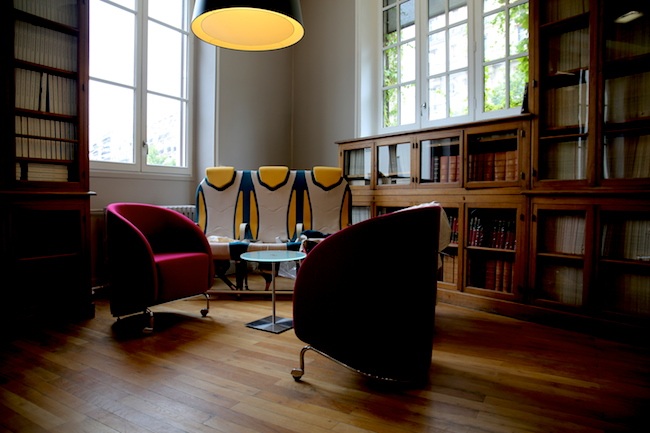
The service is the space between the experiments
Today, Agoranov organizes its offer around health, digital technology, and industry and greentech. An assigned startup manager gives a founder a regular point of contact. Workshops and office hours bring in outside expertise. The published facilities list adds private offices, shared workspace, laboratories and meeting rooms to the package.
That combination addresses different kinds of friction. A laboratory company may need suitable physical infrastructure before it can do useful work. A digital company may have a working product while still struggling to define its buyer. Both can need introductions, commercial judgment and help planning the next financing step. The useful unit of support is the specific obstacle.
Sorbonne’s programme listing puts the standard incubation period at a maximum of 24 months. A fixed window makes the offer legible: founders get a period of concentrated assistance, then must move on. For a team, the sensible use of that time is to set milestones that change the business’s prospects, rather than treating attendance at events as progress.
- 01Submit the
questionnaire - 02Technology +
business review - 03Expert + selection
committees - 04Sign the incubation
agreement
The application process reinforces that seriousness. After the questionnaire, eligible projects undergo economic and technological assessment. Founders present to an expert committee; a selection committee makes the final decision. Successful applicants then sign an incubation agreement. The official page explicitly describes the process as confidential.
A founder can prepare by making the distinction between a technical claim and a business claim explicit. What has been demonstrated? Who needs it? What will the next period of work establish? Those are useful questions to answer before an incubator meeting, even if the eventual application goes somewhere else.
No equity still needs a budget
Agoranov’s financial design is central to its identity. Regional documentation describes support without equity participation. Public money and the association’s own resources pay for the organization that provides that support. Hosted startups have historically paid rent, according to reporting on the Raspail operation. Founders should read the financial terms of their agreement before building a budget around the offer.
A 2023 regional dossier included a €1.36 million forecast funding plan: €570,000 from the research ministry, €250,000 each from the European Social Fund and Paris City Hall, €80,000 from the region and €210,000 in own resources. This is a dated planning document, useful for understanding the model rather than estimating today’s turnover.
Shares calculated from the €1.36m forecast funding plan. Rounded; not audited revenue.
There is a second budget distinction worth making. In November 2024, the region documented a maximum €250,000 investment subsidy against a €660,000 eligible base for Agoranov’s Cité de l’Innovation project. Those figures describe a defined grant project. They do not price the whole university building or the full cost of creating a successful startup.
The incentive is interesting: Agoranov can select companies without needing an ownership position in each one. That does not remove the hard questions. Staff, equipment and space still need financing, and an accepted company still needs customers. Public support changes who pays for early assistance; it cannot supply demand for the eventual product.
The famous names are only part of the room
Agoranov’s users range beyond the software businesses that make its alumni list recognizable. Its 2026 portfolio entries include Thirty2, developing bio-based dyes, Exora, working on refrigeration using industrial waste heat, and Sapienas, developing a bioactive ingredient for skin conditions. The range makes its three-sector structure feel less like a filing system and more like an operating requirement.
The team includes sector advisers and entrepreneurs in residence. Director Jean-Michel Dalle appears alongside people working in health, digital technology, industry, energy and space. An applicant’s useful question is therefore specific: which person understands the next decision this company needs to make?
The community also extends beyond companies currently seeking investment. The young entrepreneurs in residence programme dates to 2004 and offers six-to-twelve-month placements within the incubator team. Startups à l’École, launched in 2015, brings companies into educational projects. At VivaTech 2025, that initiative connected pupils with the entrepreneurial world alongside startups including Biomemory.
These activities give Agoranov more than one point of entry. A founder may arrive with a company, a young graduate through a placement, and a pupil through a school project. The culture described by those programmes is one of repeated contact with entrepreneurship, at different levels of experience.
The next problem is where growing companies go
Agoranov’s work with Sorbonne Université addresses the stage after a startup’s first foothold. The Cité de l’Innovation plan brings incubation and subsequent accommodation into a wider university setting, alongside technology-transfer and research-support organizations. The attraction is continuity: growing teams can remain close to scientific resources as their requirements change.
A 2026 application announcement advertised startup intake from November 2026, with offices, shared services, a dedicated manager and three L1 laboratory lots. It specified a link to Sorbonne or its partners and companies created after January 1, 2021. Those conditions belong to that call, whose June 28 deadline has passed; they should not be mistaken for universal Agoranov eligibility rules.
For founders choosing support, the comparison should be equally concrete. IncubAlliance offers a research-linked route in Paris-Saclay across several deeptech fields. Paris Biotech Santé concentrates on human health in a hospital-university environment. The relevant choice depends on research connections, facilities, stage and sector expertise. An incubator’s celebrated graduates cannot answer those questions for a new applicant.
Agoranov’s model is most persuasive where access to scientific infrastructure and experienced people can shorten the path to a viable business. It is a weaker fit for someone seeking only an immediate investment cheque, unrestricted tenancy or guaranteed sales. The part readers can copy is smaller than the institution: identify the next expensive uncertainty, find the person or facility that can resolve it, and put a deadline on the work.