The most revealing number in Embla’s pitch is not the pounds lost. It is the milligrams avoided. The digital health company says members in its largest study lost an average 16.7 percent of their body weight after 64 weeks while taking about 1.08 milligrams of semaglutide a week - less than half the 2.4-milligram maximum dose used in the landmark Wegovy trials. In a market intoxicated by demand for weight-loss injections, Embla has built a business that asks its customers to buy less of them.
Those customers have changed. Embla began in Copenhagen in 2021 as an online program for individuals. Today, the company presents itself in the United States as a managed weight and cardiometabolic benefit for self-funded employers, third-party administrators and health plans. The employee gets an app, a consistent coach, clinical monitoring and, if eligible, a GLP-1 prescription from an independent licensed provider. The benefits executive gets a different promise: an escape from pharmacy costs that rise every time a patient moves to a higher dose.
It is a tidy commercial inversion. Most virtual clinics market access to a scarce, popular drug. Embla markets the care wrapped around the drug, then measures success partly by how little drug the member ultimately needs. That does not make the medicine incidental. It makes the medicine a lever rather than the whole machine.
01 / The productA clinic hiding inside a habit app
Embla’s three current programs cover a longer arc than a prescription. EmblaThrive offers psychology-led coaching without medication for people managing weight, prediabetes or metabolic risk. EmblaThriveMD adds clinician-supervised GLP-1 treatment, personalized dosing and a tapering plan. Embla Embrace is the maintenance layer, meant to keep habits intact and catch regression after active weight loss. Together they amount to acquisition, treatment and retention - described in the softer language of care.
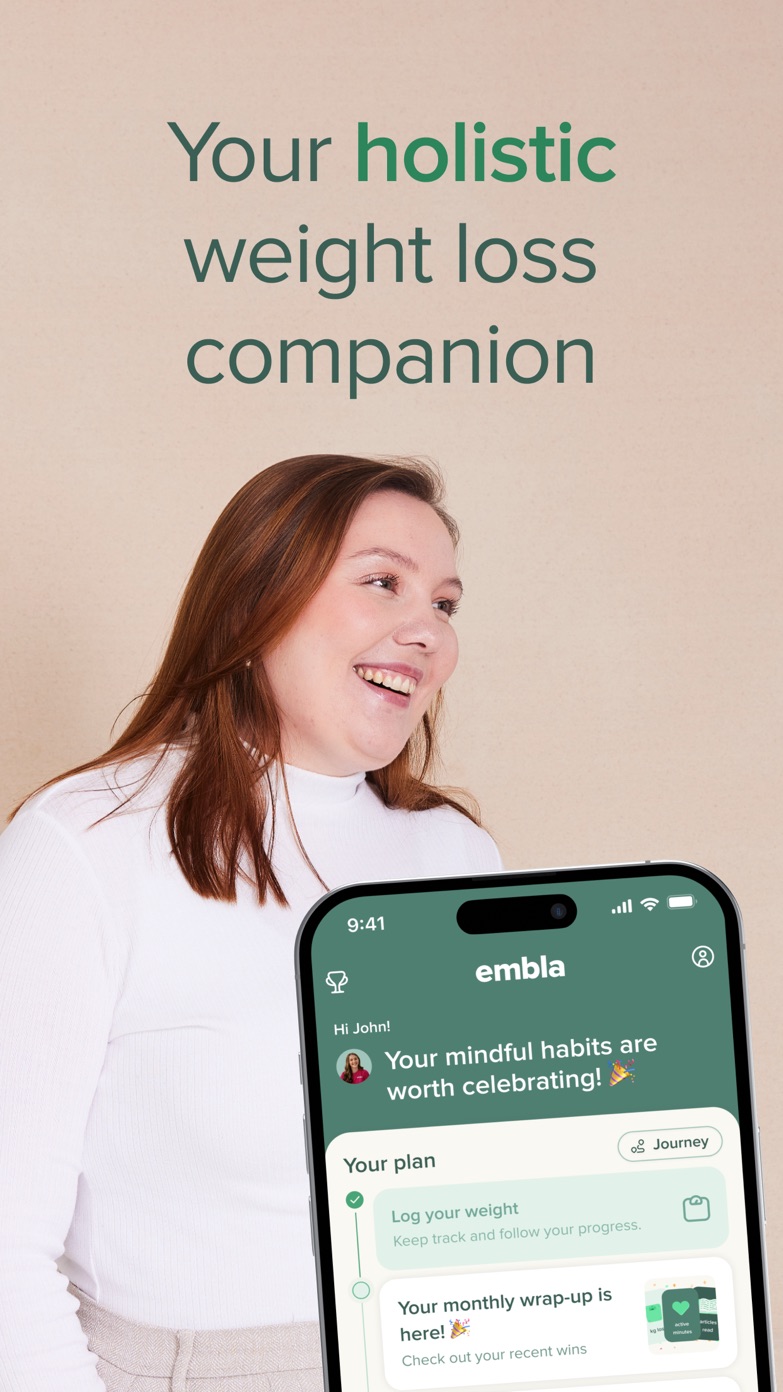
The phone is the waiting room.
Members log weight, sleep, mood, movement and meals; book video sessions; message a coach; follow courses; and review progress. Photographing lunch is easier than searching a calorie database, which is precisely the point.
The app’s job is not merely to count. A meal photograph gives a coach context. Sleep and mood logs can expose why a supposedly simple nutrition plan keeps collapsing on Wednesday night. Scheduled video calls create moments to adjust goals. Apple Health and Android Health Connect reduce manual entry. Embla has also added what it calls therapy-trained AI for round-the-clock guidance and escalation, though human coaching remains the conspicuous center of the service.
“Most weight loss programs treat medication as the solution. We treat it as a tool.”Embla’s description of its model
That emphasis reflects the founders. Laust Wilster Axelsen came from health-tech entrepreneurship. Nicholas Syhler is a cardiologist and a former innovation lead at Novo Nordisk, the maker of Wegovy. Their diagnosis was that obesity care lacked support around medication, not another way to dispense it. They combined clinical oversight with coaching informed by acceptance and commitment therapy, cognitive behavioral methods, nutrition and exercise.
02 / The evidenceThe chart that became a sales deck
Embla’s strongest evidence comes from TRIM, a real-world observational analysis of 2,694 people in its internet-based weight-management program. At 64 weeks, the study reported average weight loss of 16.7 percent. About 98 percent lost at least 5 percent of their body weight, 85.3 percent lost at least 10 percent, and 51 percent lost at least 15 percent. The reported average weekly semaglutide dose was roughly 1.08 milligrams.
Similar destination, different medication load
The tapering result is the commercially provocative part. Embla reports that 78.5 percent of the relevant cohort tapered or stopped GLP-1 treatment without average weight regain after tapering. Every member is supposed to enter treatment with a step-down plan rather than treating the prescription as an automatic lifetime subscription. For an employer, lower dosage can mean lower pharmacy spend. For a patient, it may mean fewer dose-related side effects and less dependence on continued access. Individual outcomes and clinical needs, of course, vary.
TRIM was observational. Members chose and participated in the Embla program; researchers did not randomly assign comparable patients to Embla and standard care. The findings show what happened in this program, not proof that Embla alone caused the difference. Benefits buyers should ask about attrition, selection, follow-up and whether U.S. employer populations reproduce the European data.
That qualification does not erase the result. Real-world evidence can reveal whether a care model survives outside a tightly controlled trial. But it does change the honest sentence from “Embla beats standard care” to “Embla produced an interesting outcome at scale, using a notably conservative dose.” The second claim is less theatrical and more useful.
03 / The moneyFrom monthly memberships to pharmacy math
The company’s first business sold monthly memberships directly to people in Denmark and Britain. Public British pricing once listed coaching at £110 a month and medication plus coaching at £235, with the drug price capable of changing the total. Current Danish pages list coaching at DKK 795 a month and medical weight care at DKK 995, with medication purchased separately. The consumer paid because the consumer wanted treatment.
America required a different wallet. Embla now shows employer modeling at under $399 per engaged member per month, while actual medication costs, copays and deductibles depend on the benefit design. The economic argument is simple: pay for coaching and clinical operations now, use less expensive medication over time, and avoid the later claims associated with obesity and cardiometabolic disease. Avant Health, a third-party administrator, has brought Embla into its employer offering. NCOA has made Thrive and ThriveMD available to eligible employees through its health plan.
The plan sponsor
A self-funded employer, TPA or health plan buys a managed benefit and reporting.
The member
An eligible employee receives coaching, digital tools and clinical care where available.
The cost curve
Embla tries to improve weight outcomes while reducing long-term drug utilization.
Outside capital paid for the transition. Embla raised €400,000 in 2021, €3.5 million in 2022 and €10 million in an August 2023 Series A from Inovo VC, SEED Capital Denmark, VentureFriends, Founders and Crowberry Capital. The last round funded expansion into the United Kingdom and United States, along with product development. Four years after founding, Embla says it has supported more than 30,000 people.
04 / What failed firstThe prescription stopped being a product
There is no public founder confession about a disastrous first version. The visible change is more instructive than a manufactured failure story. A consumer weight-loss subscription can grow, but it leaves the company selling one member at a time while the largest financial pain sits with whoever pays the pharmacy bill. In the United States, that buyer is often the employer or health plan. Embla kept its protocol and changed the customer.
The market also changed around it. Once GLP-1 access became widespread, access alone became a thin advantage. The expensive part was no longer finding a prescriber. It was paying for escalating doses, keeping members engaged and deciding what should happen after the weight came off. Embla’s response was to make tapering, coaching and measurable utilization the product. The molecule attracted attention; the workflow became the moat.
The clever thing to copy is not “add coaching.” It is to make the costly input less necessary, then charge for the system that does it.
05 / The stealA playbook with sharp conditions
What another founder can borrow
- Start with a costly, powerful commodity customers already demand.
- Wrap it in the human workflow that determines whether it works.
- Measure input utilization beside the final outcome.
- Give the economic buyer a dashboard and a graduation path.
- Publish the data, including the design limitations.
The conditions matter. Embla’s approach depends on members answering messages, logging enough information to guide care and building a durable relationship with a coach. It requires licensed clinicians, reliable medication supply, careful eligibility decisions and a benefits buyer willing to fund service before savings are certain. Some patients may need long-term medication. Some will not tolerate it. Some will prefer in-person care, and others will simply stop opening the app.
It also may not work as advertised if lower dosing reflects a population that would have done well anyway, if attrition hides poor outcomes, or if the European study does not transfer to a more diverse American workforce. A rushed employer rollout could turn a high-touch program into another underused wellness portal. And cost savings disappear if coaching expense, medication rebates, eligibility expansion or re-prescribing outweigh dose reduction.
Yet Embla occupies a sensible place in the market. Noom Med and WeightWatchers Clinic bring large consumer brands. Omada, Vida and Form Health sell clinical and behavioral care to employers. Ro and other telehealth clinics make drug access convenient. Embla’s distinguishing claim is narrower: personalized lower dosing, intensive coaching and a deliberate route off medication can deliver competitive outcomes at a more manageable cost. Narrow claims are often better businesses, provided the evidence keeps up.
The company’s next milestone is not another splashy funding round. It is repetition. Can U.S. employer groups achieve the same adherence, dosing and tapering patterns? Can the service retain its human texture as enrollment grows? Can an observational result become a credible comparative record? If Embla can answer yes, its odd-sounding proposition will look less like restraint and more like product discipline: sell the care people need, and less of the expensive thing they do not.