The arresting detail in Well’s sales pitch is a bill that might disappear. In March 2026, the health engagement company announced a model that puts 100% of its fees at risk against agreed health and financial outcomes. For an employer accustomed to buying a wellness platform and hoping employees remember the password, this changes the conversation. Attention has to lead somewhere.
- The buyer: employers trying to make health benefits work harder.
- The member experience: personalized suggestions, rewards and a human Well Guide.
- The wager: repeated, well-timed actions can improve health enough to justify the fee.
Well occupies an awkward stretch of healthcare: the distance between knowing what to do and doing it. A screening can be covered, recommended and entirely forgotten. A useful benefit can sit untouched because nobody knows it exists. The company’s proposition is to shorten that distance, one small action at a time. Its commercial offer gives that proposition a financial consequence.
A casino executive notices the health plan
Gary Loveman, Well’s co-founder, chairman and CEO, previously ran Caesars Entertainment. His move into health makes for an irresistible origin story, provided one resists the temptation to turn every notification into a slot machine. What carries over is an interest in individual behavior: which person responds to which offer, and what makes someone return?
On Well’s company page, Loveman describes his experience at Caesars as the moment employee health plans began to look inadequate. They were poorly suited to helping people understand their health potential and improve their circumstances. That observation supplied a problem worth pursuing. Analytics, clinical knowledge and incentives would become ingredients in the answer.
Loveman and David Werry launched Well in 2019. The formation announcement described an AI-driven health engine that used clinical and consumer data to adjust its engagement with each member. Well already had a corporate customer and $25 million in seed funding. General Catalyst, John Doerr, partners from Hellman & Friedman and Mosaic Health Solutions were among the investors. The founders and leadership team invested too.
The ambition was broad, but the unit of work was deliberately small: help a person choose the next useful step. A company-wide health campaign has to speak to everyone. A daily health partner can learn that one member needs help finding a physician while another wants to sleep better. Those are different conversations, even when both employees carry the same insurance card.

The app is the entrance. A person helps with the stairs.
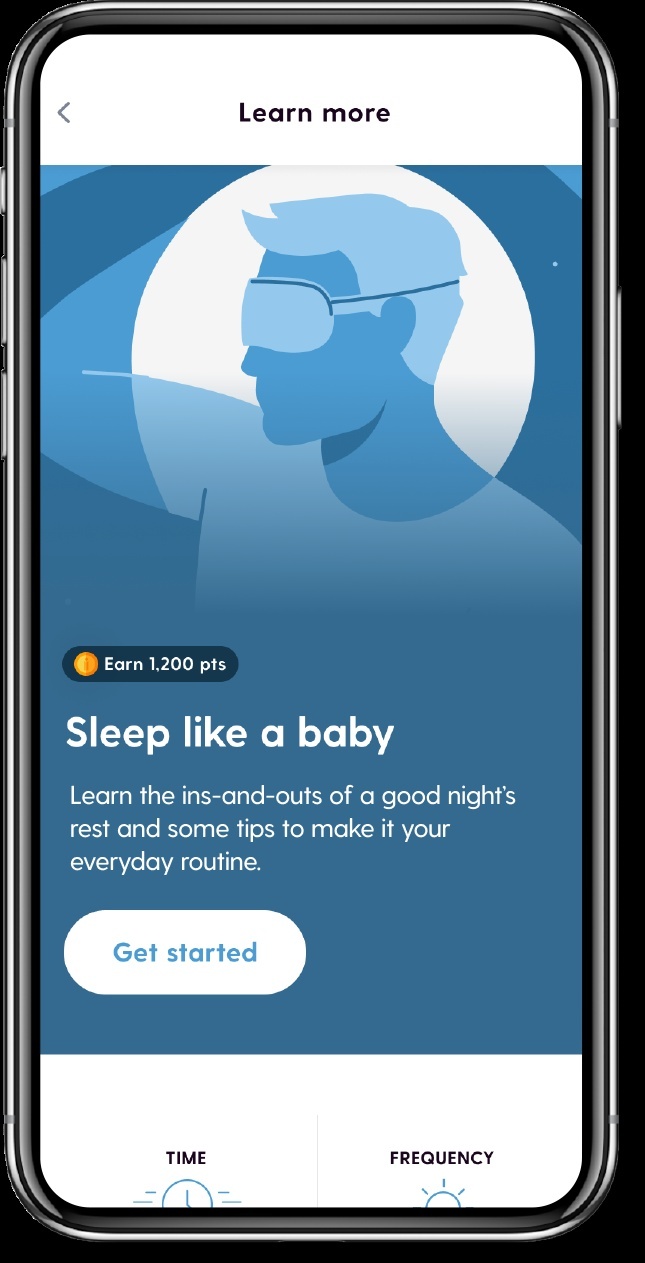
Members encounter Well through a mobile or web experience. It offers health suggestions, questionnaires, habit-building journeys and ways to track activity, stress or sleep. Completing eligible activities earns points that can become rewards. The platform’s AI Health Engine is intended to adjust recommendations as it learns more about the person.
 ONE PERSON.
ONE NEXT STEP.
REPEAT.
Then there is AskWell, the route to Well Guides. These are humans who can help members find providers, understand benefits, schedule care and work on health goals. At Amentum, the public program page presents this assistance alongside everyday recommendations and rewards. It is a useful pairing. A suggestion to obtain care becomes more practical when somebody can help with the logistics.
The rewards are specific to the employer’s program. Amentum’s page advertises up to $250 in gift cards, including a $25 sign-up bonus, for eligible participants, with exclusions for particular plans. USAA’s public program describes challenges and assessments linked to plan-dependent premium discounts. At UNC Health, the program combines points with a primary-care visit to qualify for a premium reduction. The employer decides the terms; the app gives members a place to act on them.
This distinction matters for the business model. Well sells a benefit to organizations, then delivers an experience to their members. Employees are the users; employers and sponsors are the buyers. A pleasant app must therefore satisfy two constituencies. One wants useful help and a reason to return. The other wants health improvement and a defensible financial result.
The bank that had benefits but needed attention
Well’s February 2026 Regions Bank case study supplies a concrete example. Regions, described as having about 20,000 associates, had partnered with Well since 2024. The problem was stalled engagement. Existing benefits struggled to move beyond a roughly 40% plateau, while employees missed relevant services and information failed to become timely action.
The intervention combined individualized analytics, targeted questions and human support. Rather than promoting every benefit broadly, the program matched people to services relevant to their needs. Questions helped expose obstacles such as access, health literacy and social context. The company reports 70% activation, 30% daily active users and a Net Promoter Score of 85.
Those are vendor-reported engagement results. Activation, daily use and a prior engagement plateau measure different things; they do not form a tidy before-and-after experiment. Still, the account identifies a problem a benefits team can recognize. Good program design was running into poor uptake. Regions changed the outreach and support around its benefits, rather than relying on their mere availability.
How many reminders is enough?
Well’s answer is unusually interested in repetition. In a March 2026 essay, Loveman describes patterns across millions of engagements: stress or anxiety management might involve eight or nine interactions, breast cancer screening more than twenty, diabetes medication adherence nearly forty. These are company-described patterns, rather than clinical prescriptions for how often everyone should be contacted.
- 01Learn the contextGoals, responses and barriers
- 02Offer a small actionRelevant guidance and incentive
- 03Help, then adaptHuman support and new information
The more revealing detail concerns almost 79,000 breast cancer screening observations. Well says conversion peaked among members receiving two interventions, then declined for groups needing more contact. Loveman acknowledges that the standard mix loses effectiveness unless it changes. A person still unmoved after several messages may need different help, rather than a louder version of the same request.
This is a practical lesson readers can borrow: record the barrier as carefully as the response. Confusion about coverage, fear of a diagnosis and an inconvenient appointment are distinct problems. Repetition earns its place when the next interaction addresses something the previous one could not. Without that adjustment, persistence can become a very efficient way to be ignored.
The invoice needs a measuring stick
Well’s 2026 pricing document describes client-customized guarantees covering clinical improvement and financial impact. Performance is measured against predefined baselines using clinical and claims data. The company also advertises a minimum 1:1 return on fees through medical and pharmacy claims savings, with reimbursement of the difference. The public materials describe the risk arrangement, rather than a universal contract price.
“If we don’t deliver measurable outcomes, we don’t keep our fees.”
David Werry · Co-founder and President · March 2026
In June 2026, Well announced Contractual Integrity Validation from the Validation Institute. Its announcement emphasizes a population-wide event-rate promise, rather than simply comparing enthusiastic participants with people who never enrolled. That distinction is consequential: volunteers may differ from nonparticipants before the app ever appears. A savings calculation needs to address that selection problem.
The designation concerns the contractual measurement approach. It should not be read as a promise that every employer will achieve the same percentage savings. Well’s announcement also states that the institute’s two $100,000 guarantees assume a 25% participation threshold. For a buyer, the sensible questions concern the agreed population, baseline, outcomes and conditions. An attractive guarantee becomes useful through those details.
A route into the benefits you already bought
Well fits between employees and an existing benefits ecosystem. Traditional wellness portals, insurer navigation services and specialist condition programs are alternatives or adjacent offerings. Well’s chosen distinction is sustained engagement across needs: help members discover and use the relevant resource, with personalized prompts and human assistance over time. Its June 2026 commentary frames contextual AI as a way through fragmented programs.
Building that service has required substantial capital. Well reported a $40 million Series A in 2020 and a $70 million Series B, publicly shared by late 2021 and described again on its website in 2022. An April 2025 announcement added $30 million and put total funding above $150 million. The stated uses included expanding the AI platform and operational capabilities.
The work also requires people. Well’s careers page separates clinical content, member services, data science and product engineering into dedicated teams. It describes hybrid work for most roles and an emphasis on learning from mistakes. The organizational detail supports a less glamorous reading of the product: someone must maintain the content, answer the question and keep the software working.
Trust is another operating condition. Well’s privacy policy says employers generally receive anonymized, aggregated information, while allowing limited identifiable reporting for purposes such as incentives and tax compliance. Members deciding what to share need that distinction. Personalization works through information; an employee’s willingness to provide it cannot be assumed.
Well’s useful idea is that a health benefit needs an ongoing relationship around it. That relationship still depends on eligible access, available care, relevant support and credible measurement. The company has chosen to make those ordinary details financially interesting. The app earns attention in small increments. The invoice asks whether those increments added up to something worth buying.