The lab test has already been ordered. Now comes a decision that hardly feels like a decision: where to have it done. For a patient, the obvious answer may be the familiar building, the nearby office, the place used last year. CareHive Health has built its current proposition around that unremarkable moment. A different, clinically appropriate location might cost less. But somebody must notice the difference, explain it, and help move the order.
- Find lower-cost care settings using claims and plan information.
- Offer a personal recommendation before the member needs to search.
- Help coordinate the change, with human support when needed.
It is a wonderfully ordinary ambition for a company using artificial intelligence. The machinery may be predictive; the practical task includes paperwork. CareHive works with health plans, employers, and value-based care organizations. Its product reaches their members, who can choose whether to act. The distinction matters: the person using the service and the organization buying it have different reasons to care about the same bill.
01 / The doctor who reduced the visits
Long before the present navigation service, Ronald Dixon was experimenting with care outside the examination room. In his account of CareHive’s origins, he describes emailing patients about chronic conditions rather than bringing them in for every follow-up. An administrator told him to stop because it was “costing us fee-for-service revenue.” A useful improvement had collided with the way the practice earned money.
Dixon went on to develop Healthcare 360. In 2020, he partnered with Jeremy Gabrysch, founder of Austin care-delivery company Remedy. The combination brought clinical software together with an operation accustomed to triage, virtual visits, and house calls. CareHive360 emerged from that lineage. The history helps explain why the company keeps returning to a particular question: what work can be removed from the path to appropriate care?

Dixon’s background includes Massachusetts General Hospital and diabetes company Onduo. He also plays piano and trumpet. There is no evidence that musical ability lowers medical spending, but it does make the founder rather more interesting than his job title.
02 / A recommendation with someone attached
The current implementation process starts with health claims and configured services entering CareHive’s platform. Members receive personalized outreach, review recommendations, and decide what to do. Clients can track savings through its ROI reporting. The important sequence is analysis, contact, choice, support. A directory leaves much of that sequence to the patient.
In April 2026, CareHive announced its collaboration with Blue Cross and Blue Shield of Texas for Individual and Family Markets members. Alerts arrive by email or text. The online experience compares nearby in-network options against the member’s benefits. Participation is voluntary, and the focus includes services ordered by the existing doctor, such as lab tests and screenings.
- 01AnalyzeClaims + benefits
- 02RecommendPersonal options
- 03ChooseMember decides
- 04CoordinateProvider + navigator
The insurer’s own March provider notice gives the idea a useful physical detail: CareHive may contact providers by fax or phone about upcoming or recurring laboratory services. Patients get recommendations too. The modern digital experience still has to converse with the fax machine.
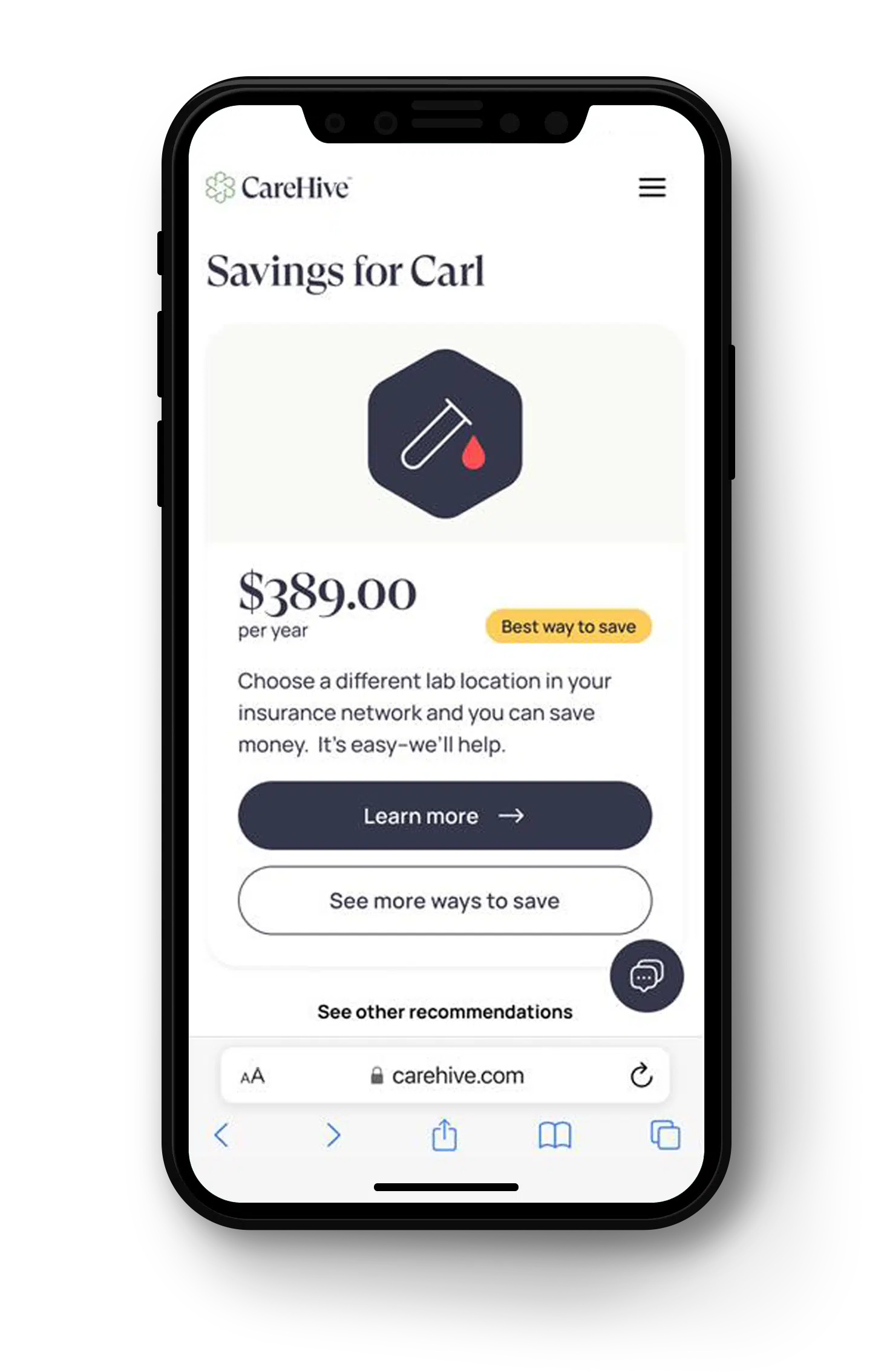
Its July 2026 decision-guidance launch describes support that includes requesting clinical-order transfers and access to human navigators. The service is free to eligible participating members, regardless of savings. That describes the guidance fee; the underlying medical service remains subject to the member’s coverage.
“It has a confidence problem.”Ronald Dixon, on healthcare decision-making, July 2026
That formulation is CareHive’s thesis, rather than a settled diagnosis of the entire healthcare system. It suggests that another column of prices may be less useful than reassurance about one particular change.
03 / The first step changed the result
An earlier retail-employer case study provides a concrete experiment. Employees initially chose between virtual and in-person starting points. CareHive reported that virtual starters often resolved their concerns without escalation. It then introduced Simple Care: each encounter began virtually, with necessary in-person escalation included at no extra cost to employer or employee.
Share of encounters beginning virtually. Historical company-reported results, not outcomes from the 2026 Texas launch.
Virtual-first encounters rose from 40% to over 95%, according to the company. The change was about the default path and the cost of escalation. Giving people a benefit and changing the way they enter that benefit are different interventions. This historical model delivered care; today’s prominent offering guides care-setting choices.
04 / Who pays, and what the numbers mean
The $10 million Series A announced in June 2019 belonged to Remedy. Santé Ventures led it, supporting technology development, recruitment, expansion, and employer services. It is part of CareHive’s predecessor history, and should be read that way.
Today, the commercial pitch is aimed at organizations responsible for healthcare spending. The July announcement cites a 5:1 return from previous national deployments. Those are company-reported historical results. They do not establish the return of the newly launched Texas service. A buyer should ask which population, time period, fees, and care categories sit behind the calculation.
Trust also has an operational dimension. CareHive announced HITRUST i1 certification for referral navigation and reported receiving the DiMe Seal in July 2025. These are relevant credentials for a service handling sensitive information. They answer different questions from whether a particular member saves money.
05 / The useful idea to borrow
The copyable move is to design around the next action: explain a specific option, preserve choice, and help finish the administrative work. CareHive’s member journey explicitly includes keeping the doctor informed when a location changes. That final coordination belongs inside the product.
The approach depends on suitable alternatives, usable benefit information, and time to make a choice. It has less room to help when care cannot safely move, no practical in-network alternative exists, or urgency leaves no shopping window. Within those limits, CareHive offers an appealing possibility: the patient gets the ordered care, and someone else takes a turn wrestling with the arrangements.