Nicholas Syhler has a founder story with the rare courtesy of an itemized bill. Three years into building Embla, he says, the company had spent roughly €1 million pursuing its original idea and had come close to bankruptcy. This is not the sort of detail one normally finds in the polished chronology of a company page. It is too specific to float and too expensive to romanticize. It makes the story useful.
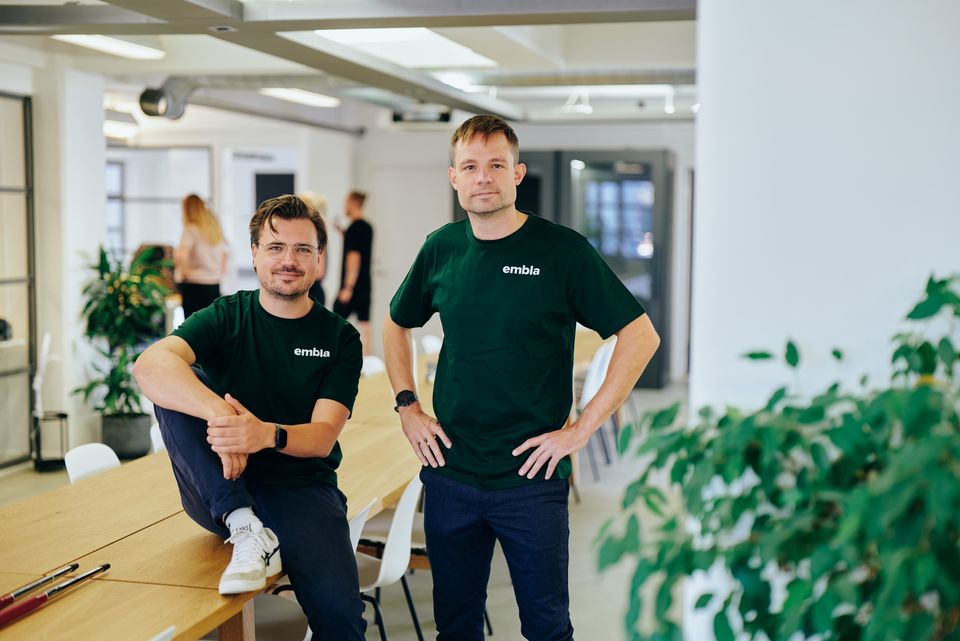
Syhler and his friend Laust Axelsen started Embla in Copenhagen in 2021. One came from medicine and the other from software. Syhler had worked in cardiology, moved to Novo Nordisk, and completed an Executive MBA at Copenhagen Business School with a concentration in digitalisation and finance. Axelsen had built software used by large numbers of people. Between them sat the attractive founder equation: domain knowledge plus technical execution, conviction plus code.
Their first plan was direct to consumer. They assembled a substantial team, developed their own technology, and built a service with more human involvement than the cheapest competitors. Syhler still speaks proudly about the work. He also speaks plainly about the economics. According to his later account, operating costs were thirty times those of the bargain end of the market. Quality may win the argument at dinner. In a checkout flow, the monthly price gets a vote.
A good product meets an indifferent market
Founders are often taught to fear being wrong. Syhler encountered a more awkward possibility: being right about how a service should be built while being wrong about where, how, and to whom it should be sold. The distinction matters. If the product is nonsense, one closes the notebook. If the product works but the route does not, the notebook needs a fresh page and the accountant needs a chair.
By Syhler's telling, Embla was being undercut in Denmark by stripped-down alternatives with radically lower costs. The team could imitate them, continue paying for its convictions, or search for a buyer who valued what made the service expensive. The first choice would dissolve the premise. The second would dissolve the company. The third required an admission that founders tend to postpone: the launch market was not sacred.
“Doing things properly is rarely the fastest path. But it's often the only path that leads somewhere worth going.”Nicholas Syhler
It is a handsome sentence, but its value comes from the scar behind it. “Properly” cannot mean repeating an uneconomic design until the cash is gone. It has to include the harder craft of finding an arrangement in which standards and survival can occupy the same office. For Embla, that meant looking west.
Keep the principle. Replace the buyer.
America did not reward them immediately. Syhler says Embla explored pharmacy partnerships and found the incentives unhelpful. The company then reached employer groups and health systems. Those organizations had different budgets, different procurement habits, and a different reason to listen. The move changed the commercial conversation from a consumer's monthly purchase to an institution's operating decision.
This was a real pivot, though not the cartoon version in which a team spins from pet food to satellites over a weekend. Embla changed geography, customer, distribution, and economic framing. It kept its appetite for a carefully built service. The founders were not rescuing every old assumption. They were deciding which assumption deserved rescue.
Syhler now lives in the Austin metropolitan area, a biographical fact that gives the corporate map a human endpoint. Embla remains Danish in origin, has a United Kingdom entity, and works the American market. Its co-CEO has crossed from hospital work to a pharmaceutical company, from Copenhagen Business School to startup leadership, and from Copenhagen to Texas. There is an appealing neatness in the sequence, though it surely felt less neat while the bank balance was expressing itself.
In 2023, Embla raised a €10 million Series A co-led by Seed Capital Denmark and Inovo VC, with Crowberry Capital, VentureFriends, and Founders also named among the investors. The funding supported international growth. Capital did not remove the obligation to find fit. It gave the company more room in which to prove that it had.
The paired title also matters. Public company records and Embla's own materials consistently list Syhler and Axelsen as co-founders and co-CEOs. There is no solitary genius pasted over the origin story. Syhler supplies his own account of calling Axelsen when he realized they were circling the same problem, and his founder advice returns to collective judgment. Even his most candid account of the pivot uses “we.” In an industry fond of converting teamwork into a single face, the grammar is worth noticing.
Syhler's corporate trail predates Embla. Danish records connect him to directorships at SuiWare, ATAH, and his own Syhler Consulting. In 2026 he became chairman of HEMI International. These are not cinematic plot points, but they complicate the idea of an overnight founder. Before the funding announcement and transatlantic plan came years of smaller formal responsibilities: filings, boards, and companies whose names rarely escape a registry. Startups arrive suddenly in headlines and gradually in people.
Beware the comfortable current
A pivot is usually narrated as a founder's revelation. Syhler's public advice points elsewhere: “This is not a one-man show. Mobilise the team to solve difficult problems and take the hard decisions.” The phrasing is bracing because it assigns the team more than execution. People are there to solve and decide, not merely to admire the founder's certainty.
In a CNBC conversation about company culture, Syhler reached for fish. Culture is the flow that guides how people behave. Some fish simply move with it. The smarter fish, in his telling, notice the waterfall ahead and propose a better direction. The image is playful enough to remember and serious enough to use. A culture that produces smooth alignment but punishes warnings is a very efficient way to reach the wrong destination.
Embla's recruiting language supplies the companion phrases: ambitious about outcomes, relaxed about everything else; direct feedback, low ego, high trust; a sense of humor about hard days. Corporate values are inexpensive to print and costly to test. A near-bankruptcy and a transatlantic rewrite constitute a fair test. Direct feedback becomes useful precisely when it is directed at the plan everyone has already worked hard to build.
Know the principle you will protect before pressure arrives.
Buyer, channel, geography, price, and promise can change separately.
A belief without a cost limit can become an unusually elegant ruin.
The colleague who sees the waterfall is doing cultural work.
The founder as translator
Syhler's own career makes him an interpreter between professional tribes. Medical training prizes evidence and responsibility. An MBA supplies the language of capital allocation and incentives. A technology company forces both into contact with designers, engineers, data teams, and customers. Embla describes specialists sitting beside builders, each shaping what the other makes. The arrangement sounds obvious only because the alternative is so common: expertise handed across departmental walls like a note under a locked door.
Translation also explains why Syhler's public writing has become more direct. His posts discuss the wrong market, the cost gap, the slow American start, and the eventual signs of fit. The numbers carry more force than motivational fog. “Three years, near-bankruptcy, and an ocean crossing,” he wrote. It is a compact description of how long a correct idea can spend wearing the wrong business model.
There are personal notes around the edges. He has said that he runs every day. He likes wine and once described it as a way to taste nature, while adding that he limits it when the going gets tough. The combination fits the larger portrait: routine without monkish theatre, pleasure with a boundary, seriousness softened by a joke. His company's culture statement makes explicit room for humor on hard days. A founder who has nearly spent his way into oblivion is entitled to one.
The valuable pivot preserves a reason for existing while surrendering a favorite route.
Today Syhler's stated ambition is scale. He has discussed new markets, institutional reimbursement, and AI-augmented services. Those plans will create fresh currents, as plans do. The interesting question is whether the habits formed during the expensive lesson will persist: measure the gap, let the team challenge the direction, distinguish the principle from the path, and change course before the waterfall becomes a quarterly report.
His story is still in motion, which is precisely why it deserves attention now. It offers no tidy exit and no retrospective claim that every wrong turn was secretly ordained. Instead there is a founder in Austin, a company with roots in Copenhagen, and a ledger that says good intentions require an economic home. Syhler kept what he believed made the work worth doing. He became less sentimental about where it had to live.