Cheri Ackerman’s early research career required a winter coat in summer. At Calvin College in Michigan, she spent hours trying to isolate a protein in a room kept at four degrees Celsius. Outside, the temperature could reach 85 degrees Fahrenheit. Inside, she wore a coat and wool hat. She learned to arrange the chilly work so that it ended just before lunch. A research schedule had acquired the pleasures of a small tropical holiday.
The scene is worth keeping in mind when reading the later credentials: Berkeley chemistry PhD, Concerto Biosciences cofounder and CEO, Hertz Foundation board member. Before those titles came an undergraduate waiting for experiments to finish, negotiating with the temperature, and discovering that curiosity could be a paid occupation. There was already a lesson in the work. A good question did not hurry a protein.
“The basic challenge of biochemistry research for me is patience.”
Cheri Ackerman, 2010
A winter coat in summer
Ackerman grew up in Holland, Michigan. At school, understanding the mechanics of everyday appliances first drew her toward science; molecular biology then gave that interest a new direction. At Calvin, she studied biochemistry and Spanish, joining two subjects that seldom share a laboratory bench. She also spent a semester in Spain. Her undergraduate years included research at the Van Andel Research Institute and work with Calvin chemistry professor Eric Arnoys.
The opportunities accumulated: a Beckman scholarship, then a Goldwater Scholarship in 2010. Arnoys described a student who asked questions reaching into the heart of a problem. In the cold room, those questions met a practical education in waiting. Scientific ambition had to coexist with a procedure that moved one step at a time. She graduated in 2011 and headed west to Berkeley.
Permission to ask a different question
During her first year of doctoral study, Ackerman applied for a Hertz Fellowship. She went through two rounds of interviews and became one of the 2012 fellows. The award offered five years of support. For an early-career researcher, that meant greater freedom to choose questions and pursue ideas whose outcomes were uncertain. It gave curiosity a longer runway.
At the time, she imagined postdoctoral work followed by teaching at a research university. She also spoke openly about faith, family, and the danger of measuring a person’s value entirely through papers and prizes. The fellowship mattered to her, but she resisted making an award the whole explanation of a life. There were commitments outside the laboratory that deserved a place in the plan.
Her Berkeley work, with Christopher Chang, focused on detecting, measuring, and manipulating copper in biological systems. She completed her chemistry PhD in 2017. Postdoctoral research took her to Paul Blainey’s laboratory at the Broad Institute of MIT and Harvard, where she worked on methods for handling very small volumes of liquids and making large numbers of experimental combinations possible.
A recurring interest connects those stages: build a method that lets researchers ask questions they could not conveniently ask before. The instrument changes the available questions. A scientist who enjoys that kind of work has good reason to pay attention when a colleague makes a new instrument.
The people in the first-day photograph
That colleague was Jared Kehe, who invented kChip as a graduate student in Blainey’s lab. Ackerman worked with him in the subgroup they called Team Droplets. The technology appealed to her because it could explore combinations that would otherwise demand an enormous amount of manual pipetting. Their collaboration also produced something harder to put in a patent: respect for each other’s rigor, imagination, and candor.
They began exploring commercialization in the winter of 2018-2019. Through Harvard’s Nucleate program, they met Adil Bahalim, who brought a focus on product-market fit. Bernardo Cervantes, a microbiologist from a neighboring lab, completed the founding group. By May 2019, four people were considering a company together. Academic commitments still had to be finished; the idea would spend another year developing alongside them.
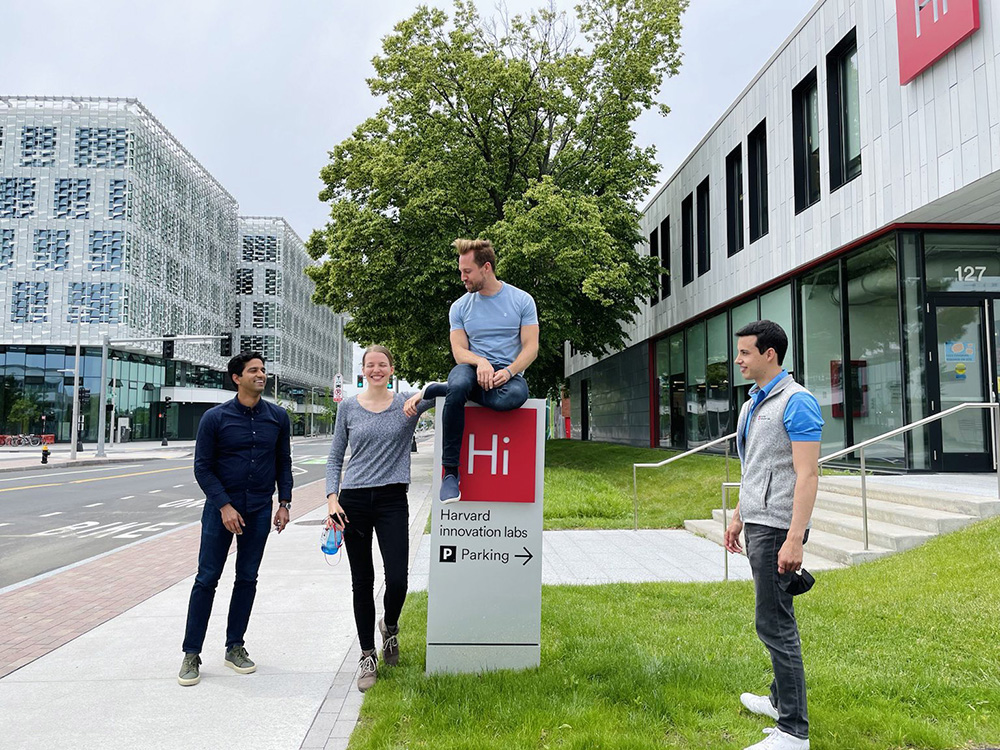
The first-day photograph at Harvard Life Lab has the informality of people who already know one another. It also offers an antidote to the solitary founder portrait. Ackerman’s decision involved a particular group of colleagues and the possibility of finding out what they could build together. The people belong inside the explanation.
A salary before a leap
In March 2020, Ackerman and Kehe were accepted into Activate’s fellowship program. Their support included two years of stipends, $100,000 for technology development, and company-building guidance. Ackerman recalled this as the moment the company became a real prospect. The fellowships were due to begin in June. The team moved toward full-time work at Concerto that spring and summer, and closed a pre-seed round in October.
The living expenses mattered as much as the ceremonial encouragement. Ackerman has argued that entrepreneurship becomes accessible to more people when early programs reduce the personal financial risk of trying an idea. Someone who needs to pay rent, or support relatives, cannot necessarily exchange an academic salary for an indefinite promise. A stipend changes what can be attempted. That is a concrete account of opportunity, with the arithmetic left in.
The CEO goes back to school
Becoming a CEO put Ackerman in an unfamiliar kind of classroom. In late 2020, she described feeling like a first-year graduate student again, learning rapidly while already responsible for decisions. She had led research teams, mentored students, taught physical organic chemistry, and taken on volunteer leadership. She had also audited a negotiation class at MIT Sloan. The preparation helped; the new job still demanded practice.
Her early routine protected mornings until roughly 11 a.m. for concentrated work, with meetings running afterward into the early evening. Before a meeting, she identified what she hoped to accomplish. Afterward, she assessed the result. During early investor pitches, she and a colleague spent substantial time reviewing their performance. The meeting ended; the learning continued.
She also sought advice from founders a few years ahead, close enough to remember the problems she was facing. In the absence of a professor assigning the next improvement, she built ways to receive feedback. The discipline was recognizably scientific, even when the subject was her own performance.
Four verbs, with consequences
Concerto’s current values are brief enough to remember: grow by experimenting, work rigorously, listen intently, and act with compassion. The verbs suit a company built by researchers, but their usefulness depends on what happens after someone recites them. Ackerman’s accounts of hiring and employee conversations supply examples.
She adopted regular one-to-one conversations after hearing another Activate CEO describe the practice. They helped her build relationships and identify concerns early. A hiring bootcamp prompted her to think about the candidate’s experience as a coherent sequence. One resulting commitment was simple: every candidate who interacted with Concerto would receive an answer, even when the answer was no. A rejection can be disappointing without also becoming a prolonged guessing game.
She has described monthly conversations about company culture and a mix of immediate and periodic feedback. The aim was to give people information about how their actions affected colleagues. These are modest practices to put beside a financing announcement. They also describe the environment in which the financed work has to happen, day after day.
An experiment needs a decision
In a 2026 conversation about leadership, Ackerman traced the four values to a founding-team retreat in New Hampshire in November 2020. The group made a large list, then progressively narrowed it. They were naming habits they already valued. They also considered what each commitment would cost. Experimentation, for example, asks people to accept some change and uncertainty.
That approach extends into operations. Ackerman described trying changes to meetings or goal setting, observing their effects, and deciding whether to keep them. The team adopted objectives and key results after long task lists left people stretched across too many activities. The question became which outcomes deserved priority and how different teams’ work connected.
She also described adapting the planning process as the company grew. A system that suited a small group could require revision later. There is a quiet demand in that attitude: anyone asking colleagues to learn has to remain willing to change the organization’s own habits. Even a useful procedure needs to earn its next quarter.
The fellowship becomes a board seat
In March 2024, Ackerman joined the Hertz Foundation’s board. She wanted to give back to a community that had supported her, gain further board experience, and contribute an earlier-career perspective. She also hoped her presence would help other women imagine themselves in board roles. Concerto already had its own board following its Series A financing, giving the new responsibility a practical connection to her day job.
The Hertz network had previously helped with a specific hiring problem. When Ackerman needed to learn how to assess a data scientist, she contacted people she knew through foundation workshops. An interdisciplinary community supplied expertise her own training did not cover. The relationship had been formed before the question arose.
She has advised newer fellows to account for other people and circumstances when explaining success. Effort belongs in the explanation, alongside support and events beyond personal control. It is consistent with the four-person photograph: the frame gets wider as the story becomes more accurate.
There is still another room to enter
The later milestones are substantial without needing embellishment. Concerto raised a $23 million Series A led by Safar Partners in November 2022. In May 2023, Ackerman was named an EY Entrepreneur Of The Year New England finalist. By November 2025, Activate reported that the company had loaded more than 100 million microbial droplets onto kChip. Those droplets are an experimental-scale measure, each part of the continuing work of testing combinations.
Away from that work, her Hertz biography describes someone who likes hiking, pickup volleyball, and travel. The person in the cold room eventually acquired plenty of reasons to get outdoors. In October 2026, another conversation is on the calendar: a Hertz Dialogue Dinner in Boston, where she is scheduled to join founder David Zhang and moderator Amir Nashat to discuss the path from research to company building.
She will arrive with more experience than she had in 2020. The subject still suits her: how a person learns to carry a new responsibility, and how the people around her make the attempt possible. Somewhere between the winter coat and the board seat, the job changed. The willingness to ask another question kept its place.