Gabriel Levesque Tremblay’s doctoral thesis begins with a seed. More precisely, it begins with the chemistry of the seed’s cell walls: how those walls change, how an embryo grows, how germination gets under way. This is an unusual opening chapter for the biography of a New York startup chief executive. It is also a useful one. Long before there was a company to pitch, there was a small biological problem to examine closely.
A doctorate with roots
His 2014 thesis at the University of British Columbia was titled Pectin Methyl Esterification Functions in Seed Development and Germination. The degree was in botany. He had already earned a bachelor’s degree in 2005 and a master’s in 2009 at the Université du Québec à Montréal. The sequence puts nearly a decade between the first degree and the doctorate. Company biographies can dispatch those years in a line; the work itself took rather longer.
The research concerned enzymes that change pectin in plant cell walls, and the consequences for growing seeds. Depending on how the chemistry proceeds, a wall can become firmer or more yielding. A developing plant needs both structure and room to expand. Gabriel examined the relationship experimentally, working with the plant Arabidopsis. In the language of a business profile, this sounds remote from entrepreneurship. In the language of the experiment, it is a question about the conditions that make growth possible.
He was first author on a 2015 Plant Physiology paper about an enzyme involved in embryo development, alongside Kerstin Müller, Shawn D. Mansfield and George W. Haughn. The paper gives this early chapter names as well as institutions. A scientific career already involves a team, even when a thesis has one name on its cover.
The long way to a founding team
- 01MontrealBSc 2005 · MSc 2009
- 02VancouverPhD, Botany · 2014
- 03BerkeleySynthetic biology postdoc
- 04New YorkAIChE · HexemBio
The other side of the interview
Gabriel grew up in Chicoutimi and moved to Montreal at seventeen. The later journey took him west to Vancouver, then south to California. At UC Berkeley’s Energy Biosciences Institute, he worked as a postdoctoral fellow on synthetic biology projects. The geographical itinerary is straightforward. The professional itinerary is less tidy: plant research, synthetic biology, scientific organizations, then startups. Each step changed the scale at which he worked.
At the American Institute of Chemical Engineers, he became director of technical entities and grants. His responsibilities included supporting twelve executive boards and societies, with interests spanning biological engineering, sustainability, energy and hydrogen safety. He worked with a portfolio of funding from government agencies and foundations. A laboratory experiment might have a narrow question; an engineering society has to accommodate a roomful of people who bring different questions with them.
There was also a microphone. In 2015, Gabriel interviewed Martin Fussenegger, the biotechnology and bioengineering professor who had won the James E. Bailey Award. The following year he interviewed another recipient, Sang Yup Lee of KAIST, whose award lecture concerned biotechnology in the fourth industrial revolution. Before becoming the founder being asked about the future, Gabriel was asking established scientists to explain theirs.
Those interviews are small but revealing pieces of his working history. They place him between the specialist and the audience, helping a technical conversation travel beyond the speaker’s own research group. The job requires attention to what another person actually means. An impressive introduction can get a conversation started. It cannot answer the next question for you.
His organizational work also reached outside biotechnology. In April 2019, he helped launch the Center for Hydrogen Safety with the Department of Energy and Pacific Northwest National Laboratory. The center brought together an engineering community around sharing knowledge and safe practices for hydrogen technologies. Its early activities included training, conferences and technical bulletins. Here, too, progress depended on people agreeing how to work together.
A friendship acquires a company name
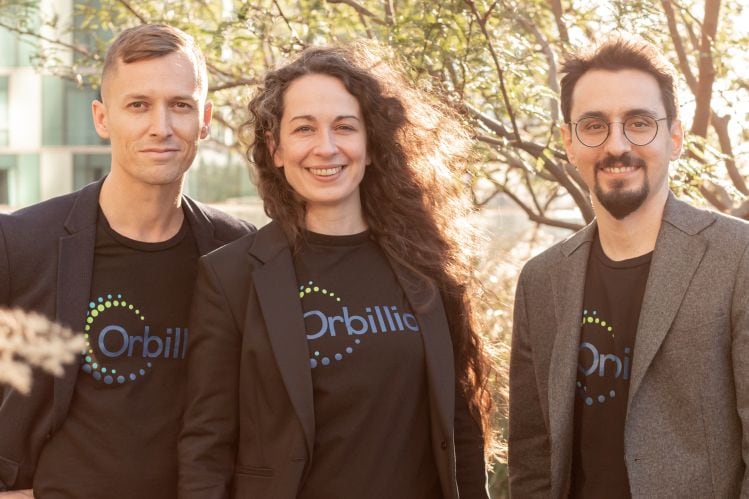
At Berkeley, Gabriel met Patricia Bubner. Both were postdocs, and they became friends over food and their concerns about how it was produced. Years later, Bubner was working with Samet Yildirim and discussing how biotechnology might change food production. The conversations eventually became Orbillion Bio, founded in 2020 by the three of them. Gabriel served as chief technology officer; Bubner was chief executive and Yildirim chief operating officer.
The origin has a pleasingly ordinary ingredient. Food was something the founders cared about before it became a market to enter. Their proposition was cultivated meat, with an early emphasis on Wagyu beef, lamb and wild elk. A company built around cell culture still had to answer a question familiar to any restaurant: would anyone want to eat the result?
In March 2021, Orbillion held a tasting in San Francisco and presented at Y Combinator’s Demo Day. Its accelerator batch was Winter 2021. The company then secured a $5 million seed round. These were different kinds of examination in quick succession: a tasting, a pitch and a financing. An attractive result on a plate and an attractive result in a spreadsheet each have their own audience.
The founders’ responsibilities were distinct. Gabriel’s CTO role put him on the technical side of the undertaking. Bubner described their shared bioprocessing experience as relevant to the challenge of growing cells at larger scale. Increasing a production volume changes the physical conditions inside a vessel, including mixing and mass transfer. Biology, unfortunately for the business plan, does not simply enlarge itself to fit the new container.
The choice of premium meats made flavor and product identity part of the early proposition. Wagyu, lamb and elk gave the company something more specific to discuss than an abstract future of food. The initial tasting offered people a way to encounter that proposition directly. There is a certain efficiency to letting dinner do some of the explaining.
The distance from a dish to a tank
Orbillion’s later work concentrated on the difficult passage from small cultures to production. In 2024, Y Combinator described a completed 200-litre cultivated-meat run and new financing that brought the company’s total raised to $15 million. It highlighted an algorithm for moving from two-dimensional to three-dimensional cultures. Those were company milestones, achieved by a team, rather than a reason to assign the entire result to one founder.
The technical record also includes Gabriel’s name as an inventor. A patent application titled Using organoids and/or spheroids to cultivate meat lists Patricia Bubner, Laura Daley and Gabriel Levesque-Tremblay. Filed in October 2021, the US application was published in March 2024. Its subject is the use of organized groups of cells in cultivated-meat production. The record connects the founding story to a particular piece of technical work.
The distinction between a patent application and a finished commercial product matters. So does the distinction between a pilot run and routine production. Gabriel’s first company occupied the space where those distinctions become daily business concerns. The public milestones show steps along that route; they do not make every subsequent step automatic.
Y Combinator now lists Orbillion as acquired. Gabriel’s next role took him from CTO to CEO, and from a three-person founding group to a five-person one. The titles changed, but one colleague made the journey with him: Samet Yildirim. Their partnership outlasted the first company’s original problem.
From technical lead to chief executive
Five founders, years of acquaintance
HexemBio was founded in 2024. Gabriel is its chief executive and co-founder, alongside Samira Kiani, Mo Ebrahimkhani, Samet Yildirim and Joshua Hislop. The company assigns Kiani the CTO role, Ebrahimkhani the CSO role, Yildirim the CBO role and Hislop the leadership of AI. Gabriel’s responsibilities include institutional fundraising and regulatory strategy. The task has become one of arranging the conditions in which other people’s work can advance.
The team’s history preceded the business. HexemBio says each founding member had known at least one other member for five years or more before the company began. Gabriel, Kiani and Ebrahimkhani had collaborated across scientific events and projects over the preceding decade. Alongside the continuing connection with Yildirim, those relationships give the company an origin measured in years of acquaintance.
That is a different way of reading a founding announcement. Five names on a website can look like five appointments made at once. Here, the names represent relationships already in motion. An organization must still be built around them, with separate responsibilities and shared decisions. Familiarity supplies a history; it does not eliminate the work.
In 2026, Gabriel’s public schedule included a Generation Space podcast conversation with host Leah Martin and investor Jeffery Jiang. He also described a keynote in São Paulo called Building at the Frontier, covering startup formation and fundraising. On that trip, he encountered former Berkeley colleague Luisa Tacca after more than a decade. A career that has crossed institutions and borders occasionally folds back on itself in a conference corridor.
“Let’s grab a coffee!!!”
Gabriel Levesque Tremblay, inviting his New York network to reconnect
The coffee invitation
Gabriel’s New York connections reach back to his AIChE years. In a holiday post, he recalled the friendships, lessons and opportunities the city had given him between 2015 and 2021. He described himself as American and Canadian and invited local friends and colleagues to reconnect over coffee. The invitation was direct, enthusiastic and considerably less formal than a founder biography.
He and Yildirim also appeared together on Grow Everything, discussing alternative proteins, consumer acceptance and the place of storytelling in biotechnology. These subjects sit beside the engineering work rather than outside it. A product needs an explanation that another person can understand, then a reason for that person to care. Their conversation moved between production and the people who might buy what was produced.
Gabriel’s stated view of setbacks is equally plain: “Failure is important. It helps you evolve and stay humble.” He likes basketball, names Magic Johnson as a dream dinner guest and calls Malibu his happy place. The details are modest enough to survive the company milestones. A technical founder can have a complicated professional history and a fairly uncomplicated dinner wish.
The seeds in that doctoral thesis belong to an earlier chapter. The co-founders in the photograph belong to another. Neither chapter disappears when the next company arrives. Gabriel’s biography has accumulated experiments, institutions and collaborators, with a few familiar names returning. Today the CEO title sits at the end of that sequence. The sequence itself is what makes the title interesting.