Huafen Liu has spent a career worrying about what happens after the clever part. A scientific instrument can be exquisitely sensitive. A published method can be beautifully reasoned. Then somebody in an ordinary laboratory has to prepare the sample, choose the standard, run the sequence, review the data and decide whether the number deserves belief. Discovery gets the applause. Repetition gets the job.
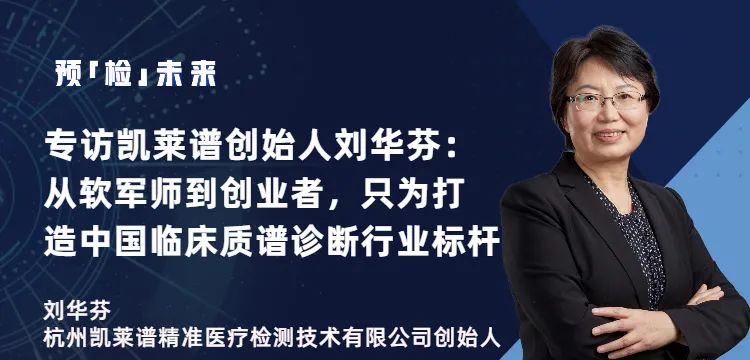
Liu made repetition her subject. Before founding Calibra Scientific in Hangzhou in 2017, she worked for more than two decades in the United States at Pfizer, Roche and SCIEX. The sequence gave her three useful views of the same landscape: the research scientist asking an analytical question, the instrument company turning physics into a product, and the applications team trying to make that product useful in someone else's hands.
Her Calibra title is founder and chief executive. Scientist, operator and translator are equally revealing. The company she built sits in the awkward space between a mass spectrometer's theoretical capability and a laboratory's daily reality. That space contains reagents, calibrators, sample preparation, software, training, quality systems and the unending nuisance of small variations. It is hard to compress into a slogan. It is also where a result becomes repeatable.
01 / ApprenticeshipThe long route to an obvious problem
Liu's public biography begins with research roles at Pfizer and Roche, then moves to SCIEX, part of Danaher. At SCIEX she held positions spanning applications, support and innovation, eventually serving as Global Director of SCIEX Labs. The nouns sound corporate. The work beneath them was practical: methods had to survive contact with users, markets and laboratories far from the people who designed the instrument.
She published extensively along the way. Calibra and conference biographies credit her with more than 100 peer-reviewed articles and presentations. Her name appears on work involving analytical standards, food testing, metabolomics, reference materials and mass spectrometry workflows. In 2016 she was recognized by AOAC International for technical and scientific excellence connected to allergen-protein methodology. Standards work is a revealing occupation. It asks a severe question of science: can another laboratory do this too?
By 2017, Liu had reached the point in a multinational career where the conventional reward is a larger version of the same job. Instead she returned to China and started again. Calibra first operated through laboratory services, working directly on clinical mass spectrometry and multi-omics projects. This was more than a route to revenue. It put the young company inside the messy loop it hoped to improve.
Liu later described customers visiting the lab and asking Calibra to help them reproduce its standards in their own facilities. The request changed the shape of the business. A capable central lab could do the work itself. A product company had to make that capability travel. The question was no longer, “Can our experts produce a result?” It became, “Can another team produce the same result with our system?”
02 / The systemEverything around the signal
Mass spectrometry separates and measures molecules with formidable precision. Yet precision inside a machine does not automatically create consistency across an organization. Sample preparation can vary. Reference materials can differ. An experienced operator can recognize a questionable run that a novice accepts. Data processing can turn judgment into a bottleneck. Maintenance, documentation and quality control sit nearby, quietly waiting to spoil a clean diagram.
Calibra's answer was to connect the parts. The company expanded from services into instruments, reagent kits, reference materials, automated preparation and software. Its own description is an integrated platform. The more useful translation is that Liu wanted fewer handoffs where accountability could vanish. If the instrument, method and calibrator disagree, the customer does not care which supplier won the argument.
The repeatability chain
preparation
measurement
result
materials
quality control
that travels
There is a founder lesson here, and it is pleasantly inconvenient. The product may be much larger than the object with the logo. In technical markets, customers often buy confidence assembled from many ordinary pieces. Calibration is not a flourish. Documentation is not the boring appendix. Support is not what happens after the sale. Together they may be the sale.
Liu's approach grew from watching where users struggled. She has argued for simpler methods, automated data processing and consistent quality control. The goal is not to remove scientists from science. It is to reserve human attention for the decisions that deserve it, rather than spending it on repetitive transfers and avoidable clerical work.
03 / Operating styleQuiet teams, specific invitations
Liu has offered a compact description of Calibra's temperament: “act first, speak later.” She used it while explaining that the company had quietly assembled an instrument-development team before publicly discussing the work. The sentence is not coyness dressed as strategy. It reflects the timescale of analytical hardware, where an announcement cannot make a finicky system dependable and a demo cannot substitute for accumulated runs.
Her public LinkedIn activity follows the same rhythm. In 2026 she introduced AIM, a Calibra mass spectrometry system that she said had been in development for four years. Her description emphasized a fully automated “sample in and result out” workflow and the practical needs of existing laboratory-developed-test users. Calibra showed the system around the ASMS conference in San Diego. Four years of work, then a short post and a booth number: the medium was almost comically smaller than the effort.
The quieter evidence of her operating style comes from colleagues. A recommendation on Liu's LinkedIn profile describes a busy leader who treats people with respect and calls her a mentor. In a Calibra employee interview, laboratory operator Shen Lingxiao remembered two brief encounters with Liu. In the first, Liu asked whether the young employee would try quality assurance because the role needed fairness and care. Years later, Liu asked whether she would take on laboratory operations. Each conversation was short. Each altered the employee's path.
This is calibration applied to people: notice the trait, name the responsibility, let the person grow into the measurement. Founders often speak grandly about talent while leaving the next step vague. Liu's questions were specific. Would you try this problem? The invitation carried more weight than a motivational speech because it came attached to real work.
04 / TranslationThe work that refuses to stay in one category
Liu still publishes and teaches. She was a corresponding author on a widely read 2020 Cell paper combining proteomic and metabolomic analysis. In 2022, she co-authored work on certified reference materials for clinical mass spectrometry. A 2023 paper included her in the team behind MetaPro, a web application for inspecting LC-MS data batches and curating libraries. In 2025, she taught an MSACL workshop on moving LC-MS/MS systems from research-grade instruments to in-vitro diagnostic devices.
The subjects look varied until one notices the shared verb: translate. Translate a molecular signal into an interpretable measurement. Translate a method into a standard. Translate data inspection into software. Translate a research instrument into a routine device. Translate a specialist's judgment into a workflow that another operator can follow without inheriting the specialist's entire career.
Her name also appears on Calibra patents for automated testing and sample preparation. The patents put machinery around the same concern that runs through the papers and products. In one direction lies scientific possibility. In the other lies dependable use. Liu has arranged her career in the narrow corridor between them.
The geography reinforces the point. Her public profile places her in San Jose, while Calibra's center of gravity is Hangzhou. Her earlier jobs were with Western multinationals; her company serves a Chinese market and appears at international conferences. Liu has spent years moving among institutions that use different rules, languages and working habits. A method that functions only inside one local culture is not yet a system. The cross-border career gave her repeated chances to see which assumptions were universal and which were merely familiar.
That corridor is where Calibra's ambition now lives. The company describes a broad platform of instruments, assays, laboratory services and multi-omics work. Liu's aspiration is plainer than the catalogue: lower the technical threshold without lowering the standard. Make the difficult work easier to operate. Let the result travel.
There is nothing inherently romantic about calibration. It is the practice of checking an instrument against something known, then checking again. But as a founder metaphor, it has charm. Measure reality. Adjust. Repeat. Speak after the result holds. Huafen Liu spent decades learning what a mass spectrometer could do. Her company began when she decided the more important question was how reliably everyone else could do it.