The visitors had seen the laboratory. Now they wanted to take its way of working home. Customers coming through Calibra’s doors asked Hua-fen Liu’s team to help them establish laboratories to the same standard. A service business had received a rather interesting request: could it teach somebody else to do the work?
Liu later recalled those visits as a step toward developing an offering that other laboratories could reproduce. The appeal lay in the whole arrangement: equipment, methods, quality management and the experience of the people running it. A machine could be delivered in a crate. Experience required a little more unpacking.
That episode is a useful place to meet the founder and chief executive of Calibra Scientific. Her career had already involved research at Pfizer and Roche and applications leadership at SCIEX, the scientific-instrument business within Danaher. She founded Calibra in Hangzhou in 2017, bringing years of work on the practical uses of mass spectrometry into a company of her own.
The visiting customers presented a problem suited to that background. Producing a result inside an experienced team’s laboratory was one task. Helping another team reproduce the work meant deciding which parts of the expertise could become products, procedures, software and training. The business opportunity came with an unusually demanding instruction manual.
An applications specialist changes the job
At SCIEX, Liu held positions including director of applications and support and global director of SCIEXLabs. Those titles place her close to the point where an instrument meets its user. Applications work carries an awkward obligation: the technology has to accomplish something specific for someone who has other things to do.
She helped develop an approach called iMethod, bringing products, methods, quality systems and technical support together. It treated the task around the instrument as part of the offering. That is a revealing piece of her professional history. Long before Calibra had its own equipment to sell, Liu was working on the connections between a product and the conditions needed to use it.
Her research career also continued to appear in the biography. Calibra credits her with more than a hundred papers or conference contributions, and records an AOAC technical and scientific excellence award in 2016. These are milestones from the period before the founder title arrived. The business grew out of an existing field of work.
Entrepreneurship nevertheless involved a change in responsibility. A specialist can concentrate on a difficult application. A founder must also assemble the people and operating arrangements that allow a company to keep delivering it. Liu’s move connected those two kinds of work, with all the organizational complications that connection implies.
The four elements Liu brought together in her account of iMethod.
A company called Calibra
Liu explained that the company’s name comes from “calibrate.” It is a workmanlike verb for a founder to choose. Calibration concerns the relationship between a measurement and a reference. As a company name, it leaves plenty of room for ambition while suggesting that someone should check the numbers before the speech.
Calibra began with laboratory services, working with Dian. Its subsequent move toward products drew on that operating experience. Liu’s customers had seen a functioning laboratory and wanted help establishing comparable working arrangements. The request supplied a link between doing the work internally and building something that could be used elsewhere.
In describing her team, Liu emphasized people with experience in both research and industrial development. She wanted specialists familiar with the passage from an idea through product development and into use. That distinction matters in her account of the company. The work was expected to travel beyond the setting in which it had first succeeded.
She also spoke about developing talent and establishing a standard for the industry. These ambitions gave the company a wider assignment than its next launch. Teaching people, documenting work and maintaining quality all require effort that can be difficult to display in a photograph. They remain part of what makes a technical business reproducible.
The customer visits make those ambitions concrete. Someone asking to reproduce a laboratory’s approach is asking for access to decisions already made: how work is organized, how errors are checked, and how people learn the routine. A founder with an applications background had good reason to listen carefully to that request.
A colleague’s account adds another view of that continuity. Ma Jinfei, an applications manager at Calibra, recalled meeting Liu while working at Dian in 2014, when Dian was preparing to purchase a mass spectrometer. He joined Calibra in 2017 and later took responsibility for work in its reagent business. His account connects the founder’s earlier applications role with the people who went on to run parts of the new company. It also gives the story a scale smaller than the corporate agreement: a professional encounter, continuing work, and a colleague carrying experience into another assignment.
The hardware arrives
Calibra’s move into instrument development required a different team from the one providing laboratory services. Liu said recruitment for that work began in 2020. By her May 2022 interview, the hardware group had grown to about thirty people, bringing together instrument engineers and specialists with experience of product development in the company’s market.
The timing offers a useful measure of the process. Building the group preceded the announcement of the CalQuant-S instrument system in 2022. Behind a named product sat an earlier decision to recruit people for work the existing service operation could not simply absorb. A new activity needed its own competence.
Liu described the company’s working style with the phrase “先做后说”: do first, speak later. It is a compact expression, and an appealing one in a business where a launch can acquire a vocabulary before it acquires a delivery date. Her account of assembling the hardware team gives the phrase some practical weight.
“先做后说”
Do first, speak later.The working style Liu described at Calibra, 2022
The story continued into production capacity. In October 2024, Calibra reported the opening of its Hunan development and production base, with Liu attending the ceremony. The site provided 2,000 square metres of space, including production, testing and storage areas. It was the company’s second research and production base.
A floor plan is a useful companion to a founder’s ambitions. Equipment must be made, checked and stored somewhere. The Hunan opening added a physical setting to a story that had begun with laboratory services and moved into products. It also placed another set of operating responsibilities inside Liu’s business.
Space for development, production, testing and storage at Calibra’s second R&D and production base.
An old connection gets a new contract
On March 21, 2025, Liu signed a renewed strategic cooperation agreement with SCIEX. She appeared alongside Cai Junsong, SCIEX and Molecular Devices’ global vice president and China general manager. Her former employer had become a partner in the company she founded.
The relationship had continued through an initial strategic cooperation agreement in 2017. Eight years later, the renewed arrangement covered channel development, product development, applications, maintenance and customer training. The list is worth reading slowly. It includes what happens after a customer decides to buy, when a product begins its working life.
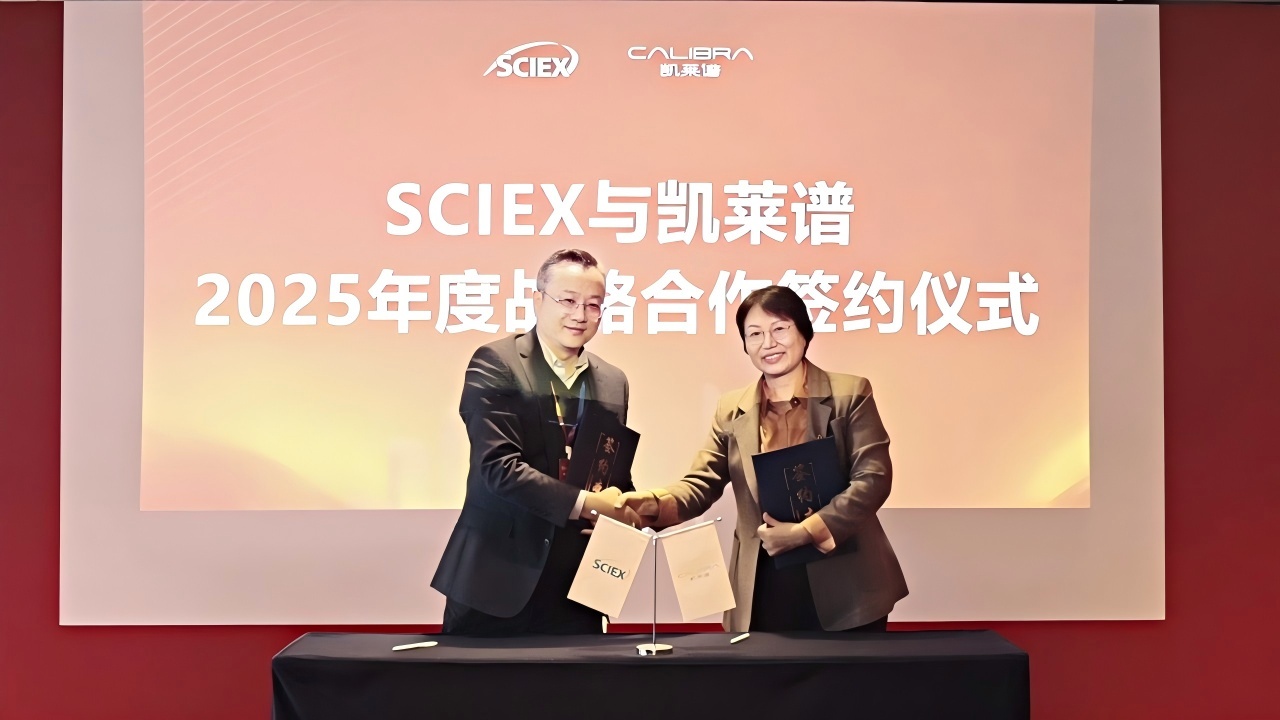
For Liu, the agreement connected two chapters of her career. At SCIEX she had worked on applications and support. At Calibra she was responsible for a business whose offering included instruments, supporting products, software and services. Training and maintenance belonged naturally in that conversation.
There is no need to turn a continuing partnership into a fable about effortless cooperation. An agreement describes work still to be carried out. Its practical terms are interesting enough: developing products, reaching customers, maintaining equipment and teaching people how to use it. These activities give the relationship its operating substance.
The signing photograph captures a formal occasion, complete with folders and a handshake. The terms point toward less ceremonial encounters: a training session, a service call, a development discussion. Those are ordinary settings for an applications business. They are also places where a founder’s promises become somebody else’s working day.
Patience has a job to do
Across her public comments, Liu has argued for patience in building technical capability. She has described it as a long-term investment requiring persistence after a direction has been chosen. This fits the sequence of decisions visible at Calibra: establish services, develop a repeatable offering, recruit a hardware team, add production capacity and maintain partnerships.
Her emphasis on quality also preceded her discussion of rapid expansion. That ordering is a practical choice for a business asking customers to rely on its methods. Repetition is the test built into the proposition. An approach that works once still has to work in another room, with another operator and a different day’s workload.
Liu’s career makes that question personal without requiring a grand conversion scene. She spent years helping people apply scientific instruments, then founded a company that took responsibility for more of the surrounding work. The title changed. The attention to methods, people and support remained visible.
The laboratory visitors offered a straightforward version of the challenge: help us do what you do. Much of Calibra’s development can be read through that request. Liu’s task was to decide how experience could travel, and what her company would need to build so that it arrived in working order.