Before Alex Arkhangelskiy had a motorcycle product to sell, he had a car product to investigate. An entrepreneur wanted to know whether drivers would buy another brake light. Alex's assignment was to find out. It was a useful beginning for a founder: permission to ask whether an idea belonged in the market before becoming responsible for putting it there.
He had graduated from San Jose State University in 2013 with a business degree and an interest in entrepreneurship. A professor helped him find an apprenticeship with Dave Hadden, an experienced product developer. Working on someone else's projects gave Alex a view of the business behind an object: research, prototypes, manufacturing and the question of who would actually want it.
The proposed light was autonomous. It could respond to slowing without depending on a driver's brake pedal. Alex, a motorcyclist, saw another possible customer. Cars already carried several lights. A rider had a different relationship with being noticed. The technology could move up from the vehicle to the back of a helmet, where a following driver might more readily see it.
That change of address became Brake Free. It is a pleasingly literal origin for a business about visibility: the opportunity appeared when Alex looked at the same object from another seat. He did not need to invent a new enthusiasm for motorcycles. He needed to take his existing one seriously enough to ask a business question. What would make this useful to a rider?
A degree earned between other responsibilities
Alex was born in Minsk, Belarus, and lived there through the Soviet Union's collapse. His family moved to Silicon Valley in 1997. He arrived without English, then learned it. The destination would eventually connect him to a university, a professor and an entrepreneur. The route to founding a technology business, however, passed through responsibilities that rarely fit neatly on a pitch slide.
He married his high school sweetheart and became a father at 23. He worked full time in retail sales while attending school part time, completing his business degree with honors. Put those commitments beside the familiar picture of the carefree student founder and the picture changes. There were customers to serve, classes to attend and a family whose day did not end when a business idea arrived.
His public professional profile includes an AT&T Mobility retail management development certification issued in February 2013. It also records participation in the Entrepreneurship Club and a semifinalist finish in the university's 2013 Silicon Valley Business Plan Competition. Sales and business planning sat alongside each other in his education. One required explaining something to a customer; the other required explaining why customers would care.
Professor Anu Basu made the introduction to Hadden after seeing Alex's commitment in her business plan class and competition. The connection makes the classroom unusually consequential in this story. A course led to an apprenticeship, which led to work on a real product, which led to a company. The university reappeared in March 2021, when Alex returned as a speaker for an event called The Road to Shark Tank.
The elegance is in what the rider does
Brake Free began building its first prototype in April 2014. The company was founded in San Jose that May. Its premise combined two demands: the light should work, and a rider should want to wear it. Anyone can propose adding another accessory. Persuading someone to attach it to a helmet requires rather more consideration for the helmet.
Alex's contribution was commercial and practical. Ian Dunn brought industrial design; the wider development team supplied the engineering necessary to turn a rider's requirement into a functioning object. Henry Li would join Alex for the televised pitch. The product's history is crowded with collaborators, which is appropriate for something whose apparent simplicity depends on several kinds of expertise.
There is also a less photogenic record of that collaboration. US patent 10,086,894, granted on October 2, 2018, names Alex O. Arkhangelskiy alongside Johannes Boot, David M. Hadden, Taylor Alexander, David Venhaus and Hugo Haselhuhn as inventors. Its title is simply Safety device. Patent titles seldom trouble the poetry shelves, but this one provides a useful counterweight to the image of a solitary founder having a solitary idea.
The device contains motion sensors and processing that distinguish slowing from other movements. A rider can turn their head or lean; the product has to interpret what is happening rather than merely respond to movement. It also addresses a particular feature of motorcycling: the bike can slow through engine braking or downshifting without the rider operating the conventional brakes.
For the person wearing it, the sequence is shorter. Fit the mount to the helmet, attach the light and switch it on. The unit requires neither a wired connection to the motorcycle nor a companion app. The engineering stays inside the object. That division of labor is the appeal: the team does the complicated work so the customer has fewer things to do before leaving.
Two thousand people take a chance
In spring 2017, Brake Free went to Indiegogo. The company credits 2,138 backers with bringing the product into the world. Those people were buying into a proposed object before it became a routine purchase. For Alex, it was a way to move beyond a business plan and discover whether the riding community would put money behind the premise.
The campaign also makes the chronology worth slowing down for. Prototypes in 2014. Crowdfunding in 2017. Fulfilled crowdfunding orders and the beginning of regular sales in March 2020. A product can be easy to attach and still take years to bring to market. The customer sees the final click. The calendar records the work that made the click possible.
The team was talking to riders before television discovered it. Brake Free appeared on Motorcycles and Misfits in February 2017 and again in November 2018. These were conversations inside the community the company hoped to serve. A motorcycle accessory has to survive the questions of people who understand motorcycles, including the questions its makers may wish nobody had thought to ask.
Later, Alex and Ian Dunn joined the Centerstand podcast for a discussion about building an aftermarket brand. The conversation included early adopters, dealers, video and the online store. That is a fair description of the job after a crowdfunding campaign: several routes to the customer, each with its own explanation to deliver. Manufacturing a unit and making a business remain separate pieces of work.
A crowd before the television audience.
A television moment, followed by ordinary Tuesdays
Alex and Henry Li appeared on Shark Tank on December 11, 2020, in season 12, episode 8. A helmet light is well suited to a demonstration: the audience can see the object, the mounting position and the illumination. Years of development become something understandable in a few seconds. Television has a generous relationship with brevity; hardware development generally does not.
They sought $200,000 for 10 percent of the company and accepted an on-air offer of $200,000 for 20 percent from Mark Cuban and Robert Herjavec. The agreement did not close. The broadcast nevertheless gave the business a national stage. Alex has described pitching to that audience as one of his major accomplishments as a business owner.
The useful part of his later account is how little inevitability he assigns to getting there. He attended a casting call in Nebraska after a friend encouraged him to try. The opportunity required an application and an appearance before it could become a story about television. The lesson is modest enough to be actionable: enter the room where a decision can be made.
The years afterward supplied more conversations. Alex and Henry discussed product development and team building on Lessons From The Tank in September 2022. In March 2024, Alex joined Cruiseman's Garage Talk; in August, he appeared on The Phil Experience. Together, the appearances show a founder repeatedly explaining the same central idea to different groups of riders, rather than relying on one evening's introduction to do the work forever.
“My mission is to create beautiful and functional products that solve real problems”Alex Arkhangelskiy
Still working the room
By September 2025, Alex was discussing the company's history and dealership opportunities with Greg Jones of Motorcycle and Powersports News in Akron, Ohio. The subject had moved from introducing an invention to helping stores carry it. A dealer has to understand what the object does before explaining it to the next person who walks through the door.
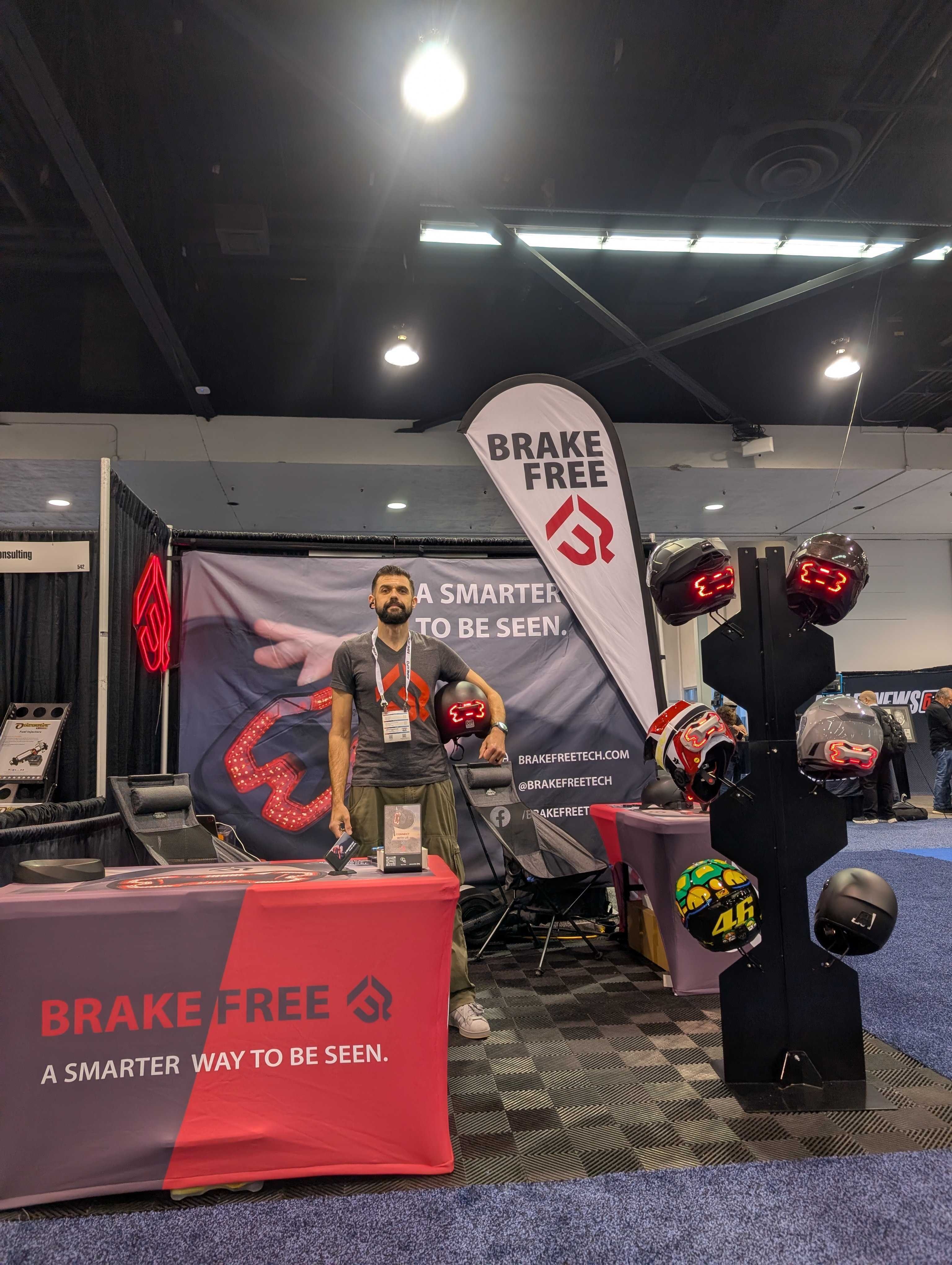
At AIMExpo in 2026, Alex stood at the Brake Free booth with illuminated helmets beside him. The company reported new dealer contacts and visits with people from across the riding industry. There is something reassuringly tangible about the photograph: a founder, a table, the product, a banner. After the university competition and the television studio, here is another place to have the conversation.
The previous year's show had brought reunions with Liza Miller and the Motorcycles and Misfits crew, whose connection to Brake Free reached back to the crowdfunding years. Relationships in this account recur. A professor introduces an apprentice. Riders host a young company. Familiar faces reappear at a trade show. The network has a history, rather than merely a number attached to it.
Alex's own advice places weight on maintaining those relationships and assembling a team with complementary abilities. His description of the daily challenge is equally practical: choosing the three projects that matter most and making time for them while urgent tasks compete for attention. It is a recognizably human difficulty. An inbox is exceptionally talented at impersonating a strategy.
Outside the company, his interests include hockey, snowboarding and skating as well as motorcycles. Movement runs through the biography, but the business depends on a careful reading of slowing down. Alex's stated professional mission is to make useful, well-designed products that solve problems. Brake Free gives that ambition a specific shape: a device on the back of a helmet, and a rider preparing to go somewhere.