The orders had fallen from fifteen to five. For a young delivery company, this was the sort of development that could send everyone hunting for a complicated explanation. Mohit Kumar and his co-founder, Arpit Dave, spoke to their restaurant customer. The telephone was dead. A business built around moving things through a city had encountered an obstacle sitting on a counter.
It was 2015, and Roadrunnr was getting its education. Kumar and Dave had left Flipkart to build a service that would handle local deliveries for merchants. They recruited delivery workers by ordering food and asking the people who brought it whether they would join. Training took place at Kumar’s home. There were dummy orders, flyers and the less glamorous work of persuading a stranger that this new arrangement would pay.
Then came the rain. Orders needed delivering, and the founders went out themselves. An on-demand business offers many opportunities to discuss efficiency; a wet delivery route provides a rather thorough examination. The two were learning what their software asked other people to do. The view from a laptop had acquired a street address.
“We were the most efficient delivery boys.”
Mohit Kumar, recalling Roadrunnr’s early months
An education before the first company
Kumar had studied computer science at PES Institute of Technology in Bengaluru. His working life took him through HolidayIQ, where he was a lead engineer, and Ola, where he worked in product management. Flipkart followed. These were useful places to encounter the distance between an idea that works in software and a service that works for people.
At Flipkart, logistics caught his attention. Goods had to arrive properly and on time, and the infrastructure could get in the way. He saw room for a business serving other businesses. He left in February 2015 and joined forces with Dave, a colleague who had worked as a business analyst. Their first software offering was a tracking link. The machinery of the company began with something a merchant could open in a browser.
Kumar recalled starting with ₹25 lakh in his bank account. By the time the first $11 million funding round arrived, he said, ₹120 remained. Such figures can look jaunty in retrospect. While the bank balance is falling, they are presumably less decorative. The story places a useful weight beside the familiar photograph of the founder taking a leap: there is a balance to watch all the way down.
The orders could disappear
Roadrunnr’s early proposition covered more than restaurant food. Local commerce meant groceries, laundry and other deliveries, too. That breadth had an obvious attraction: the company could carry orders for many kinds of customer. It also left the business exposed to whatever happened to the companies supplying those orders.
In 2016, Kumar described a sobering change. Around eighty percent of deliveries were food. Among the company’s top hundred customers, he said, forty-five had shut down. Demand that had seemed diverse was becoming concentrated. A delivery network could do its job and still lose business because somebody else’s business had stopped working.
Roadrunnr combined with TinyOwl to become Runnr. The pairing joined delivery capability with a food-ordering operation. It was a substantial adjustment to the original idea of serving local commerce broadly. It also made the underlying question harder to avoid: where would the orders come from, and how much of that answer could the delivery company control?
There had already been experiments with the physical equipment. In 2015, Roadrunnr piloted electric scooters fitted with GPS and sensors. Dedicated vehicles could also let people without their own motorbikes join the fleet. Long before Ultrahuman, Kumar was dealing with the meeting point between software, hardware and the people expected to use both.
Try the partnership before signing it
The next major decision involved Zomato. Before the acquisition was announced in September 2017, Kumar spent about a month working closely with its team. The purpose was refreshingly practical: find out whether the two teams would get along. A proposed combination had an opportunity to experience an ordinary working day.
By the announcement, he had moved from Bengaluru to Delhi and had been living there for roughly two months. The paperwork was catching up with a relationship already being tested. For anyone tempted to picture acquisitions as a handshake followed by instant cooperation, the sequence offers a useful correction. People had to work together before they could reasonably promise to do so.
Runnr gave Zomato a delivery operation to build on. For Kumar, it closed a chapter that had begun with a browser link and personal deliveries. His first company had asked him to manage a network in which workers, merchants and customers could each change the outcome. Whatever came next would inherit that education, even if it looked nothing like a delivery business.
- 2015A tracking link and delivery runs
- 2017Runnr joins Zomato
- 2019Ultrahuman begins
- 2022LazyCo brings hardware expertise
- 2023Ring AIR arrives
A ring has very little room for excuses
In 2019, Kumar and Vatsal Singhal co-founded Ultrahuman. They knew each other from engineering college and had worked together at Runnr. That long acquaintance gave the new venture a relationship stretching back beyond either company. It also joined two people whose early interests had centred on computers.
The company’s move into rings required another kind of expertise. In April 2022, Ultrahuman acquired LazyCo, the wearable company behind the Aina ring. Its team joined Ultrahuman’s hardware development operation. The acquisition brought people who already knew something about making a small object do useful work.
The first ring, R1, appeared in 2022. Ring AIR followed in 2023. Comfort helped drive the redesign. Kumar described reworking the object from its curvature to its circuit board and heat insulation. The battery and sensors overlapped to reduce the area they occupied. These are details a wearer should ideally never need to consider.
A ring makes engineering unusually intimate. Weight, shape and warmth are experienced on a finger, all day. The product has little room to hide its compromises. A software founder can explain a feature at length; the customer can settle the question of comfort by taking the thing off. That gives every internal design choice an unusually direct route to a verdict.
The factory enters the story
Making the object introduced another dependency. Kumar described suppliers quoting lead times stretching from six months to a year, with uncertainty beyond that. He had also heard accounts of factories shutting while finished goods remained inside. If Ultrahuman wanted to decide when its products evolved, manufacturing could scarcely remain an abstraction.
The company chose to learn more of that work itself. The decision meant confronting gaps in the supplier ecosystem and the difficulty of finding industrial designers with relevant electronics experience. Control came with an obligation to understand the process. A factory does not become cooperative because its owner has a persuasive slide deck.
In an announcement introducing the UltraFactory in Plano, Texas, Kumar sought people in production engineering, materials science and firmware. The recruitment list gives a compact picture of how far the work had travelled from an early tracking link. Software was still there, alongside the materials and machines that would have to accommodate it.
The customer gets a vote
His account of finding customers had changed, too. At Runnr, Kumar had believed a sufficiently good product would find its market. By 2024, he was talking about identifying the right customer and finding a way to reach that person. The product could be carefully built and still need a route into somebody’s life.
He described product-market fit as uneven within Ultrahuman. Ring AIR had found it to some extent, while newer parts of the business were still being tested. He also favoured content and relationships with reviewers over advertising that stopped producing results when spending stopped. The reasoning was about work that could keep helping after the initial effort.
There is a practical modesty in admitting that one part of a company works while another is still an experiment. It leaves room to keep learning. A founder who has watched orders disappear with customers’ businesses has good reason to examine where demand comes from. The market’s approval is something to understand closely, then earn again.
A computer small enough to forget
By February 2026, the engineering priority for Ring PRO was battery endurance. Ultrahuman advertised up to fifteen days between charges. Kumar said reaching that figure had taken months of work. A tiny battery imposed a physical limit on a familiar consumer request: please let this object need less attention.
Ring PRO’s advertised maximum battery life at its February 2026 announcement. A product claim, with actual use dependent on conditions.
His next ambition gives the ring a larger job. In March, Kumar described wanting smart rings to become computers worn on the body, capable of doing more processing themselves. On September 3, Ultrahuman announced $70 million in financing, with Qualcomm Ventures among the participants. The company presented its next chapter around human-computer interfaces. That describes a direction of travel; the work of making it useful remains ahead.
Kumar, now based in Dubai, says he enjoys reading about martial arts, cycling and history. He also describes having fun at work and seeing little separation between it and his personal life. It is an unusually candid account of where he puts his attention. The interests outside the office remain visible, but the company occupies plenty of the picture.
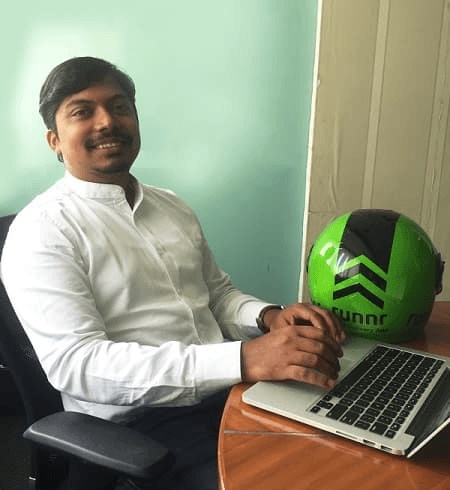
The office photograph from his Runnr years supplies an apt final detail. He is seated with a laptop, beside a bright green delivery helmet. Two tools, for two parts of the same promise. Years later, the object under discussion fits on a finger. The questions remain stubbornly practical: who will use it, who will make it, and what happens when the plan has to leave the desk?