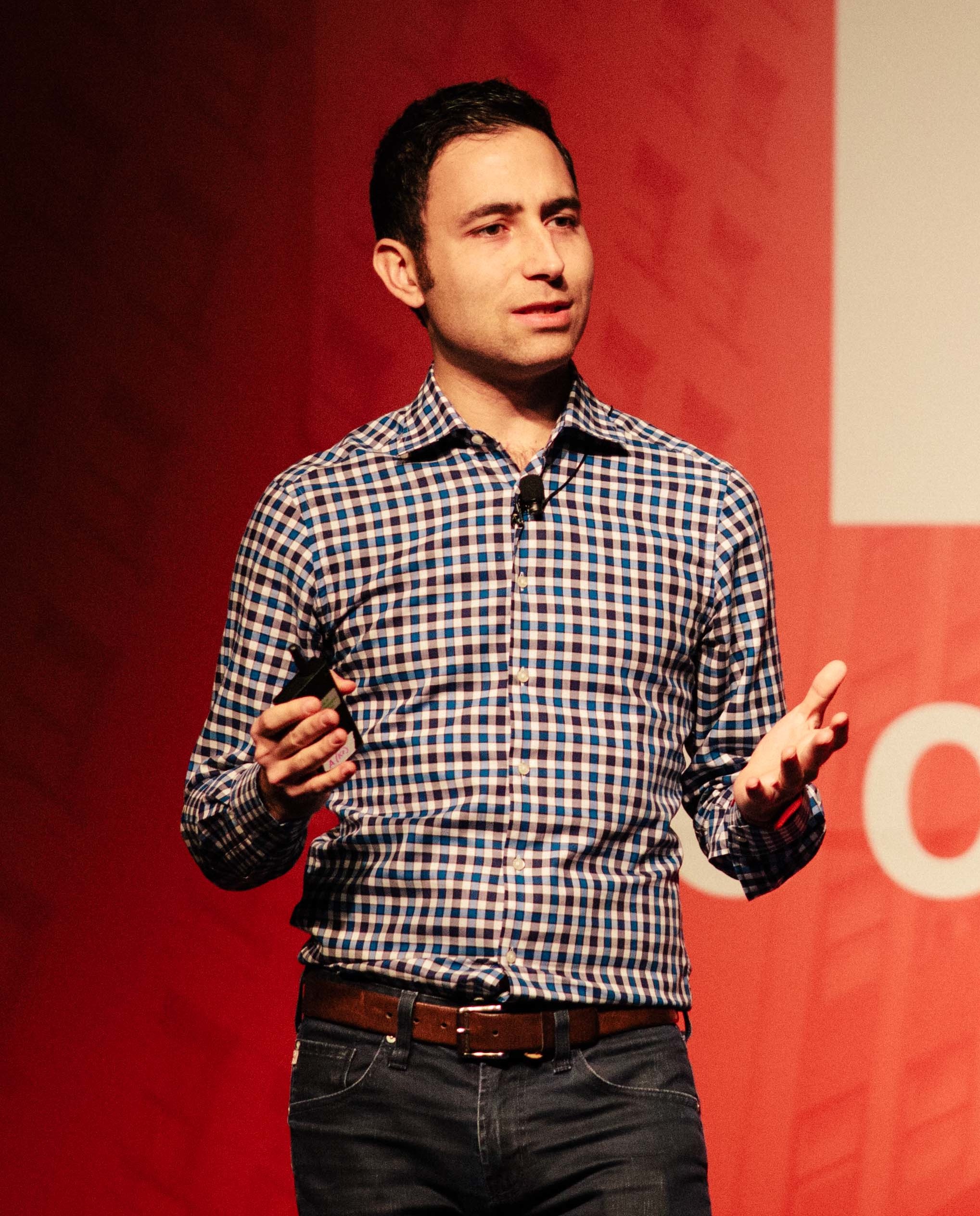
The Original
Execution Machine
Scott Belsky has spent two decades building the argument that creativity without execution is just a hobby. He has made the argument at Behance, at Adobe, in two bestselling books, across 282 angel investments, and now inside A24 - the studio that turned indie filmmaking into a cultural institution. At every stop, the core question is the same: what does it take to make something actually happen?
The grandson of Stanley Kaplan - founder of Kaplan Test Prep, the man who democratized standardized test preparation - Belsky grew up surrounded by the idea that access and meritocracy are worth building for. He went to Cornell, studied applied economics, got an MBA from Harvard Business School, and then did what a lot of Harvard MBAs do: went to Goldman Sachs. But the Goldman chapter was always a detour. By 2006, he had co-founded Behance with Matias Corea and started building the platform that creative professionals actually needed.
What made Behance unusual - and ultimately worth $150 million to Adobe - was not the idea. Platforms for creative portfolios had existed. What was unusual was how Belsky built it. No venture capital for five years. Manual curation at launch. Personal outreach to influential designers and photographers to seed the platform with work worth caring about. He ran Behance as a constraint-fueled operation, which is also, not coincidentally, the philosophy he would later distill into a book.
Personal frustration is a clue for collective frustration, and collective frustration is a signal for opportunity to be creative.
- Scott BelskyAdobe acquired Behance in December 2012 for approximately $150 million. Belsky stayed, which is rarer than it sounds. He moved from VP of Products to General Partner at Benchmark - one of Silicon Valley's most selective VC firms - and then did something even rarer: he left Benchmark after a year to go back to operating at Adobe. He became Chief Product Officer in 2017, overseeing Creative Cloud during the period when Adobe's market cap grew from roughly $19 billion to over $170 billion. That is not a coincidence. That is what happens when a product obsessive with founder instincts gets control of a creative tools empire at the precise moment those tools needed to go from desktop to cloud to AI.
At Adobe, Belsky launched Adobe Express, brought Photoshop and Illustrator to the web and mobile, built out 3D and immersive product lines, and incubated the company's AI strategy. He also founded the Content Authenticity Initiative - an open protocol for verifying the origin of digital content, now embedded in cameras manufactured by Canon, Fujifilm, Leica, Nikon, and Sony. In a moment when generative AI was beginning to blur the line between authentic and fabricated, Belsky was already architecting the infrastructure to mark the difference.
He announced his departure from Adobe in January 2025. By March, he was at A24.
The move is surprising only if you expect careers to follow a legible path. A24 - the studio behind "Everything Everywhere All At Once," "Moonlight," "Midsommar," and enough A-list films to constitute an entire aesthetic era - is not a technology company. It is, however, a creative organization that works at the intersection of storytelling, craft, and cultural ambition. For someone who built Behance for creative professionals, ran Creative Cloud for working artists, and has spent two decades thinking about how tools shape creative output, A24 is a logical next chapter. Belsky is founding A24 Labs, building a team of designers and engineers to bring technological innovation to filmmaking. Whether that means new production tools, new distribution surfaces, or something that does not have a name yet, the operating logic is the same as always: execution over ideation, craft over concept.
Entrepreneurship is about identifying edges that will someday become the center.
- Scott BelskyRunning in parallel with all of this is Belsky's investment practice - 282 angel investments spanning early-stage companies across enterprise software, consumer tech, fintech, health, and climate. His exits include Uber, Pinterest, Reddit, Warby Parker, and sweetgreen. His active portfolio includes Airtable, Notion, Clay, Ramp, Superhuman, Character.AI, Suno, and Supabase. He describes his investment thesis in terms of product craft and go-to-market instincts rather than sector theses. He is looking for design-driven teams solving problems that begin as personal frustrations. He coined the term "operangeltrepreneur" to describe the hybrid identity - part operator, part angel, part entrepreneur - that he has inhabited throughout his career.
His newsletter, "Implications," has 42,000+ subscribers and is ranked #86 in Technology on Substack. Published monthly, it covers the intersection of technology, product design, and business strategy - less a recap of what happened and more a forecast of what it means. He runs 3-5 miles every morning without checking his phone. He holds three sacred weekly "concepting" hours that he protects from calendar creep. He maintains priority lists in Notion across work, investments, health, and family. The discipline that characterized Behance's bootstrap years is still operational. It just operates at larger scale now.
Belsky is also on the board of Atlassian (since August 2024), the Museum of Modern Art, COOP Careers (a non-profit focused on first-generation college graduates), and the Cornell Tech Council. He splits his time between these obligations and the work of building A24 Labs from scratch - recruiting designers, engineers, and people who care about what happens when technology meets storytelling at the highest level.
The tagline he has carried since the early days of Behance: "It's not about ideas. It's about making ideas happen." After twenty years, it still fits. What has changed is the scale of what he is making happen.
Two Bestsellers,
One Argument
The book that made "execution" a creative concept. Based on years studying creative teams, it breaks down how ideas become outcomes - through organized action, community accountability, and constructive leadership. The philosophy behind Behance distilled into a field guide.
Portfolio / PenguinFive years of interviews with legendary founders, artists, and executives compressed into 100+ lessons about the volatile, unglamorous stretch between starting and finishing. Named one of Inc.'s most inspiring books of 2018. BookAuthority lists it among the best startup books of all time.
Portfolio / Penguin