The modern history of BRP begins with a gloriously specific annoyance: snow. In 1937, Joseph-Armand Bombardier patented a vehicle that could cross it. He founded a company in Valcourt, Quebec, five years later, and in 1959 the lightweight Ski-Doo helped turn winter from an obstacle into a weekend plan. Today the company descended from that workshop sells machines for snow, water, dirt, asphalt and the occasional patch of sky. Rotax engines power recreational aircraft. Sea-Doo personal watercraft make lakes noisier. Can-Am vehicles haul fencing supplies, attack desert races and commute through Paris without a clutch.
That range makes BRP easy to mistake for a collection of hobbies with an accounting department. The more useful view is a shared industrial system. The brands speak to different tribes, but they reuse design talent, powertrain expertise, factories, software, suppliers, logistics and dealers. BRP posted CA$8.44 billion in revenue for the year ended January 31, 2026, with roughly 17,000 employees and products sold in more than 110 countries.
Five identities, one engineering spine
BRP's core portfolio is unusually legible. Ski-Doo owns the familiar yellow-and-black snowmobile shorthand. Lynx brings a tougher Finnish snow identity. Sea-Doo covers personal watercraft and the modular Switch pontoon. Can-Am stretches across ATVs, side-by-sides, three-wheel roadsters and electric motorcycles. Rotax is the mechanical spine, building engines and electric power units for BRP and outside manufacturers.
One platform of capability / five customer worlds
The company solves several different problems, some practical and some delightfully unnecessary. A farmer needs a Defender side-by-side that starts on a cold morning and carries tools. A mountain rider wants a snowmobile that feels light while climbing. A family wants a stable afternoon on the water. A new motorcyclist may prefer the Can-Am Pulse's twist-and-go electric drive, regenerative braking and reverse to the choreography of a clutch and gearbox. BRP wins when engineering removes friction without sanding away the fun.
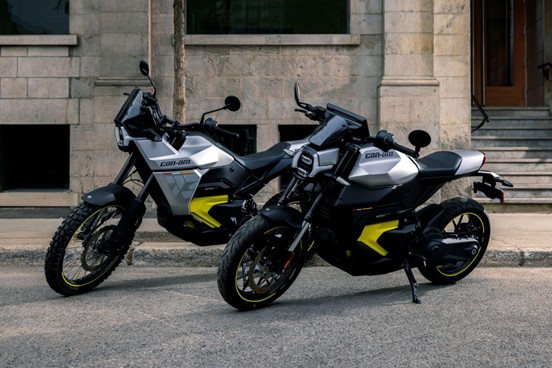
“Heritage gives you permission to return. It does not give customers a reason to buy.”The strategic test behind Can-Am's electric motorcycles
02 / How the money movesThe vehicle is the opening scene
Most vehicles leave the factory complete. BRP treats completion as negotiable. Its LinQ system lets riders attach cargo boxes, fuel cans, coolers and racks without tools. There are windshields, plows, audio systems, riding suits, oils and replacement parts. Parts, accessories and apparel generated more than CA$1 billion in annual revenue by fiscal 2026, had nearly doubled over the prior decade, and grew almost 10 percent that year.
This is more than cheerful upselling. Accessories deepen identification with the brand and give dealers recurring revenue after a machine leaves the showroom. In July 2026, BRP opened a 950,000-square-foot distribution center in Saint-Philippe, Quebec. It centralizes shipments for more than 2,050 dealers, can process over 2.5 million orders a year and feeds 16 other distribution centers. A cargo rack becomes a logistics problem long before it becomes a margin line.
The company is extending the system in both directions. BRP Experiences has delivered more than two million guided or rental rides through outfitters at over 225 destinations in 14 countries. It lets a curious customer try the activity before buying a machine. BRP Financial Services, launched in the United States in August 2026 with lending platform Octane, brings the purchase journey under BRP branding. Dealers get faster approvals and tailored loans; BRP gets a tighter view of the transaction.
03 / The expensive detourWhat failed first: ordinary boats
The clean corporate story would move straight from garage invention to electric motorcycle. The useful story includes boats. BRP bought Alumacraft and Manitou in 2018 and Australian manufacturer Telwater in 2019, building a conventional marine group around fishing boats and pontoons. It looked adjacent to Sea-Doo. The customers liked water, the factories shaped recreational hardware, and dealers understood seasonal products.
But adjacency on a slide is not the same as operating fit. As boating demand softened, Alumacraft and Manitou deteriorated first. BRP recorded CA$113.8 million of impairments related to those businesses in fiscal 2024, followed by another CA$183.9 million on assets held for sale in fiscal 2025. In October 2024 management put the conventional marine businesses up for sale, explicitly choosing to channel investment back to powersports. Alumacraft and Manitou assets were sold during fiscal 2026. A planned Telwater sale to Yamaha Motor Australia was blocked by Australian competition regulators in December 2025, so that exit remained unfinished.
The bill for learning where the edge ends
Electric and light-mobility ambitions supplied a second correction. BRP had committed to offer electric models across its product lines and explored lower-voltage categories. By the fourth quarter of fiscal 2026, it recorded CA$232.5 million in normalized impairment charges on EV and light-mobility assets, citing difficult EV-industry and light-mobility dynamics. That number does not mean the electric products failed wholesale. Electric Ski-Doo and Lynx models reached the market, Pulse and Origin shipments began, and the Outlander Electric followed. It means the expected scale and economics no longer supported the old carrying values.
04 / What changed their mindDemand replaced doctrine
BRP's revised posture is visible in its language. The company's 2030 sustainability plan calls for electric vehicles “in alignment with customer demand,” while targeting a 4 percent average reduction in use-phase emissions for each new combustion model introduced by 2030. It also targets a 30 percent reduction in absolute Scope 1 and 2 manufacturing emissions from a 2022 baseline and at least 85 percent waste diversion at each manufacturing site.
That is a less cinematic plan than electrifying everything, and probably a more credible one for powersports. A snowmobile sees cold, remote terrain and violent peaks in power demand. A ranch ATV may spend the day far from a charger. Buyers often optimize for uptime, range, towing and resale value before emissions. Electric works where quiet operation, easy control, low-speed torque and convenient charging solve a real problem. It struggles when infrastructure, purchase price or duty cycle turns the battery into the adventure's least amusing participant.
The mistake was not trying adjacent products. It was assuming shared scenery meant shared economics.
05 / The copyable playbookSteal the system, not the product count
BRP offers a useful pattern for builders far from engines. Keep customer-facing brands specific while centralizing the expensive capabilities customers rarely see. Ski-Doo and Sea-Doo do not need the same voice; they do benefit from shared powertrain research, procurement, embedded software and distribution. Make add-ons modular so personalization becomes a platform instead of a pile of custom jobs. Use experiences to lower the trial barrier. Treat dealers as product infrastructure, because discovery, financing, setup and service determine whether complicated hardware feels trustworthy.
Five things worth copying
- Build brands around a job and an identity, not an org chart.
- Share hard capabilities underneath: engineering, software, factories and logistics.
- Design accessories into the platform before launch, not after customers improvise them.
- Give people a low-commitment way to try the category through rentals, demos or guided experiences.
- Review adjacencies by channel fit, operating fit and repeat revenue - not by how tidy they look in a portfolio diagram.
This playbook does not travel everywhere. A multi-brand portfolio becomes overhead if products cannot share technology or distribution. Dealers become a bottleneck where customers expect instant direct delivery. Accessories disappoint if the base product lacks loyalty or has a short life. Experience programs fail when insurance, training and local regulation cost more than the lead they create. And a heritage story is useless when it asks a customer to subsidize an inferior product.
06 / The next lapA new CEO inherits a narrower brief
Denis Le Vot became BRP's chief executive in February 2026 after three decades at Renault Group, replacing José Boisjoli, who had led BRP since its 2003 independence. The timing matters. Le Vot did not inherit a blank strategy. He inherited a pruning job, the M28 growth plan, healthier dealer inventory and a portfolio whose strongest engine was Can-Am off-road.
Early moves favor commercial plumbing as much as spectacle: the giant parts hub, branded U.S. financing and a refreshed corporate identity intended to connect BRP more visibly with its famous product brands. The spectacle still arrives on schedule. In August 2026 Can-Am promised major off-road product news every six months for four years. Sea-Doo unveiled a 350-horsepower personal watercraft, a faster Spark X and a 1,991-unit Ayrton Senna edition. The company knows its customers did not come for a lecture on portfolio discipline.
BRP now sits between durable strengths and uncomfortable conditions. Its brands carry recognition competitors would spend decades buying. Its dealer and accessory system is hard to reproduce. Yet powersports purchases are discretionary, tariffs can bite a globally manufactured product, snow refuses to honor quarterly guidance, and electric demand remains uneven. Polaris, Yamaha, Honda, Kawasaki and Textron do not need BRP to make many mistakes.
The lesson from Valcourt is not “stay in your lane.” Ski-Doo itself created a lane where there had been snow. The better instruction is to know which capabilities made the original leap work, then demand that every new category use them. BRP's next act will be judged less by how many playgrounds it can name than by whether each machine strengthens the system beneath it.