A consulate is a building designed to make distinctions. Inside, outside. Admitted, refused. At Technology HUB in Ciudad Juárez, the old U.S. consulate acquired a different brief: put people together. One surviving detail captures the change. A former bomb shelter became a meditation room. The architecture had prepared for the worst; its new occupants were trying to make something useful happen.
- A former consulate became a campus for offices, business services and learning.
- The commercial focus is the manufacturing economy around Juárez and El Paso.
- The Bridge Accelerator helps regional suppliers approach large industrial buyers.
- Rental income, paid services and partner-backed programs serve different needs.
The name promises technology. The proposition is more earthly: a place to work, people who know what factories need, and help getting from one to the other. A desk is easy to understand. Access to a purchasing department is rather more interesting. For a small business, the second can matter considerably more than the first.
01 / A building with a previous career
The founders took possession of the property in 2014. The first phase opened in 2015. Ricardo Mora, Rudy Vázquez, Rubén Rivera and Fermín Reyes brought experience spanning telecommunications, manufacturing, finance and software. Their interests were shaped by an earlier airtime-recharge platform: working with a Silicon Valley company to validate it exposed them to models for getting businesses to market.
They adapted the building as well as the idea. Architects HADVD describe preserving much of the original exterior and reusing concrete walls, pipes, wiring, armored glass and doors. Offices, outdoor areas and meeting spaces gave the compound a new purpose. The buildings received names suited to a technology campus: Tera, Giga and Mega. Bureaucracy seldom gets such cheerful retirement plans.
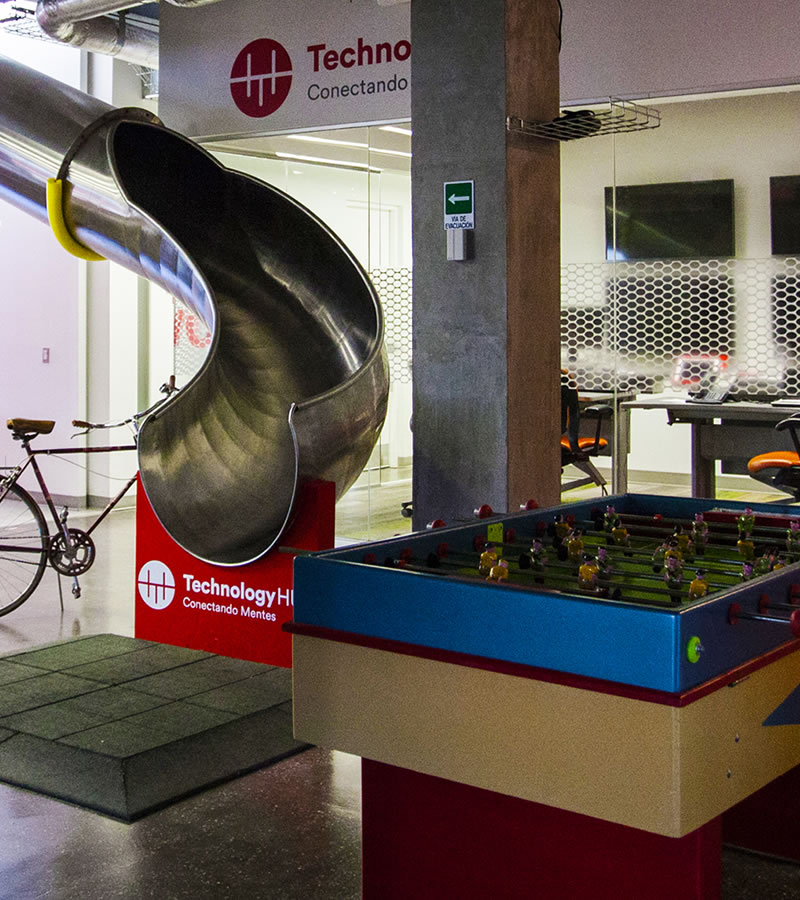
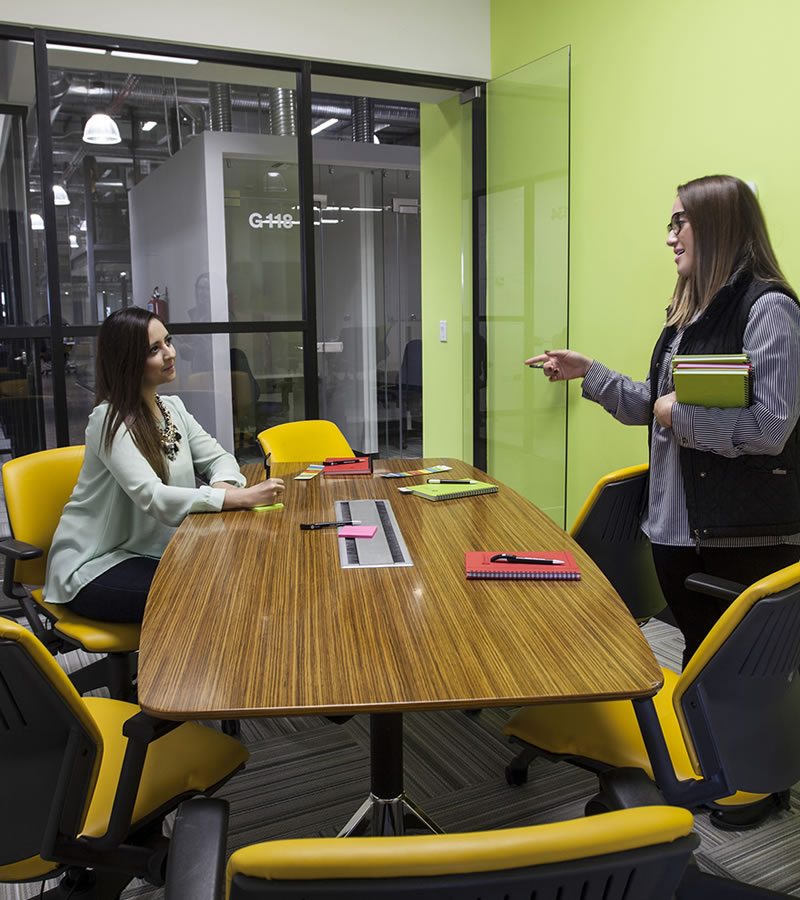
The setting matters beyond its novelty. Technology HUB serves a border economy, with manufacturers, suppliers and professionals moving between Mexico and the United States. It borrows the campus vocabulary of Silicon Valley, but its business opportunities are rooted in what this region already does. Manufacturing supplies a demanding audience for all that entrepreneurial enthusiasm.
02 / The office is the entrance
The workspace offer begins with furnished offices advertised from US$300 a month, subject to availability. Internet, utilities, reception during office hours and controlled access are included in the published package. Meeting rooms can be rented by the hour or day. An entrepreneur can buy a manageable workplace before committing to the complications of maintaining an office independently.
advertised office starting price*
listed supplier-program fee*
Other customers arrive with different problems. Corporate teams need training. Professionals need certification exams. Companies need software. Event organizers need rooms. Technology HUB offers technical courses, a Pearson VUE testing center, application development and event spaces. Its software service names Telcel, Claro and Oxxo among clients; those names belong to that service, rather than a claim that every company occupies the campus.
This combination makes the business harder to compare with an ordinary landlord. A conventional office provider competes on location, price and amenities. A training company competes on teaching. Technology HUB brings those purchases into proximity. The plausible advantage is convenience and repeated contact: someone you meet through one service may become useful in another. Proximity creates possibilities; it does not sign contracts.
03 / Follow the purchase orders
That distinction explains The Bridge Accelerator, launched in 2019. The program prepares regional businesses to supply large manufacturers. Microsoft and Pioneers 21 became partners. A 2024 World Bank report describes a twelve-week program, offered twice yearly and then managed by FUNAX. Its participants are small and medium-sized businesses with industrial ambitions, a more specific audience than anyone with a promising pitch deck.
Microsoft’s account of the original ten-company pilot offers a useful measure of progress. The participants secured 52 new purchase orders totaling nearly US$1.4 million and created 33 regional jobs. In October 2019, Microsoft announced US$1.5 million in support to extend the work. That commitment funded a program; treating it as a venture financing round for the campus would obscure what happened.
By February 2024, a program update reported eight cohorts involving 90 businesses, more than US$85 million in facilitated sales and over 750 new jobs. These are cumulative, self-reported program outcomes. They are not Technology HUB’s revenue, and they should not be mistaken for a measurement of what each participant gained. Still, the choice of metric tells you where attention is directed: toward actual commercial relationships.
04 / An introduction cannot buy materials
The obstacle appears after a buyer becomes interested. A supplier may need equipment, materials and enough cash to carry production before payment arrives. Vázquez described projects escaping Juárez because businesses lacked the financial support to handle operations worth several million dollars. Training can improve readiness. A connection can open negotiations. Neither automatically pays the production bill.
“We were really divided.”Ricardo Mora, speaking in 2018 about the city’s need to reconnect.
That is the condition worth examining before copying this model. An industrial accelerator needs nearby demand, capable suppliers and a route to financing. A handsome building without those relationships would have a much thinner proposition. The transferable idea is to start with the buyers a region already has, then organize the practical help smaller firms need to serve them.
05 / Leave room for the next generation
The campus also works on a longer timetable. Affiliated Fab Lab Juárez offers fabrication tools including 3D printing, laser cutting and CNC. Through FUNAX, education programs reach students and underserved communities. These activities address a different customer and a different horizon: people learning what they might eventually make, rather than businesses pursuing their next order.
By August 2026, the company was promoting an app for reserving rooms and events, while reporting a presentation pairing sculptor Sebastian with physicist Gerardo Herrera Corral. The combination is revealing. This is a property business with industrial connections, educational ambitions and room for culture. Its useful lesson is modest enough to travel: give existing local talent more occasions to meet the people who need it.