The first clue was on the logo. When Aticco opened in Barcelona in 2016, its branding included the words “startup incubator.” The business sold somewhere to sit. Its founders were already thinking about what might happen after people sat down.
- Flexible offices are the core; housing and startup support widen the offer.
- Membership buys access and activities. Useful connections still require participation.
- Startup Booster’s published terms include equity. The coffee is the cheaper commitment.
The attic had an incubator in mind
Gabriel Espín, Franz Pallarés and Juan Carlos Morales found an attic in a former court building on Ronda de Sant Pere. The Spanish word, ático, supplied the name. Friends, family and other stakeholders participated in early backing. It is a pleasing origin for a company that would make introductions part of its sales proposition: the first useful network helped get the doors open.
There was a practical problem beneath the romance. A freelancer needs reliable internet. A young company needs room to change size. Neither necessarily wants to manage an office. Aticco offered shared infrastructure, then added occasions for its occupants to meet. A terrace can attract a tour; a recurring breakfast gives someone a reason to return.
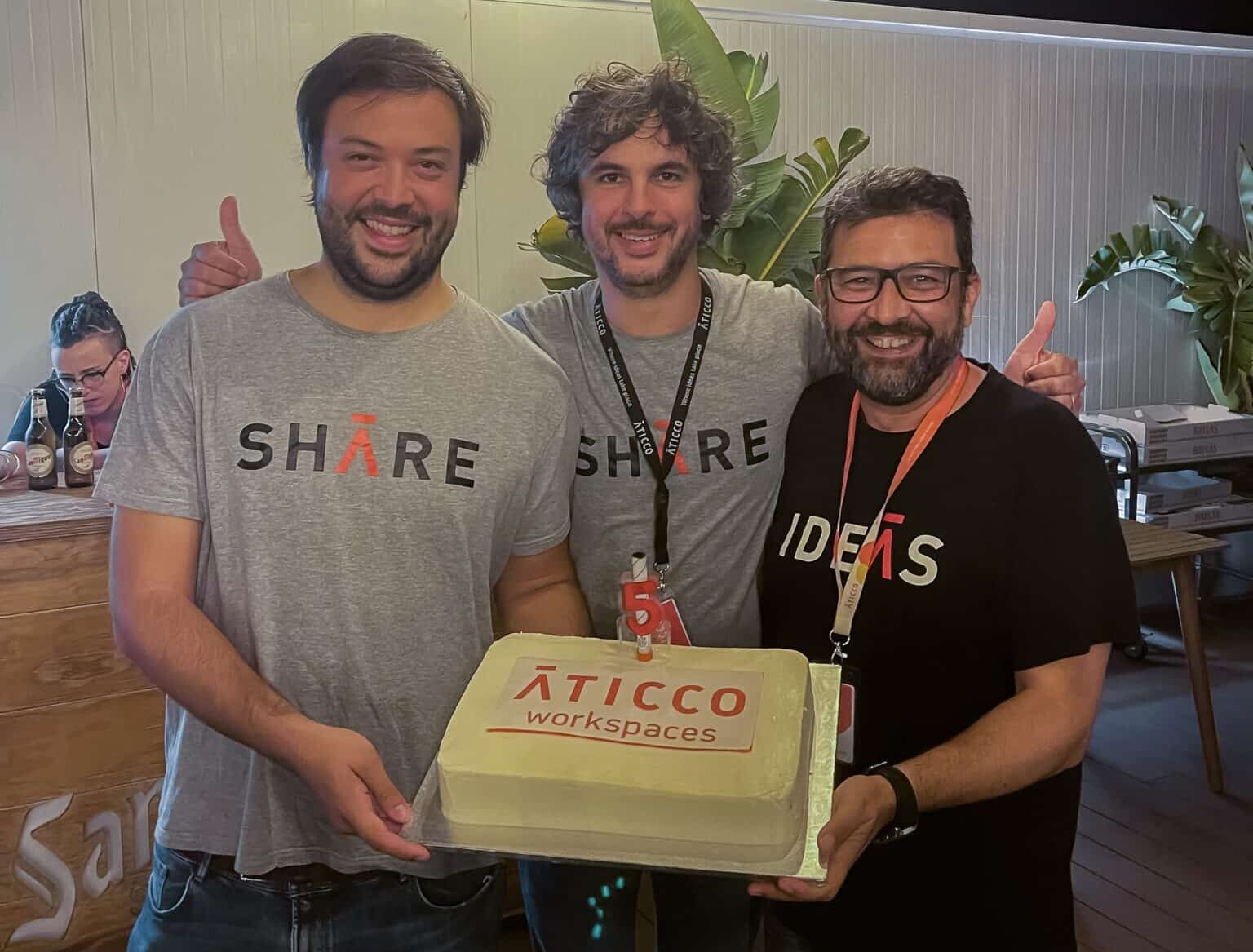
By 2020, the company’s anniversary account says, it had five Barcelona buildings and was preparing its first Madrid centre. Then the pandemic attacked the assumption underpinning every shared office: people would keep coming in. Aticco’s retrospective describes that interruption as an opportunity to broaden its offer. Coliving and Aticco Lab arrived that year. The incubator ambition acquired an operating business.
An office invoice, with a social life attached
Today the menu runs from hot desks and dedicated desks to private offices, customised corporate spaces, meeting rooms and event hire. Freelancers, startups and remote corporate teams can choose different amounts of permanence. The expertise is operational: design the space, keep it working, handle the everyday services and organise the community calendar.
The published general plans FAQ lists a day pass at €35 plus VAT and Flex membership at €220 plus VAT. Those figures conceal an important distinction. Recurring memberships include round-the-clock access, a mobility programme and a minimum two-month contract. Short-use passes have restricted hours and location rights. Someone attending occasionally should count actual working days before falling in love with the furniture.
Aticco’s homepage reports more than 7,500 members and 400 companies. Revolut and Podimo appear in its customer testimonials. These examples matter because coworking is often pictured as a room of solo entrepreneurs. Established teams also buy flexibility, service and somewhere agreeable for colleagues to gather.
“Aticco is an extension of the team.”Isabel Salazar, Podimo Spain country manager, in an Aticco testimonial
Aticco Living addresses a neighbouring problem: professionals arriving in a city need accommodation as well as office space. It bundles furnished housing with utilities, cleaning and activities. The company’s January 2026 retrospective reported more than 600 units and a Corporate Talent House concept. The commercial logic is understandable. A relocated employee has several recurring needs; supplying them together can reduce the number of arrangements they must make.

The stock exchange gets new neighbours
Barcelona Finance Hub, opened in 2024, gives the model a narrower audience. It occupies space in the stock exchange building on Passeig de Gràcia and brings financial businesses, startups and investors into a specialist community. Early reporting put investment in the first 1,000-square-metre phase at €1.5 million.
Its pricing makes an unusually useful distinction. Annual community memberships are advertised separately from coworking plans. You can join the financial conversation without renting a daily workstation. In May 2026, Aticco announced eToro as a Global Partner, with investment education among the proposed activities. The differentiator is the selection of neighbours and programming around their interests.
That places Aticco alongside flexible office alternatives such as WeWork, Regus and Spaces, while its related businesses extend the comparison. A prospective customer can also assemble an office, housing and startup advice separately. Aticco’s argument is convenience and connection. Whether the bundle wins depends on which pieces the customer actually uses.
Mentorship has a price, too
Startup Booster turns introductions into a more structured arrangement. Its current offer requires an operational product already in the market and at least one person working full-time on the venture. Selected teams choose three to five mentors to form an advisory board. Meetings run monthly, with the startup CEO leading them.
The published participation terms specify a negotiated 2% to 5% equity allocation to Aticco Lab and mentors, with an exception for a qualifying Leyton Impulse scholarship recipient. Investment of up to €100,000 is advertised, subject to progress and selection. That is a ceiling, not a cheque handed to every applicant. A founder should assess the advice and dilution together.
In September 2026, Aticco Lab announced its integration with Muutos. Anna Busquets, Muutos’s founder, became CEO; Quino Fernández moved to president. The announced scope includes established businesses and institutions, carrying the innovation offer beyond the familiar startup-and-corporate pairing.
A bigger room is still a bet
Expansion required capital. A €10 million round announced in April 2024 brought in GCO Activos Inmobiliarios and family offices, while the founders retained majority control. By March 2026, Diagrame had opened in Barcelona’s 22@ district with roughly 20,000 square metres. Aticco reported 75% occupancy in May. Size supplies more possible neighbours; it also raises the stakes of keeping them.
The community promise has faced scrutiny, too. In July 2026, a language-rights organisation complained about a dismissed employee’s treatment over Catalan use. Aticco denied a language-based dismissal. Around 40 staff subsequently defended its multilingual practice. The dispute deserves acknowledgement alongside the company’s upbeat account of its culture.
The transferable lesson is practical: organise repeated opportunities for relevant people to meet, then make participation easy. It works poorly for someone who needs solitude, rarely attends or has no use for the adjacent services. The attic’s original proposition survives at a larger scale. A desk provides the address. What happens nearby determines how much that address is worth.
Step inside
Explore Aticco’s spaces, compare plans and access, or visit Aticco Living, Startup Booster and Barcelona Finance Hub.