A landlord usually wants you to stay put. At Level39, outgrowing your desk is part of the proposition. A founder can arrive with a laptop, move into an office and eventually become a tenant elsewhere in Canary Wharf. The property owner can keep the relationship through every move. In a business crowded with talk of disruption, this is a pleasingly understandable incentive: help small companies become customers for bigger rooms.
Level39 sells that progression alongside the everyday necessities of work: desks, meeting rooms, internet access and somewhere to take a call. Its distinguishing asset is the surrounding financial district, plus a team that connects members to advisers, investors and other businesses. The view gets people’s attention. The useful introduction is what might justify the bill.
A property bet with a fintech address
Canary Wharf Group opened Level39 on March 18, 2013, with Eric van der Kleij as its founding head. The choice of location gave the project a specific commercial purpose. Young financial-technology businesses would operate close to institutions that might buy their products. In the original conception, retail businesses could also find testing opportunities in the estate’s shopping centres, while urban technology could connect to its development plans.
“If the start-ups are successful, so will CWG be: it’s a nice alignment.”
Eric van der Kleij · Founding head · 2013
The early model included subsidised space and sponsored accelerator programmes, without requiring participating companies to surrender equity. By December 2013, van der Kleij reported 66 accepted members from more than 450 enquiries.
That history helps explain a sometimes confusing label. Level39 has been called an accelerator, an incubator and a coworking space. Today, its public offer is organised around paid memberships. A company buys a working environment and access to activities and connections. There is no reason to mistake a membership application for a funding round.
Two desks make a good opening scene
Revolut supplies the recognisable name. Level39’s account places its founders at two hot desks in 2014, before the financial app’s launch. By 2017, the company occupied a 45-desk private office in the community’s High Growth Space:24. In February 2018, it moved to Westferry Circus as a Canary Wharf Group tenant.
The sequence makes the property argument visible: a small starting commitment, more room as the team expands, then a conventional tenancy. It does not establish that a particular workspace produced Revolut’s growth. The founders still had to build the product, win customers and execute. An address can support those activities; it cannot claim ownership of them.
Datatonic offers a less glamorous, more useful account of the same arrangement. The data and AI consultancy arrived in 2015 with coworking memberships, moved into a small office and kept changing its footprint. Founder Louis Decuypere recalled: “We took around 7 different office configurations scaling up to 100 people”. In 2023, the business graduated into a Canary Wharf tenancy.
For an expanding employer, those changes matter. Too much space ties up money in empty seats; too little makes hiring a facilities problem. Datatonic’s experience suggests that continuity can survive repeated moves when the operator has somewhere else to put the team. The relationship remained useful after the original room stopped being useful.
A sequence of moves, not a measure of Level39’s contribution to company growth.
The monthly bill, minus the mystique
The published entry prices make the offer easier to evaluate. Community Membership starts at £300 plus VAT a month and includes a place to work for up to five days monthly. Coworking starts at £440 plus VAT, with 24/7 access. Private Office Membership starts at £700 plus VAT per desk each month. Those are starting prices checked in September 2026, rather than a bespoke quote.
At the office starting rate, five desks mean £3,500 a month before VAT, or £42,000 across twelve months. That arithmetic is a useful pause in any tour. A founder should be able to explain what the location, support and flexibility will contribute to the business before treating the expense as inevitable.
Your team, at the starting rate
£700 × desks. Excludes VAT and extras. Illustrative arithmetic, not a quote or statement of contract length.
The coworking details are practical: reserve a hot desk through the app, book meeting rooms, use the member pantry and join curriculum sessions. Café39’s prepared food and barista drinks cost extra. The workspace is for members, although prospective applicants can request a trial day. Testing the commute and spending an ordinary working day there is a better purchasing exercise than admiring a photograph.
The people between the desks
Level39’s directory extends beyond fintech into cybersecurity, data and AI, healthtech, sustainability, education and other specialisms. Its March 2026 anniversary account names eToro, Fuse Energy, Sanius Health, D2 Legal Technology and Gemba among the businesses it supports. That breadth gives a founder more potential neighbours, although membership alone says little about which relationships will become commercially useful.
The operator reports more than 180 businesses across 60,000 square feet. Its annual activity figures include over 260 events, more than 14,000 attendees and upwards of 40 international trade missions from over 20 countries. These are measures of activity. A crowded calendar gives members opportunities; the number of events does not tell a buyer how many customers they will win.
The work also has a human scale. Eleven dedicated staff, supported by Canary Wharf Group departments, cover membership, events, operations and other functions. MentorHours, investor sessions and workshops provide structured encounters. The quieter task is knowing enough about a member’s problem to make a relevant introduction.
International programmes add another use for the address. Innovation Norway’s Tech Executive Accelerator has operated at Level39 since around its launch, according to a 2024 account. For a visiting business, a London base can be most valuable when it comes with people who understand the local commercial landscape. The office is fixed; the relationships travel.

Why there is a treat at three
The membership comparison includes a 3pm treat. It is a small detail, and a revealing one. Shared refreshments give people a reason to leave their screens without having to announce that they are networking. Formal meetups do the more deliberate work: a January 2025 gathering opened the community to neighbouring Canary Wharf businesses, with brief member pitches and a roaming microphone.
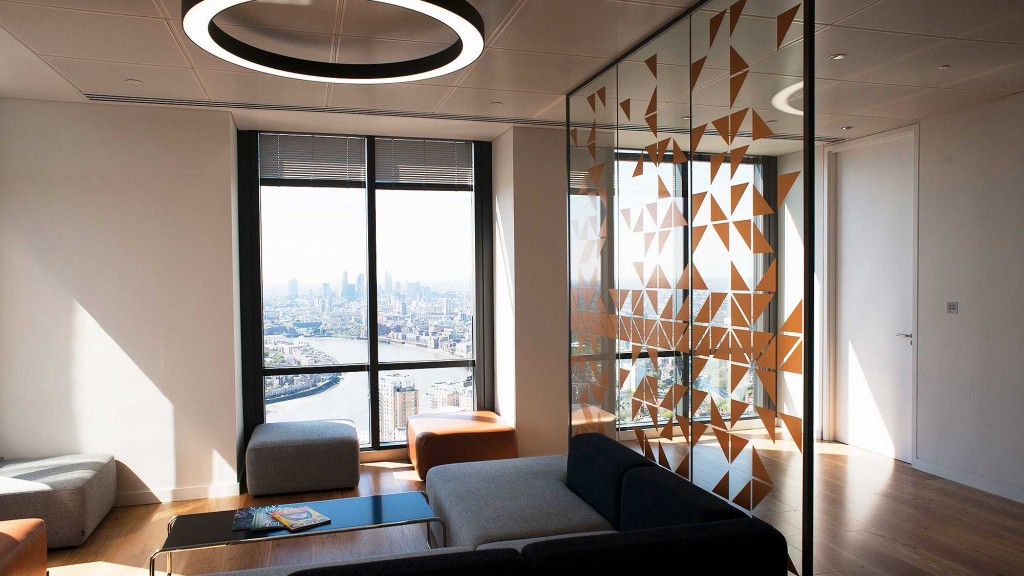
The building’s design anticipates different kinds of encounter. Gensler’s original scheme combined shared working areas, offices, breakout spaces and rooms for meetings and events. Before opening, the architects even used illuminated, laser-cut cardboard panels to turn the unfinished space into a preview venue. The professional surroundings began with a little theatrical improvisation.
Hospitality is also a product in its own right. The Sandbox accommodates 200 in theatre format; the GROW Boardroom seats 20; Space39 can hold 250 standing guests for evening events. Venue hire creates another customer group: organisers who need somewhere to convene a conference, launch or discussion. It also brings people into the building who might otherwise never encounter its members.
When movement stopped
A useful company profile needs something harder than the success stories. In May 2020, member YourParkingSpace described how its rapid growth collided with lockdown. Its business depended on people moving around. Founder Harrison Woods recalled a record growth week in March followed, just seven days later, by preparations for the national shutdown.
The first response was financial housekeeping: paying suppliers and reassuring staff that the company could cope. Then the team reconsidered its product and worked with supermarkets, retail parks and private-space owners to offer free parking to NHS workers. It reported more than 20,000 NHS subscribers. The same account acknowledged the limit: free spaces could not remain available indefinitely when commercial activity resumed.
Fellow member CybSafe approached disruption through rehearsal. It had previously tested home working around transport problems and ran a two-week remote trial as other countries entered lockdown. The UK shutdown arrived just before the planned return. Chief executive Oz Alashe emphasised deliberate communication to keep people together. Both accounts put responsibility where it belongs: with the company’s own decisions, even when it belongs to a supportive community.
Buy the introductions you can use
For a prospective member, the comparison is concrete. A conventional serviced office can provide desks and meeting rooms. Remote working removes the need for a shared address. Level39’s case becomes stronger when a business needs repeated contact with financial institutions, technology peers or advisers, and has people willing to participate.
The lesson for other workspace operators is equally specific: start with nearby customers and build activities around their needs. Give growing teams somewhere to move. Treat introductions as work someone must organise, rather than something the furniture will produce. Level39’s February 2026 newsletter, with its CEO breakfast and applied-AI discussions, shows that the convening continues long after opening day.
For a founder selling to large organisations, an introduction is only an opening. The next meeting still needs a clear offer, a credible demonstration and a reason for the buyer to act. Those are sensible things to prepare before asking a community manager to make the connection.
A founder can copy the discipline without copying the postcode. Arrive with a list of people to meet and problems to solve. After a trial or an initial period, count useful conversations, follow-up meetings and time saved. If customers are elsewhere, the commute is punishing or the team will rarely attend, the membership becomes harder to justify. A skyline looks much the same whether the business case works or not.
Take the next lift
Explore Level39, compare memberships, browse the community or catch up on Inside Level39.