The most revealing thing about ROCKIT may be the room it inherited. In 2016, Barclays opened Rise Vilnius, a place for financial technology companies to work and meet. Three years later, Barclays was withdrawing from Lithuania. Swedbank bought the centre. The agreement required a new name. On 1 July 2019, the desks acquired a different sign above them: ROCKIT.
- Startup mentoring, coworking and introductions to corporate partners.
- An eight-week programme for teams already working on an MVP.
- A Vilnius base, a Kaunas hub and regional support backed by EU funds.
The bank kept the room
That handover matters. ROCKIT began with an existing community and a financial institution willing to preserve it. At the relaunch, the centre had 34 resident startups and 64 members. New agreements with the European Bank for Reconstruction and Development and Startup Wise Guys added financing and acceleration connections. A change of landlord became a change in the possibilities available to the tenants.
The early mechanism was concrete. Wise Guys Fintech 3 brought ten teams from seven countries to a four-month programme in Vilnius. Initial investments of €30,000 to €100,000 were planned for their ideas. Swedbank offered workspace, expert access and encounters with bank employees. Those investment figures described that accelerator cohort, rather than an automatic cheque for anyone renting a desk.
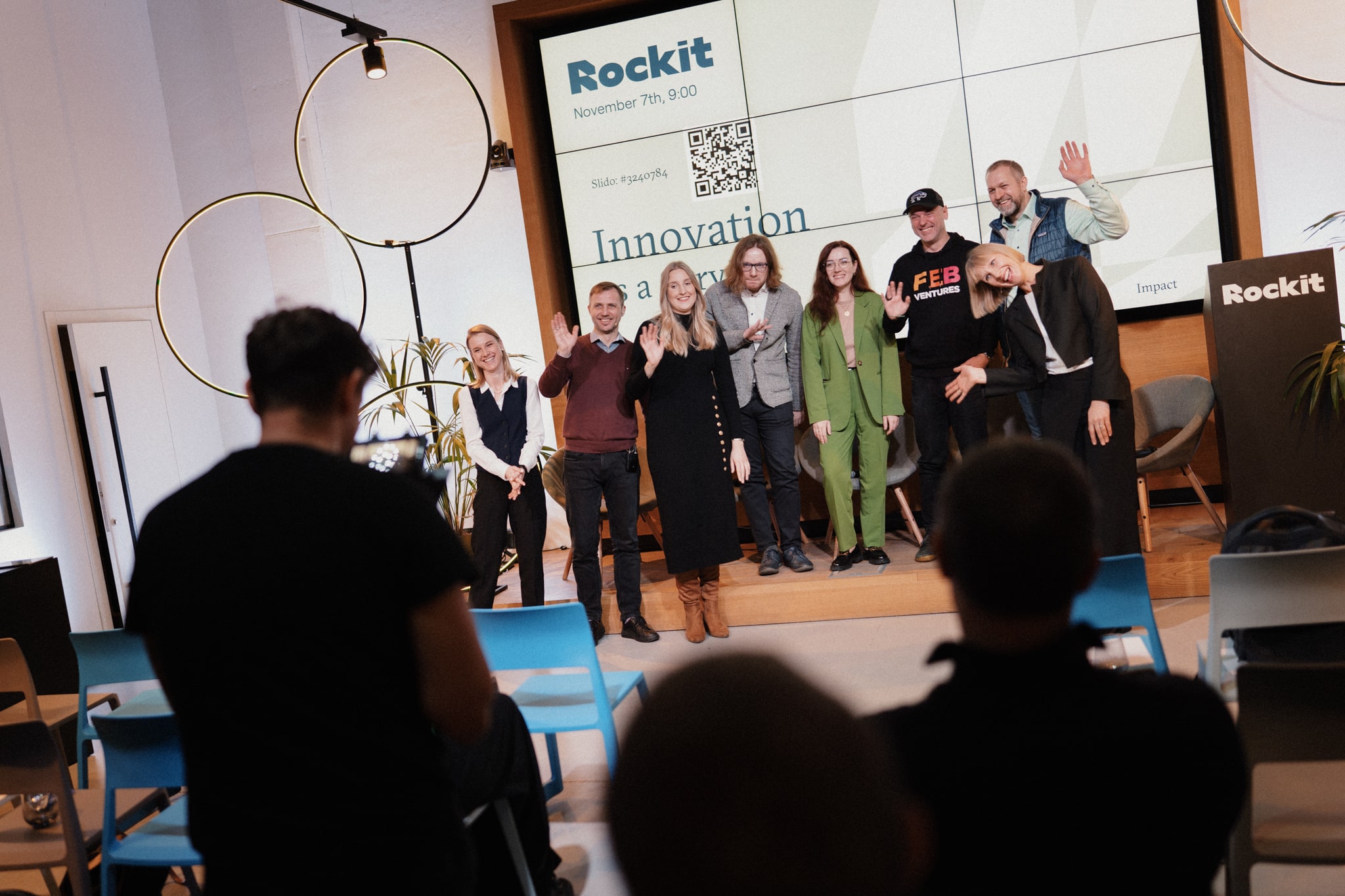
Eight weeks to stop guessing
Today, ROCKIT welcomes startups across industries and stages, with particular attention to early-stage teams. Its fifth pre-accelerator batch runs from 6 October to 26 November 2026. FIRSTPICK, the Baltic venture fund and accelerator, supplies programme content. The format mixes online and on-site work, individual mentoring and meetings with other founders.
The intended participant already has an MVP: a minimum viable product that can be tested. Eight weeks provide a timetable for validation, digital learning materials and live mentor sessions. A Progress Day at Tech Spa in Druskininkai adds a gathering outside the ordinary office routine. The programme puts a calendar around work that founders can otherwise postpone indefinitely.
A February 2026 interview published by ROCKIT offers a useful explanation of the problem. Domantas Patinskas of Kiloverse described founders who cling to assumptions: “They hold onto their idea for too long without adapting it to reality.” A good mentor makes that attachment harder to maintain. The practical lesson is to bring something testable, then listen when the evidence inconveniences you.
“They hold onto their idea for too long without adapting it to reality.”Domantas Patinskas / ROCKIT interview, February 2026
The introduction has a price tag
ROCKIT occupies the space between a coworking operator and a startup support organisation. Founders can buy community access, desks or private office space; the platform also offers event facilities and a podcast studio. Its published menu lists community membership at €120 per person, a flexible desk at €150, and a dedicated desk at €250, excluding VAT. Founders should confirm billing terms when applying.
The distinction becomes interesting when someone needs a potential customer. ROCKIT describes routes into Swedbank through strategic partnerships, proof-of-concept programmes and innovation events. The bank’s stated areas of interest include fintech, sustainable technology, data, e-commerce and AI. For a team building something relevant to those needs, an introduction can be more useful than another afternoon spent polishing a pitch.
There is also a targeted subsidy. Swedbank offers selected sustainable-innovation startups three months of ROCKIT coworking membership. Applicants must have a Swedbank business account and a company founded within the previous twelve months. Those conditions matter: a perk for a qualifying new business does not establish the price of everyone else’s membership.
Twelve desks, away from the capital
ROCKIT’s regional expansion makes the model more interesting still. Its Kaunas branch opened in November 2025 at Drobės fabrikas, a former factory. The announcement specified twelve flexible desks. The promise attached to them included mentoring, pre-acceleration, community activities and consultations with market experts. Twelve is a pleasingly modest number. You can imagine the room without consulting an economist.
Behind the expansion sits a larger effort. STARTUOLIS runs from February 2024 to February 2027, supporting central and western Lithuania through hackathons, pre-acceleration and incubation. Its stated objective is to reduce the innovation gap between the capital and other regions. The published project value is €979,567.09, with funding of €832,632.03. This is a regional programme budget, not ROCKIT’s valuation.
Total project value

Results worth reading carefully
The alumni give the broader remit substance. ROCKIT’s 2025 review highlighted SensePilot, which develops hands-free computer control, and Luna Robotics, which develops imaging systems for FPV drones. It reported that programme alumni collectively raised or won more than €1.5 million during the year. Investment, grants and prizes share that total. It measures reported alumni progress; it cannot tell us how much progress the hub caused.
External recognition offers another view. In March 2026, Swedbank reported that ROCKIT placed 47th overall in the Financial Times European startup-hub ranking, and sixth for mentoring. The narrower result is the revealing one. Mentoring is a service a founder can experience directly: someone examining a problem closely enough to ask a better question.
Its convening work now reaches beyond its own desks. ROCKIT and Startup Lithuania co-organised Startup Fair on 17 September 2026. Event reporting counted more than 2,000 participants, 450 startups and 430 investors. Earlier that year, an EBAN Recharge session reversed the usual ceremony: eight investors pitched, while founders supplied jury feedback. Even finance benefits from occasionally swapping seats.
A room is only the beginning
A founder choosing among coworking spaces, accelerators and bank innovation programmes should start with the next obstacle. Need regular mentoring for an MVP? Examine the cohort. Need somewhere to work in Kaunas? Look at the desks. Need a corporate pilot? Ask whether the product fits a partner’s priorities. These are different purchases, even when one organisation helps arrange them.
ROCKIT’s example is useful to anyone building a startup community: combine a place to return to with scheduled work and people who have a reason to help. Introductions need follow-through; validation needs contact with customers. The clever part of the room is what it makes easier to do after you leave it.