Ross Kinsella had a peculiar problem. He was living in Dublin and wanted a startup life in Galway, his hometown. In PorterShed’s account of his experience, the FleetOps member recalls thinking the programmers he needed were somewhere else. Then a shared workplace appeared, and people who had seemed absent became visible. The useful discovery was other people.
- PorterShed pairs Galway workspace with practical help for technology businesses.
- A day desk costs €30 excluding VAT; regular desks start at €300 a month.
- Its ambition reaches beyond occupancy: help companies grow while keeping opportunity in the West.
The desk was a way to find each other
There is a familiar regional dilemma here. A city can have graduates, experienced engineers and promising companies, yet still feel short of opportunity to someone starting out. Talent scattered across offices and kitchen tables is difficult to recognise as a community. PorterShed’s origin suggests a practical response: give those people somewhere to turn up.
Galway City Innovation District was established in 2015. PorterShed opened the following May behind Ceannt Station. Its founders included Maurice O’Gorman, Mary Rodgers, John Breslin, David Cunningham and Conor O’Dowd. The purpose was to make staying in Galway compatible with an ambitious career. Multinational companies also needed somewhere to land on Ireland’s west coast.
“there was a place in my hometown”
Ross Kinsella, FleetOps, on finding his startup community
Under CEO Mary Rodgers, the offer combines workspace with mentoring, programmes and introductions. Its operating team handles the daily work; a voluntary board helps steer the organisation. That arrangement matters because introductions require someone who knows both the person asking and the person who might help. Coffee machines have yet to acquire that skill.

An old newspaper office gets a new assignment
The physical experiment expanded. Bowling Green opened in March 2022; Market Street began operating that October, followed by a formal ministerial opening in April 2023. The latter occupies the former Connacht Tribune office. A building once concerned with recording Galway’s activities now accommodates people hoping to add a few of their own.
Enterprise Ireland reported more than €2.9 million in public funding behind PorterShed a Dó. That figure is a grant contribution, rather than the full cost of the transformation. AIB has backed the organisation since its inception, while partners including KPMG, the Western Development Commission and SIRO/Vodafone support different parts of the operation.
The commercial offer is straightforward. Buy a contract-free hot-desk day, take a dedicated desk, or discuss hybrid and corporate arrangements. Virtual office membership supplies a business address and mail handling. Meeting rooms, privacy booths and podcast facilities handle the less glamorous requirements of work: having a confidential conversation, assembling a team, or recording something without the washing machine joining in.
PorterShed sits between the ordinary office market and startup development. Members and alumni have included Altocloud, now part of Genesys, Diligent and Rent the Runway. XOCEAN describes using the Bowling Green gigabit connection for surveyors operating around the world. The local address can support work whose geography is considerably less local.
The AI programme asks who will pay
In May 2025, PorterShed announced AI Venture Forge, a twelve-week accelerator for businesses with AI at the centre of their products. The inaugural group comprised ten teams. Its launch described access to MIT’s Orbit entrepreneurship platform and computing support from the Irish Centre for High-End Computing. These are specific resources a founder can use, rather than another invitation to feel inspired.
The current programme moves through customer discovery, production, commercial design and fundraising preparation before Demo Day. Six months of PorterShed membership is included. In-person participation gives the programme a clear practical condition: the team must be able to spend time in Galway. A distributed company seeking occasional online advice would need to consider a different format.
- 01Discover
- 02Build
- 03Price
- 04Pitch
- 05Demo
Read that sequence as a theory of where technical ambition meets trouble. A working model still needs a customer, a price and a viable cost of serving that customer. The programme makes those questions scheduled work. Its earlier NDRC involvement also connects PorterShed to a national startup network, giving Galway founders routes beyond their immediate neighbours.
Count the jobs carefully
The tenth-anniversary Spark recap reports 3,064 jobs across member and alumni companies, alongside growth of 638 member jobs since joining. Those figures answer different questions. The first describes the employment footprint of a group of businesses. The second describes a change after arrival. Neither, by itself, proves that a shared office caused every job.
Jobs across member and alumni companies
Additional member jobs since joining
That distinction makes the case more interesting. The organisation operates as a not-for-profit, with memberships, facility bookings, sponsorship and public support contributing to its model. Its own account welcomes members growing beyond the hub. A landlord usually prefers you to keep paying rent. Here, an eventual departure can be a satisfactory result.
Borrow the habit, then build the network
For a founder, the sensible first experiment is modest: try a day desk or book a tour, then assess the people and programmes around it. Ask whether the relevant expertise is accessible. A handsome room cannot substitute for customer demand, and a technology-focused community will have more to offer some businesses than others.
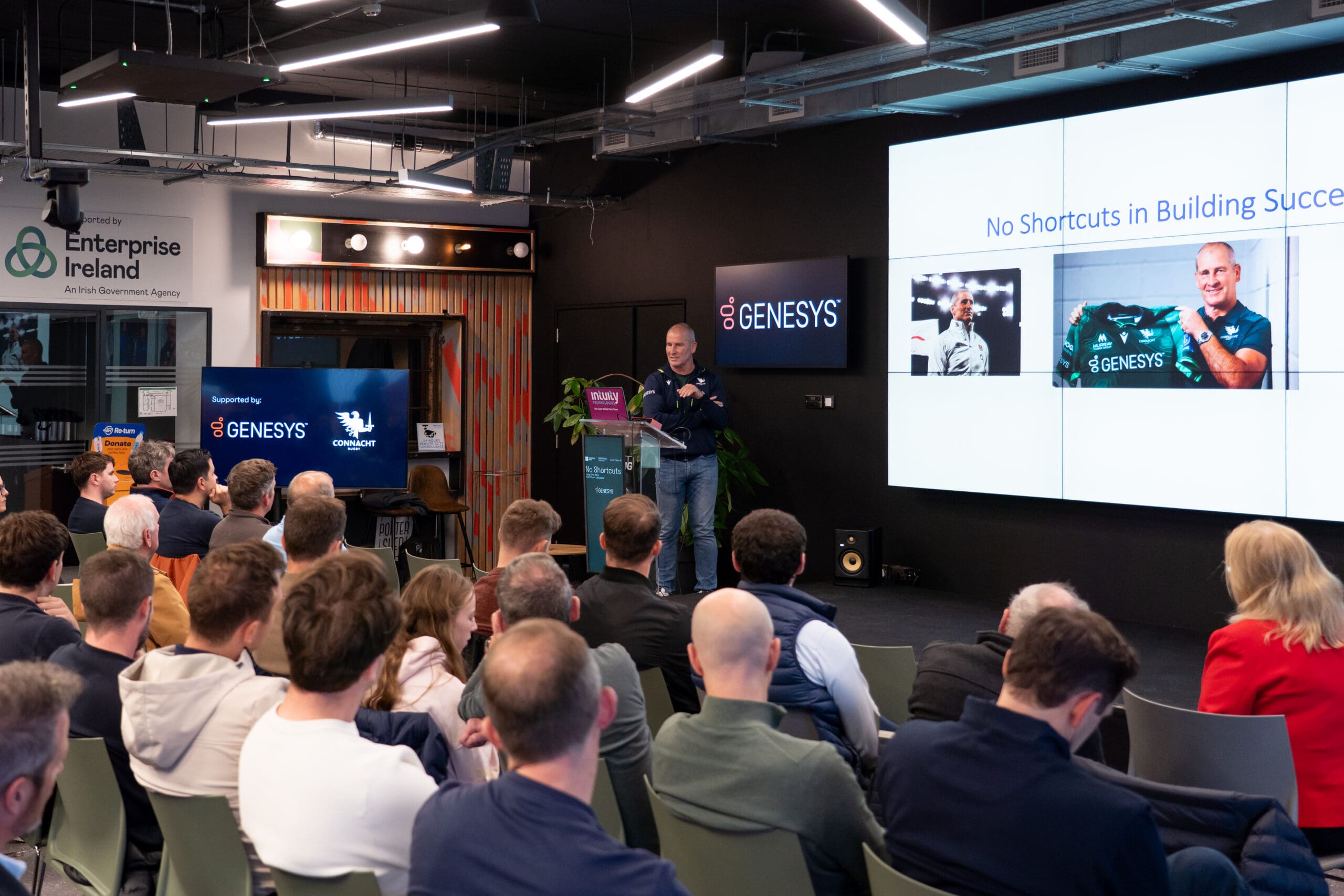
For another town, the transferable idea is to make existing talent easier to find, employ people who keep connecting it, and build relationships that reach outside the region. My reading of PorterShed’s story is that the premises enable the habit; the repeated encounters give it value. Replication would depend on committed operators, relevant businesses and backing that survives beyond an opening party.
The habit now extends to younger builders. PorterShed’s August 2026 FutureHack account describes more than 80 teenagers tackling Galway’s practical problems. A shared address gives them somewhere to try. Whether the next company begins with an engineer returning home or a student’s pitch, the useful invitation is the same: come in, find your people, get to work.