An exoskeleton can help someone walk and still need help getting through a hospital’s purchasing process. In Catalonia, ABLE Human Motion’s robotic devices reached six public hospitals through a tender. Biocat says its Healthcare System Access Program helped the company develop the technical and strategic capabilities to compete. The engineering belonged to the company. The route to adoption required another kind of expertise.
That is a useful introduction to Biocat, the Barcelona foundation whose work takes place between scientific discovery and the people expected to use it. Its territory is full of research, startups, hospitals and investors. Its assignment is to help those groups do business, develop talent and get worthwhile innovations into care. Sometimes that means an accelerator. Sometimes it means finding the right people to discuss a purchasing problem.
For a health entrepreneur, the distinction matters. A promising prototype and a functioning business are separated by questions about evidence, budgets, workflows and responsibility. Biocat has built much of its current strategy around that difficult stretch.
The hospital door is a separate problem
The access problem became a formal assignment in 2022, when the Catalan Ministry of Health asked Biocat to coordinate an expert subcommittee on accelerating adoption. PASS, the resulting program, was publicly launched in 2024. Its practical architecture includes a platform listing innovations, a navigator for available resources and programs, and a support unit for prioritized technologies.
That architecture gives each side somewhere to start. Innovators can seek guidance on what the system needs. Healthcare organizations can find technologies through a shared registry. Biocat works alongside the ministry, CatSalut, the assessment agency AQuAS and TIC Salut Social Foundation. Putting those organizations into the process makes adoption a shared task rather than leaving every startup to reconstruct the route alone.
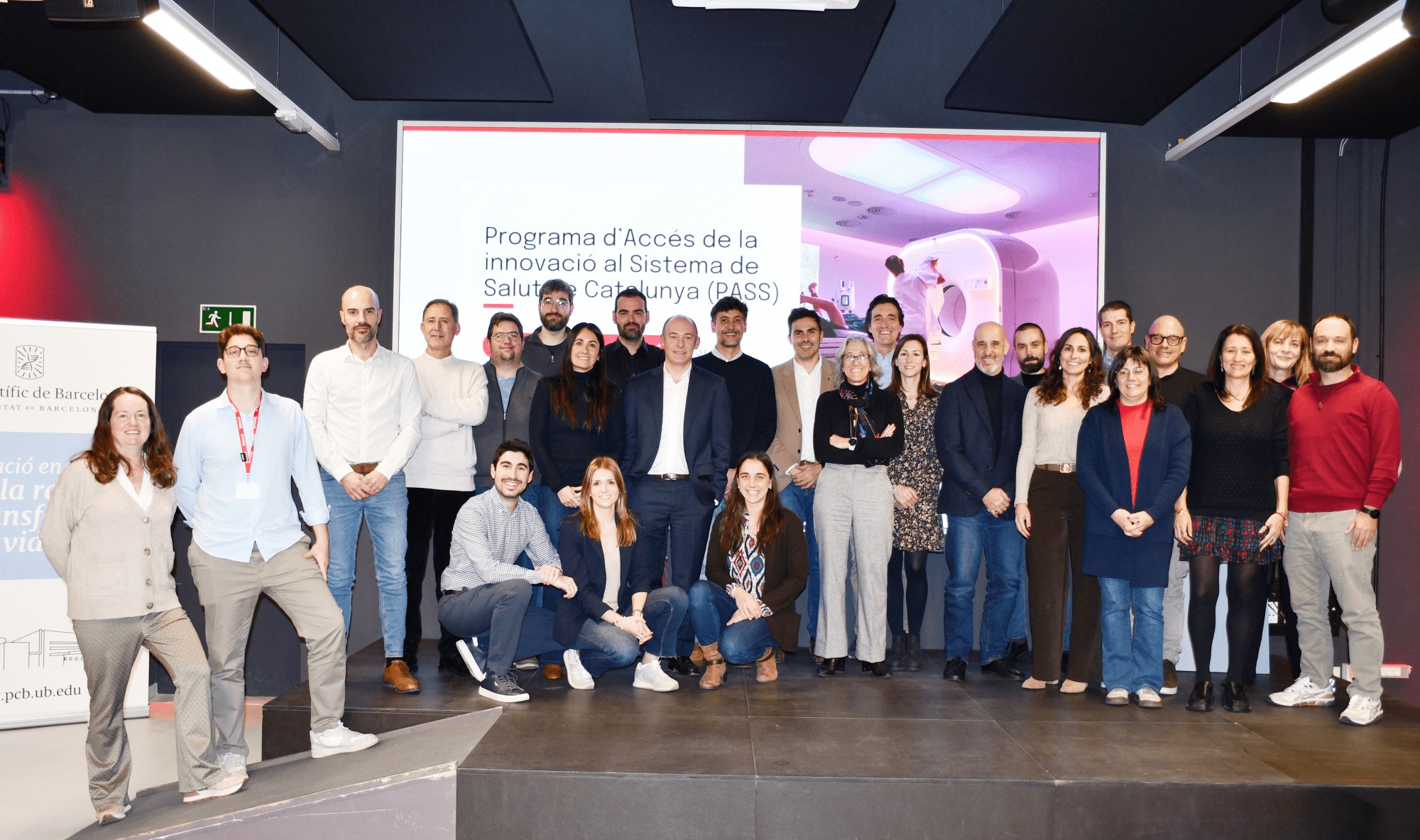
The first INNOPASS call, part of PASS, selected ten initiatives from 61 applications in 2025. Each received an Innovation Passport giving access to a year of personalized support. The cohort included Mediktor, MiWEndo Solutions and Inbiomotion, alongside other diagnostic, biotechnology and digital health proposals. Selection recognized maturity and potential relevance to the system. It did not amount to a purchase order.
By January 2026, participants were describing the difficulty in unusually practical terms: fragmented routes into care, integration with existing systems, cost efficiency and scaling beyond individual pilots. Biocat’s account of the meeting reported that adoption had become the central challenge for these mature solutions. The obvious lesson for founders is to investigate implementation while they can still change their product.
- 01FindInnovation platform
- 02NavigateTools and programs
- 03GuidePrioritized support
Support makes the route clearer. Evaluation and purchasing still matter.
Twenty years of connecting the dots
Biocat began in 2006 at the initiative of the Government of Catalonia and Barcelona City Council. The distinction between its name and its territory is worth keeping straight: Biocat is the public-private foundation; the BioRegion of Catalonia is the much larger life sciences and healthcare ecosystem. The foundation’s work benefits that ecosystem without making every company in it a customer.
Its position is unusual because it serves several constituencies at once. Researchers need help transferring knowledge. Startups need validation, capital and access. Hospitals need solutions that fit care delivery. Investors need a legible supply of opportunities. Biocat’s expertise lies in knowing the organizations, their capabilities and the steps between them. Its published values emphasize collaboration, credibility and efficiency, qualities that make particular sense for an institution trading in connections.
There are alternatives for individual tasks: a university technology transfer office, a specialist accelerator, an investor network or a market-access adviser. Many can also be collaborators. Biocat combines those connections with a regional public mandate and direct work on health-system adoption. Its usefulness depends on the problem a user brings, rather than on a single product that everybody buys.
The budget is €2.879 million. Read the label.
Biocat reports a total budget of €2.879 million for 2025. That is the foundation’s operating scale, a much more useful number for understanding the organization than the investment totals it reports for Catalonia. Its economic overview groups spending around adoption, advanced therapies, visibility, talent and digital transformation. It also publishes financial information through its transparency portal.
The business model combines institutional support, grants and collaborations with income from some programs. Access to the Health Investment Portal is free. Training and acceleration can carry fees. The result is a mixture of public-interest infrastructure and services for particular participants, with different terms attached to each.
The second figure measures the ecosystem. It is not money raised by Biocat.
The wider sector offers plenty to work with. The 2025 BioRegion report counted 1,650 companies and 94 research institutions; health startups and scaleups secured €517 million in investment. Those figures describe regional activity, not a causal scorecard for the foundation. In presenting the report, CEO Robert Fabregat said, “The challenge now is to continue scaling up,” connecting that ambition to greater adoption and patient impact.
First, find a need worth solving
Biocat’s training starts earlier than the pitch deck. d·HEALTH Barcelona brings people from life sciences, engineering, business and design into multidisciplinary teams. Inspired by Stanford Biodesign, the program asks them to observe clinical practice, identify unmet needs and develop a prototype and business model. Its detailed program describes eight months of part-time work, 220 hours of training and mentoring, and a two-week clinical immersion.
The attraction is access to problems as they are lived. Watching a clinical activity gives an aspiring founder a different starting point from imagining a market at a desk. The program then filters needs before moving into solution development. Readers can copy that sequence even without joining: observe, check whether the need matters, and only then commit to the product.
The tenth edition’s June 2026 graduation showed the range this can produce. Six teams presented proposals addressing subjects including hospital-acquired infections, bruxism, CPAP adherence and advanced Parkinson’s disease. These were development projects presented to investors and experts, a stage at which feedback can still shape what happens next.
CRAASH comes with homework
For teams already carrying a technology, CRAASH Barcelona offers another entry point. The approximately five-month 2026 program focuses on medical devices, diagnostics and digital health, with mentoring from Boston’s CIMIT. Its published price is €1,250 for teams from the BioRegion and €12,000 for teams outside it. That makes geography materially relevant to the decision to apply.
The time bill deserves equal attention. Participation rules say each team should expect to invest 40 hours per week. They specify attendance commitments, mentoring, masterclasses and required interviews. Teams must cover their own travel and accommodation for Barcelona, where applicable, and Boston. A founder evaluating the program should price the calendar as carefully as the fee.
A founder evaluating the program should price the calendar as carefully as the fee.THE PARTICIPATION TEST
The broader transfer work includes meetings with technology transfer offices and Tech Transfer Day, which drew more than 120 participants in its fourth edition in 2025. Those activities address another part of commercialization: research groups, licensees and investors need opportunities to compare needs and capabilities before a formal deal is possible.
A better introduction starts with better filters
The Health Investment Portal turns matchmaking into a service people can use directly. Startups, spinoffs and academic projects can present opportunities for investment, licensing or co-development. Investors and corporate scouts can search, contact technology owners and arrange meetings. Biocat validates registrations, so free access still comes with curation.
The 2025 redesign added filters including regulatory stage, investment ticket size and type of co-development. Those are useful details: two people can both say “health investment” and mean entirely different transactions. The activity report recorded 96 research projects, 64 startups or spinoffs and 165 scouts at launch. These are participation figures, not evidence that every introduction produced a deal.
Advanced therapies take the argument across borders
The same coordination problem extends into advanced therapies. ATMP Catalonia, launched in 2023, brought attention to scattered capabilities, specialized talent, financial sustainability and industrial scale. Its work groups cover subjects ranging from patient access to gene and cell therapies. ATMP Catalyst followed in 2025 to support early projects, with public backing and collaboration from Leitat and Barcelona Science Park.
Biocat also coordinates PRECISEU, a nearly €23 million European project running from July 2024 to June 2029. Its founding consortium brought together 25 partners across 12 European regions. The ambition is to make personalized medicine easier to develop and adopt through work on health data, advanced therapies and the regional systems around them.
In April 2026, PRECISEU launched an €11.57 million funding call. Its terms required interregional consortia, at least one SME and a clear regulatory route to market; support was limited to eligible funding regions. That is a concrete boundary around the opportunity. Neither a compelling idea nor a Barcelona address automatically supplies the required partners, maturity or implementation plan.
Biocat’s twentieth-anniversary event is scheduled for November 2026. The institution has a story to celebrate, but its practical challenge remains easy to recognize. For the next innovator, the useful question is which obstacle needs attention now: identifying a need, validating a business, finding capital or entering care. Biocat has a route for each. Progress still depends on what happens after the introduction.
Follow the work
Biocat website · News · Insights · Investment portal