The revealing detail about TusPark UK is a laboratory waiting list. By 2023, its Bio-Innovation Centre at Cambridge Science Park was full. Young biotechnology companies wanted in. Growing companies needed room to spread out. A building designed to help businesses get started had reached the point where helping them leave mattered, too.
- A £200 million partnership with Trinity College brought five new buildings to Cambridge Science Park.
- TusPark combines scientific workspace, business support and investment.
- Its international proposition centres on connecting UK companies with China.
This is a useful place to begin with a company often filed under venture capital. TusPark UK deals in something considerably heavier than a term sheet: buildings. Inside those buildings, it tries to put together the conditions under which an experiment can become a business. The distinction matters when the experiment requires a wet lab.
01 / First, somewhere to put the science
The UK holding company was incorporated in March 2017. Its parent, Tus-Holdings, traces its origins to the Tsinghua University Science Park Development Centre, founded in Beijing in 1994. The British operation brought an established combination of property, incubation and investment into an existing scientific neighbourhood.
The Cambridge partnership had begun taking shape through reciprocal visits between TusHoldings and Trinity in 2016. An agreement followed in 2017. TusPark’s later description puts the development at 350,000 square feet across five buildings. The Bio-Innovation Centre opened in May 2019, giving Cambridge Science Park its first bio-incubator.
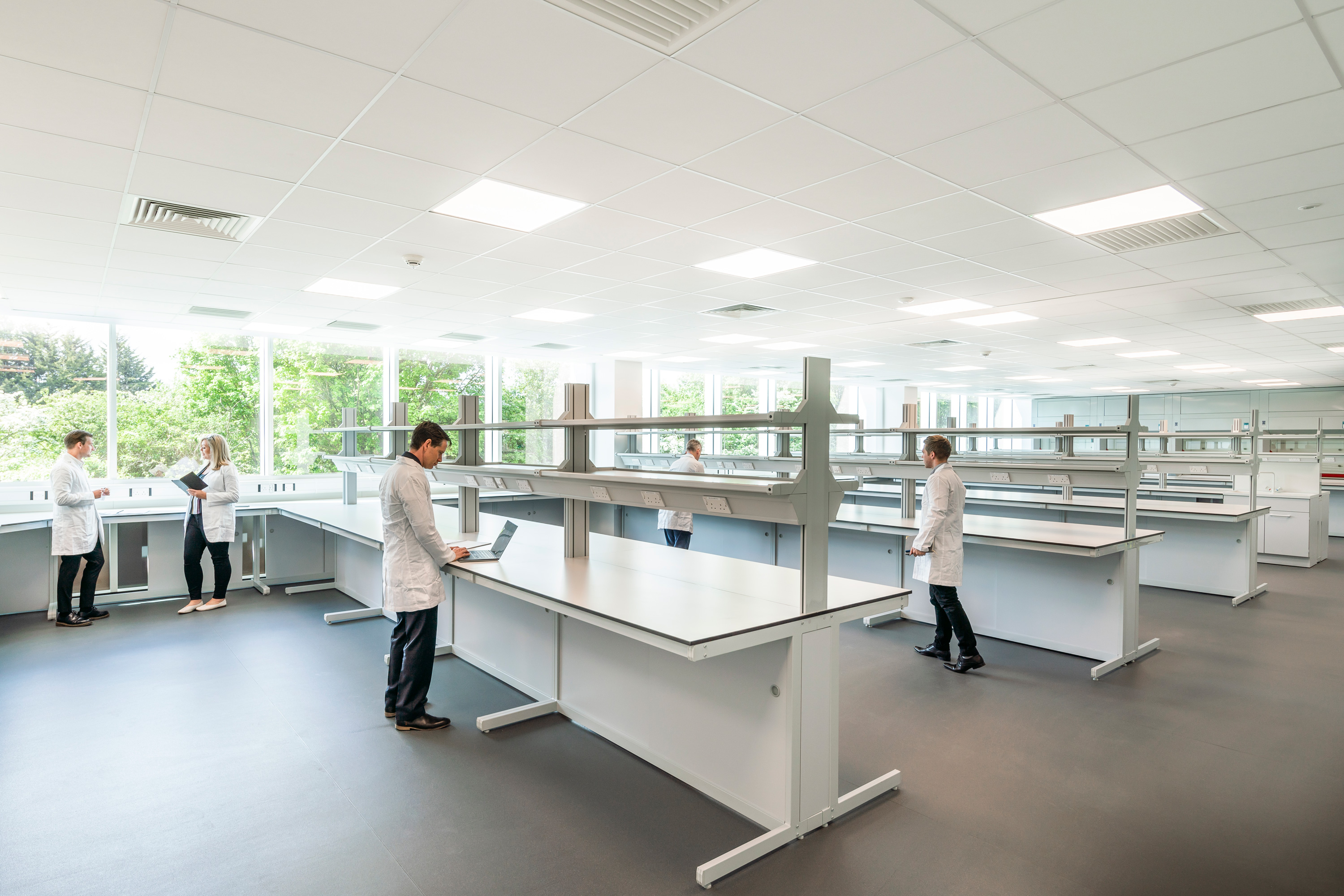
What does “space” mean here? The centre’s brochure describes laboratories of roughly 600 to 700 square feet, with larger options, shared equipment and communal areas. There are autoclaves, a glasswasher and a dedicated room for ultra-low-temperature freezers. Such details sound mundane until you imagine a small scientific team arranging them individually.
The architects, Scott Brownrigg, made adaptability part of the design. A structural grid measuring 7.5 metres by 9 metres allows accommodation to change between laboratory and office uses. The practical attraction is flexibility as teams and their work change. A discovery does not arrive with a reliable five-year seating plan.
02 / Follow the tenant
Mogrify supplies a concrete example. In May 2019, the cell-therapy technology company announced its move into 12,000 square feet of laboratory and office accommodation as the centre’s anchor tenant. It had appointed 15 new staff, bringing its headcount to 20. The move connected recruitment, research and physical capacity in one decision.
Other names associated with the Cambridge centre include Novogene, AI VIVO and Xampla. Their work spans different kinds of science and technology. Xampla, for example, develops materials from natural plant polymers. TusPark supplies an environment in which specialist companies can work; the scientific products belong to the tenants.
“Companies typically enter in teams of three or four”Wei Meng, TusPark’s head of UK innovation and real estate, in a March 2024 interview
In that interview, Meng said tenants had collectively raised more than £150 million. It is an encouraging measure of activity around the building, with a clear boundary: tenant fundraising is neither TusPark’s revenue nor money raised by TusPark itself. Occupancy and capital raised describe different parts of the story.
Funding and available space determine the pace.
03 / The other address is a network
Cambridge is only one expression of the business. In Newcastle, TusPark offers workspace memberships with round-the-clock access, meeting rooms, broadband and business support. That is a different entry point for an entrepreneur who needs a desk and useful introductions rather than specialist laboratory infrastructure.
Across both locations, the international offer is more specific than a promise to “go global”. TusPark helps companies assess a Chinese opportunity, identify partners and consider routes such as a local office or joint venture. Its services include investor introductions and connections to advisers on intellectual property, legal matters and accounting.
For a founder, these are separate decisions. A place to work does not establish demand overseas. An introduction does not establish a partnership. TusPark’s proposition becomes interesting when a company has a defined commercial reason to enter China and needs people who can help it make the next practical move.

04 / A building has edges
The business combines property leasing and workspace memberships with company investment and growth support. Its investment interests include life sciences, digital technology, renewable energy and new materials. Unlike an investor offering capital alone, it can also supply working space. Unlike a workspace provider offering accommodation alone, it promotes investment and international commercial connections.
The £200 million figure belongs to the Cambridge development. Treating it as a venture funding round would misread the company. It represents a substantial commitment to physical infrastructure, made with a local institutional partner and within an established science cluster.
That setting matters. A One Nucleus annual review for 2023/24 described the difficulty of finding follow-on laboratory accommodation. Companies raise money against scientific milestones, then need to recruit and expand quickly. If larger tenants cannot move, those behind them cannot expand, and newcomers cannot get their first bench. Full occupancy can conceal a queue.
For a prospective tenant, that suggests a practical set of questions. Which facilities are shared? Can the team add another laboratory without relocating? Who helps with the move when it needs a larger site? For a company considering China, ask the equivalent commercial questions: which customers, which partners, and which local expertise? The value of this combination should be judged against those tasks. A founder can compare the parts separately, then decide whether having them connected makes the work easier. That is a more useful test than counting introductions.
05 / Make the next move possible
TusPark has continued building connections around the property. Its European Innovation Academy launched in March 2025 with 17 founding members, including legal, insurance and corporate-services organisations. In June, it announced an affiliate partnership with Innovate Cambridge. Its January 2026 news highlighted BBC coverage of Bio-Innovation Centre partners and tenants.
The lesson a founder can copy is the sequence: choose infrastructure that supports the next experiment, find partners with a specific job to do, and think about the move after the next funding milestone. The model depends on suitable space, capital and useful commercial relationships. At TusPark, the waiting list makes the final requirement especially clear: successful incubation needs somewhere to go.