Consider the awkward moment when a scientific experiment works. The molecule behaves. The sensor records a signal. The founder has evidence worth showing someone. Then comes a less photogenic question: where will the next hundred experiments happen? In biotechnology, the distance between an idea and a business is measured partly in laboratory benches, instruments and people who know how to use them.
- IKP shares expensive research infrastructure with startups and established companies.
- Its Hyderabad campus and Bengaluru makerspace serve different stages of product development.
- Funding, IP, manufacturing and regulatory support help connect an experiment to a commercial plan.
IKP Knowledge Park has built its business around that distance. It is a not-for-profit science park and incubator, with a 200-acre base in Hyderabad’s Genome Valley and a hardware-oriented operation, IKP EDEN, in Bengaluru. Its customers range from small research teams to corporations needing their own facilities. The interesting part is how much its definition of useful infrastructure has expanded.
A banker’s idea acquires laboratory benches
The park began through ICICI and the government of the then-undivided Andhra Pradesh. IKP identifies banker Narayanan Vaghul as its founder and architect. Its institutional history makes a useful distinction: incorporation came in July 1998; the campus opened in October 1999. The first company, Medicorp Technologies, arrived in June 2000. Deepanwita Chattopadhyay became CEO the following year.
The initial proposition was tangible: give research businesses somewhere to work. Multi-tenant blocks called Innovation Corridors provided shared infrastructure; larger companies could lease land for bespoke facilities. A small firm and a multinational do not need identical premises. Bringing both into the same park allowed the institution to serve different budgets and stages of development.
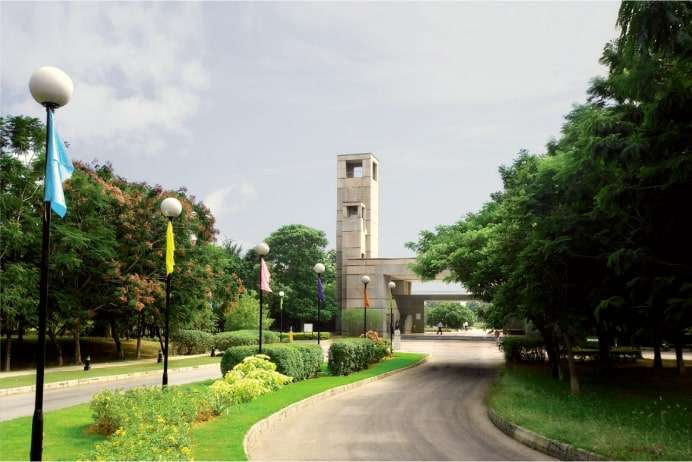
IKP reports an initial investment of ₹111 crore. It also claims a thirtyfold private-sector investment multiplier. The latter is an institutional impact claim, rather than an independently established return on capital. The former makes the scale of the undertaking clear: sharing a laboratory begins with somebody paying to build one.
The building was only the first answer
IKP’s published timeline records cash break-even in 2003 and the launch of its Life Sciences Incubator in 2006, backed by the Department of Science and Technology. That sequence matters. Providing space created a platform; incubation added help for teams still learning how to turn research into a company. Today the incubator describes 20,000 square feet of modular wet laboratories.
A-LABS, established in 2012 with BIRAC and Department of Biotechnology support, adds specialist analysis. The NABL-accredited facility lists a 400 MHz nuclear magnetic resonance instrument, chromatography and mass-spectrometry equipment, microscopy and thermal analysis. Its staff also help develop analytical methods. Researchers can send samples rather than establish a residence on campus.
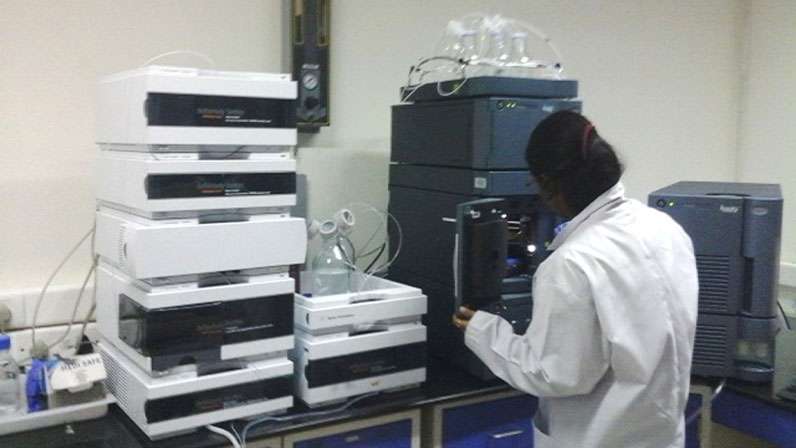
For a founder, the attraction is access to a capability before committing to ownership. For IKP, the range of users includes SMEs, independent researchers and incubated startups. The expertise is specific enough to be useful: molecular characterization and method development sit a considerable distance from the usual incubator calendar of talks and networking evenings.
Then the prototype needs a body
Bengaluru’s EDEN, established in 2015, extends this logic into hardware. Its makerspace supports work with metal, plastic and wood. BioNest adds a biochemistry laboratory and an ISO7 clean room. A team developing a physical healthcare product can face both mechanical and biological problems; the facilities acknowledge that untidy overlap.
EDEN’s public testimonials name Trestle Labs, ANSCER Robotics and Cureous Labs. Trestle co-founder Bonny Dave describes support extending across product, technology, manufacturing and market access. These are endorsements selected by the institution, but they reveal what founders are buying into: practical assistance and proximity to people confronting similar problems.
“This place has been our home since 2018.”Bonny Dave, Trestle Labs co-founder, on IKP EDEN
Growth Labs addresses another transition: manufacturing. IKP describes dedicated spaces leased at partner sites, giving startups access to industry facilities, alongside mentoring and funding opportunities up to ₹20 lakh. The approach brings existing capacity into a young company’s path. It is a useful alternative to assuming that every promising prototype deserves an immediate factory of its own.
- 01 / TESTWet labs + A-LABS
- 02 / BUILDEDEN + Growth Labs
- 03 / PROTECTPRIME + licensing
- 04 / PREPAREQuality + regulation
Money comes with different instructions
IKP’s financial role requires careful reading. It helps implement BIRAC’s Biotechnology Ignition Grant, which offers up to ₹50 lakh in grant-in-aid for proof-of-concept work. That money supports eligible innovators; it is neither IKP’s own fundraising round nor a universal subsidy for taking laboratory space.
Genesis presents a different bargain. Its 2026 programme page advertises up to ₹30 lakh in exchange for 2–3% equity, with a twelve-month programme for early deep-science startups at technology-readiness levels two and three. IP protection, regulatory clarity and investment readiness are explicit outcomes. The advertised first-cohort timetable pointed to a September start.
Up to this investment • Equity in the startup • 12 months
ARK, meanwhile, describes embedded operators helping MedTech and HealthTech ventures with working proof of concept. It explicitly excludes software, consumer technology and ideation-stage ventures. Selection matters. A programme designed around physical science cannot be judged by whether it suits every founder with a pitch deck.
The paperwork belongs in the product
PRIME handles intellectual property and technology transfer: assessment, licensing, patent work and commercial agreements. COMPASS adds quality-system, testing and regulatory-submission support for medtech. Together they address an uncomfortable truth about commercial science: a result must be reproducible, defensible and suitable for its intended market.
Partnerships widen the institution’s reach. Its documented Grand Challenges work includes the Gates Foundation and USAID, tackling problems such as tuberculosis and agriculture-linked nutrition. Programme administration has also brought scrutiny: a USAID audit recommendation covering 2017–18 identified five instances of material noncompliance. The government oversight listing records the recommendation as closed, with zero questioned costs.
C-CAMP in Bengaluru offers overlapping life-science incubation, funding and technical platforms. IKP’s particular combination is a large research park, a hardware makerspace and services reaching into commercialization. The lesson a reader can borrow is practical: identify the costly bottleneck, then ask which parts can be shared. Equipment access cannot create customer demand. It can, however, let a founder spend more time discovering whether the science deserves a business.
Visit the working parts
IKP website · IKP EDEN · Genesis · ARK · BIG
LinkedIn · X · Facebook · 2025 newsletter · Chattopadhyay audio interview