A young company can raise money and still lack the machine that would tell it whether its invention works. In Trieste, Area Science Park has built much of its proposition around that awkward gap. Its 2026 Deep Tech Revolution programme gives each of five selected startups €200,000 of support. Half comes as cash. The other half comes as technical services, including access to research infrastructure. The microscope gets a seat at the funding table.
That arrangement makes sense once you understand the institution behind it. Area is a national public research organisation, supervised by Italy’s Ministry of University and Research, that also manages a science and technology park. Companies come for research space, specialist equipment, computing and help turning experiments into something customers might buy. Its place in the market sits between the laboratory, the industrial development team and the startup support programme.
The proposition is unusually physical. Sequencers produce biological data. Electron microscopes inspect materials. A computing centre helps make sense of the results. Patent specialists investigate whether somebody else has already claimed the promising idea. Each addresses a different reason a research project might stall before reaching production.
A science park with its sleeves rolled up
Area’s public origins explain its long horizon. A presidential decree established the founding consortium in March 1978. Activities began in 1981 in buildings of the former Padriciano refugee camp; companies and research centres started settling at Basovizza in 1991. Technology transfer became an explicit line of work in 1997. This was an institution assembled over decades, through buildings, partnerships and research programmes.
Today, the two campuses contain about 65,000 square metres of laboratories, offices and shared space. Area describes a community of around 55 companies and more than 2,800 researchers, technicians and entrepreneurs. Those people work across the park’s organisations. Nearby scientific facilities include Elettra, the synchrotron light source, and the FERMI free-electron laser. Elettra’s name honours Marconi’s floating laboratory - a pleasingly nautical reference for a machine on the Karst plateau.
Area’s own scientific capabilities have expanded more recently. The genomics and epigenomics laboratory began in 2018; data-engineering research and the ORFEO computing centre followed in 2020. The electron microscopy laboratory, LAME, was established in 2022. The sequence of additions shows how a park operator acquired more of the tools needed to participate directly in research.
Bring a sample. Bring a difficult question.
The life-sciences offer starts with LAGE, the Laboratory of Genomics and Epigenomics. Its services include DNA and RNA sequencing, genotyping, methylation analysis and microbiome studies. Food and soil can be research material alongside human and microbial samples. The laboratory combines equipment with sample preparation, analysis and tailored consulting, allowing users to obtain specialist work without assembling every capability themselves.
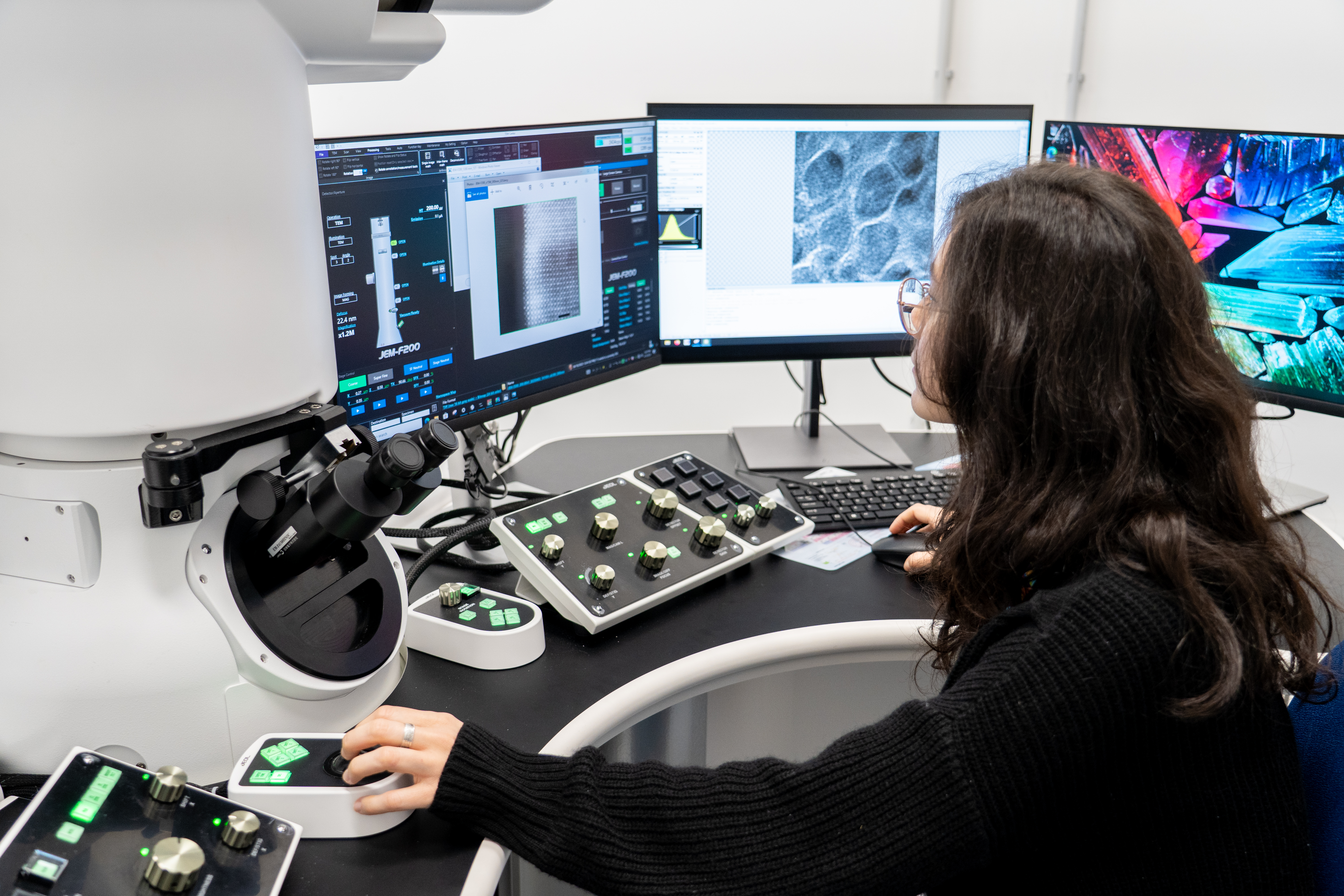
At LAME, the questions concern what materials look like and how they behave at very small scales. Its research includes battery materials, catalysts and structures examined under heat, electrical stimulation or different environments. For an industrial user, the useful distinction is between knowing a material’s composition and investigating what happens while it operates. The laboratory supports proposals from both academic and industrial researchers.
LADE, the data-engineering laboratory, connects computation with experimental work. Its ORFEO infrastructure supports simulations, AI and scientific data management. Researchers work across mathematics, physics, engineering, bioinformatics and computer science; visiting programmes and internships bring others into that mix. The practical advantage is access to people who understand scientific workflows as well as computing hardware.
Complementary capabilities, selected around the research question.
The €3 million behind the computation
In October 2025, Area announced a €3 million ORFEO expansion financed through Italy’s recovery plan, the PNRR. It included a new 125 kW server room, cooling systems, more storage and three AI nodes with eight GPU accelerators each. This is the cost of a particular infrastructure upgrade, rather than the price of running the park or buying a research service.
The resulting capability has a concrete research example. In June 2026, researchers from the University of Trieste, Area, SISSA and Human Technopole announced DEVIL, an open-source tool for comparing gene activity across cells from multiple patients. They reported analysis of more than ten million cells in under two hours, with up to fortyfold acceleration on the largest datasets studied. Those are reported benchmark results, dependent on the workload and computing setup.
Speed addresses only part of the problem. Cells from one patient share characteristics; treating them as independent observations can distort conclusions. DEVIL models that relationship while taking advantage of parallel computing. The work illustrates why buying hardware alone is insufficient: statistical choices and software design determine whether faster analysis produces a useful answer.
“This work would not have been possible without ORFEO”
Stefano Cozzini, director of Area’s Institute for Research and Technological Innovation, on the DEVIL research.
The ORFEO expansion and the published DEVIL study offer a useful pairing: a capital investment followed by a specific application. A computation benchmark measures that application. It does not establish that a hospital has improved diagnosis or that a drug has reached patients.
Half the startup cheque is a laboratory
Deep Tech Revolution applies the same equipment-and-expertise logic to young businesses. The five selected companies work on ultrasound-assisted surgery, microalgae cultivation, superconducting switches, automotive supercapacitors and optical communications. The twelve-month programme combines non-repayable support with scientific services, training and international visits.
Area received 80 completed project applications and selected five. Each gets €100,000 in cash and €100,000 in services, making the announced total €1 million. The services portion matters: a grant can pay bills, while access to a suitable instrument and its operators can help resolve a specific technical question. Those two needs are related, but founders cannot spend laboratory access on salaries.
Five selected startups. €1 million total announced support.
This design suggests a practical lesson for other programmes: connect funding to a defined experiment and the resources required to perform it. Its usefulness depends on the match. A company needing materials characterisation may benefit directly; one whose immediate problem is sales distribution may need a different partner. Selection and access arrangements also mean this is a programme to apply for, rather than money automatically available to every park tenant.
The pilot plant behind the lunch
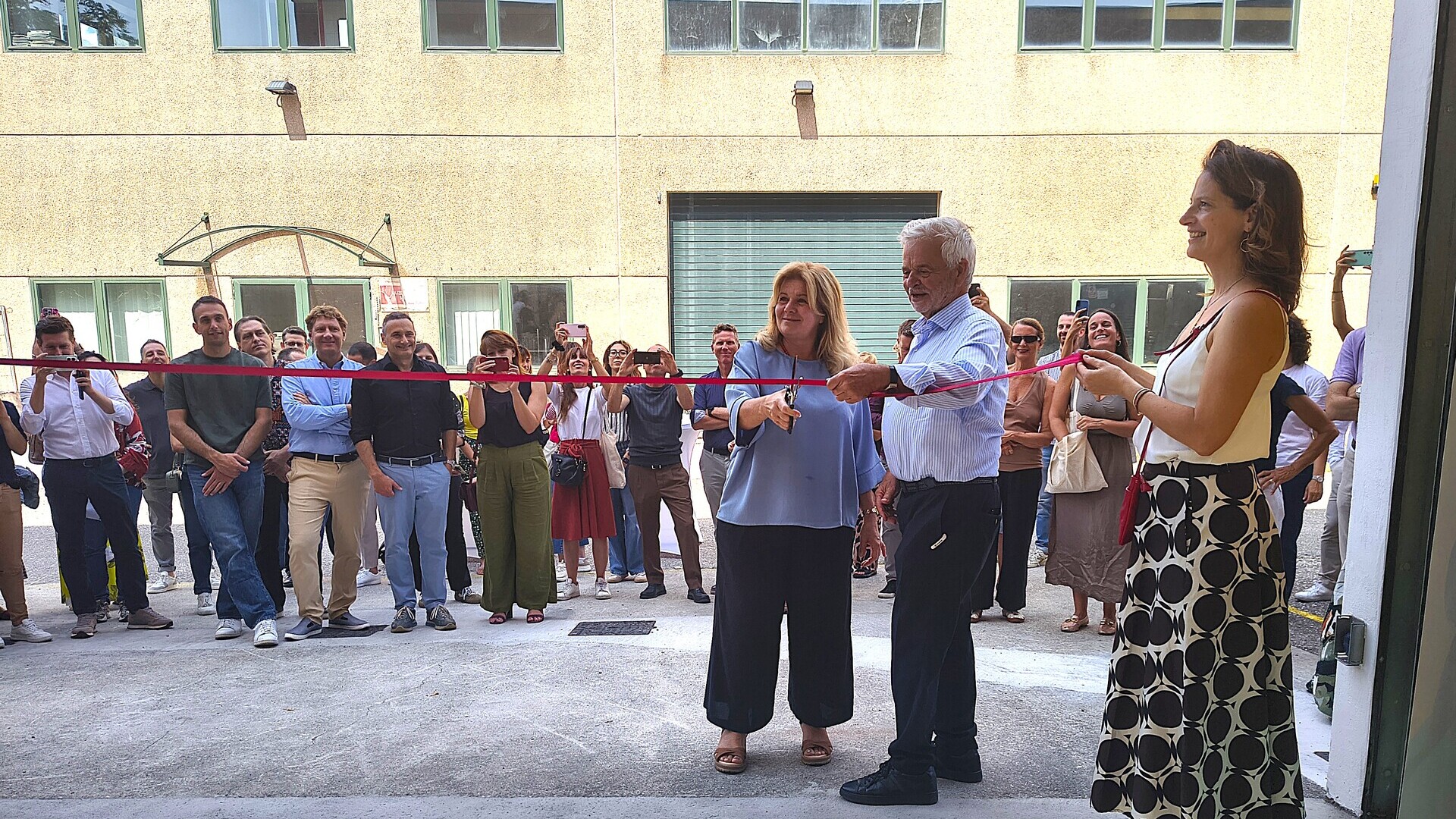
For a less abstract customer example, consider specialised nutrition. In July 2026, park tenant Dr. Schär inaugurated a new research pilot plant in Trieste. Its R&D centre, opened in 2003, has 35 researchers working across areas including food chemistry, biotechnology, raw materials and product evaluation. Their work supports development for the company’s 12 production plants.
The new facility collects and integrates data from different machines to support formulation development and validation. Intermediate-scale testing gives researchers a stage between the prototype and industrial production. That makes the commercial problem easy to recognise: a promising formulation must survive changes in process and scale while retaining the qualities that made it worth developing.
Dr. Schär’s operation also clarifies the customer relationship. It is a resident company with its own research team, products and industrial responsibilities. Area supplies the surrounding setting and services; the tenant carries out its business. A park can accommodate this established corporate research operation alongside startups still investigating whether a technology works.
The application that came back improved
Area’s digital innovation work contains a documented setback. A 2021 proposal for the European Digital Innovation Hubs initiative was not admitted to funding. The partnership revised it. In February 2023, Area announced that the resulting IP4FVG-EDIH proposal had received the European Commission’s Seal of Excellence, enabling access to national funding. The proposal covered 36 months and a total cost of €5.5 million.
The record describes revision after rejection, rather than an abandoned mission. The offer remained centred on helping businesses test digital technologies before implementing them. Its demonstrators give companies somewhere to investigate a solution before committing to a production change. The lesson available to copy is procedural: improve the proposal, assemble complementary partners and make the intended service concrete.
The earlier regional IP4FVG programme reported 404 company digital-maturity assessments and support for 177 SME digitalisation projects. Its activities included matching businesses with technology providers and peer learning among technical staff. These figures show reach and activity; they do not, by themselves, measure productivity gains. For a manager, the useful starting point is a defined operational problem that can be assessed and tested.
Who keeps the instruments running?
Area’s economics combine public research responsibilities, competitive project funding and services for industry. Its offer also includes laboratories and offices, technical support and innovation programmes. Different users enter through different arrangements: a research collaboration, a service request, a startup call or an application to establish an R&D operation in the park.
That breadth distinguishes it from narrower alternatives such as a contract laboratory, a commercial computing provider or an accelerator. Each can address part of the same need. Area’s appeal is the possibility of combining scientific infrastructure with research expertise and business support. The fit is strongest when a project needs several of those capabilities and can work within the relevant access and programme rules.
The next phase makes continued operation central. Area’s 2026-2028 plan prioritises completing, consolidating and maintaining its infrastructure investments. In February 2026, the organisation announced more than €21 million for INGenIO, a distributed rare-disease research infrastructure linking multi-omics, AI and partner laboratories. In July, two initiatives in which Area participates, Microscopy Europe and NFFA2050, entered the ESFRI roadmap. These are commitments to future research capacity, with outcomes still to be earned.
A fresh route opened on September 8, 2026: HPC4SME, a €450,000 call for smaller businesses with, or committing to establish, an operating presence in Friuli Venezia Giulia. Projects must be worth €30,000 to €100,000. Area’s digital services are covered in full under the call’s conditions, while a cash contribution covers 80 percent of eligible company expenses. Businesses must first discuss the proposed project with Area’s technical team.
This makes the access question practical. A qualifying company can propose a simulation, an AI test or an analysis of business data, then establish which services it needs. The preliminary discussion is mandatory, and funding is limited. The offer requires company work and a defined project; an interesting idea alone does not complete the application.
A prospective user can begin with a sample, a measurement problem or a proposed experiment. Area’s PATLIB centre can add patent and competitive analysis; the park team handles establishment enquiries; laboratory teams handle scientific access. The most productive conversation is likely to be specific: what needs testing, which expertise is missing, and what result would justify the next investment?
Visit the labs, follow the work
Area Science Park · Contact the team · News and research updates · Meet the five startups
LinkedIn · X · Instagram · Facebook · Research software on GitHub
Watch Tech Stories: people behind the science ↗