Every research university in America sits on a filing cabinet of patents that will never become anything. A discovery gets published, a professor moves on, and the intellectual property quietly gathers dust. Invenshure was built on a simple bet: that some of those hard problems are actually companies, if someone is willing to do the unglamorous work of building them. Since 2011, this Minneapolis venture studio has been that someone.
The distinction matters more than it sounds. A traditional venture capital firm invests in founders who show up with a plan. Invenshure does something closer to the opposite - it goes looking for the science first, licenses the IP from institutions like the Mayo Clinic, the University of Minnesota, and Stanford, and then assembles the company around it with its own in-house scientists, engineers, and operators. The founder, in effect, is the studio.
01 / The ModelCompany building, not check writing
Invenshure describes what it does in plain terms: "We turn hard problems into thriving companies." The mechanics behind that sentence are what make it interesting. Rather than treating capital as the product, the studio treats execution as the product. It employs the people who can carry both the science and the business, and it runs the same play over and over.
Source IP
Find original research at top institutions that nobody is commercializing.
License it
Secure rights to the patents and bring the science in-house.
Build the team
Staff scientists, engineers, and operators to turn it into a product.
Scale or exit
Grow the company, then acquire, exit, or keep operating.
It is a deliberately hands-on approach, and it explains why the studio's headcount looks nothing like a typical fund's. A VC firm with a portfolio this broad might have a dozen investors. Invenshure carries a staff of about 34 - because it is not just picking companies, it is running them.
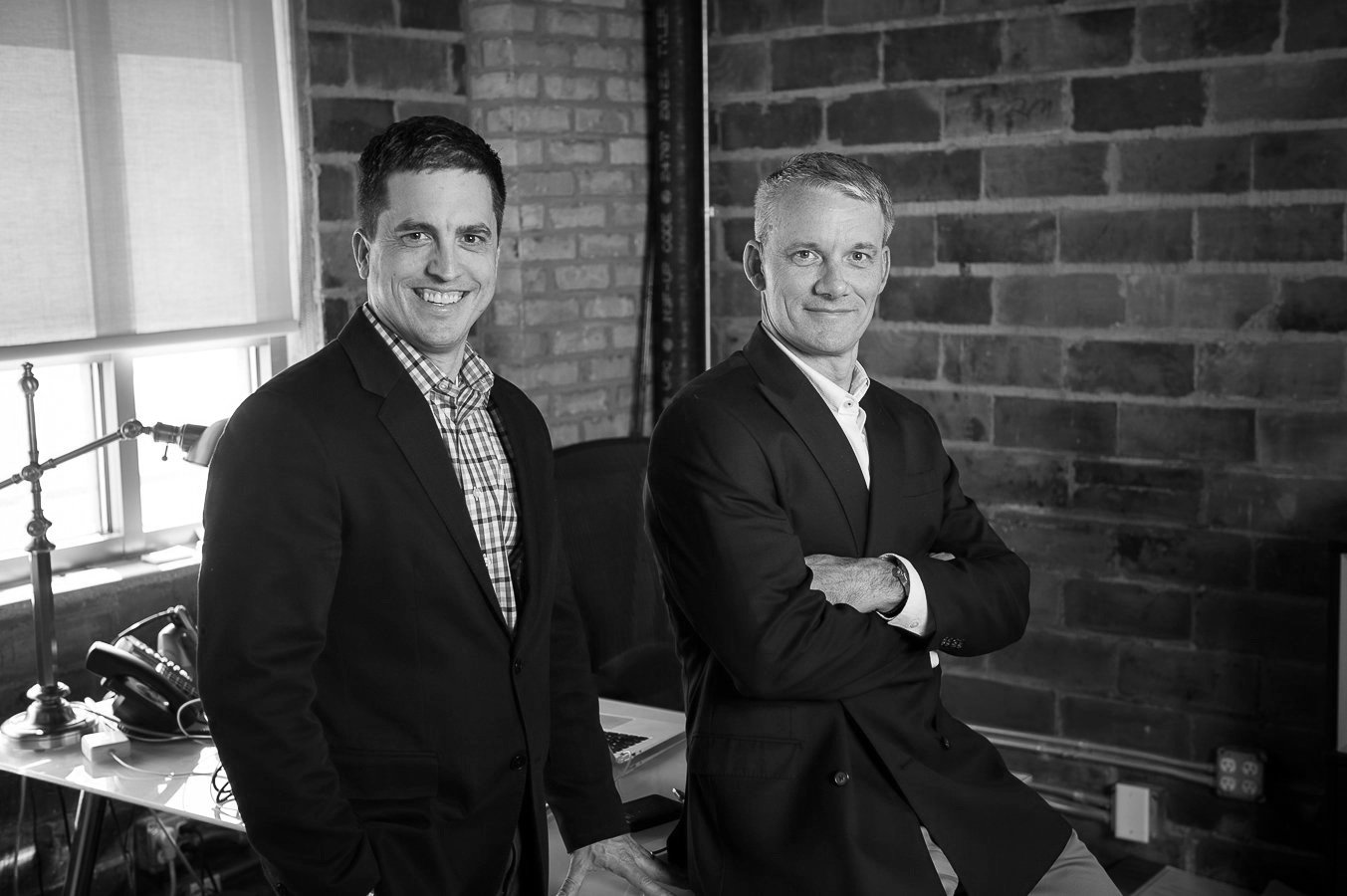
02 / The FoundersTwo engineers who keep co-founding
Invenshure's co-CEOs, Troy Kopischke and Danny Cunagin, did not arrive at the studio model by accident. Both came out of Steady State Imaging, a medical-imaging company that sold to GE Healthcare in 2011 - the same year they started Invenshure. Cunagin had earlier led Logic Product Development, growing it into one of the larger product-development firms in the country. Kopischke, an electrical engineer and physicist by training, handled commercialization.
Between them they have co-founded seven companies inside the studio and are still shipping. It is a founder profile you do not see often: people who treat starting companies not as a one-time event but as a repeatable engineering discipline.
Why this is unusual
Most successful founders exit once and become investors. Kopischke and Cunagin exited once and became builders - choosing to keep starting companies from scratch, inside a system they designed to make it repeatable.
03 / The PortfolioFrom cancer drugs to machine sensors
The range of Invenshure's portfolio is genuinely hard to categorize, which is part of the point. The common thread is not an industry - it is original IP that needed a company built around it. That has led the studio into pharmacogenomics, medical imaging AI, research data infrastructure, industrial IoT, and now precision oncology.
OneOme
Genome-based prescription advisor, launched with the Mayo Clinic. Ranked #2 most innovative biotech worldwide by Fast Company in 2018.
Imbio
Automated cardiothoracic image analysis and diagnostics. Acquired by 4DMedical.
Flywheel
Data management and machine-learning platform for scientific and clinical imaging.
Exosite
Cloud data platform for remote monitoring of connected industrial equipment.
GeneMatters
Telegenetic counseling services. One of the studio's exits.
MEKanistic
Dual PI3K/EGFR inhibitor targeting cancer resistance. FDA IND cleared in 2026.
If there is a headline in that list right now, it is MEKanistic Therapeutics. Launched by the studio in 2022, the company is built around MTX-531, a small molecule designed to block two cancer-signaling pathways - EGFR and PI3K - with a single molecule. Preclinical findings were published in Nature Cancer in 2024, and in May 2026 the FDA cleared the drug's Investigational New Drug application, opening the door to a Phase 1 trial in advanced solid tumors, with first-patient dosing anticipated later that year.
04 / The CustomersInstitutions, investors, and end markets
Invenshure has two kinds of customers, and they sit on opposite ends of the pipeline. On the front end are the research institutions and scientists who have IP but no clear path to market - Mayo Clinic, the University of Minnesota, Stanford Medical, Oregon Health & Science University, and the University of Michigan among them. On the back end are the investors in its funds, who are buying access to a diversified portfolio of deep-tech and healthcare companies they could not easily build themselves.
The end markets, meanwhile, belong to the portfolio companies: hospitals and clinical labs buying genomic testing, radiologists using automated imaging tools, researchers managing data, and industrial manufacturers monitoring equipment in the field.
05 / The Market FitWhere a Midwest studio sits
The venture studio model has become fashionable, with names like Flagship Pioneering setting the template for building companies around science. Invenshure has been running a version of it from Minneapolis since before it was a trend, embedded in Minnesota's Medical Alley - one of the densest medtech ecosystems in the country, home to the University of Minnesota and the Mayo Clinic.
That location is a real advantage. Proximity to major research institutions is the raw material of the studio's business, and the Twin Cities offer both the science and a lower-cost base to build in than the coasts. The studio has also extended internationally through an arm known as Invenshure Hungary.

06 / The Track RecordHow it has played out
Invenshure founded
Kopischke and Cunagin start the studio the same year they sell Steady State Imaging to GE Healthcare.
OneOme launches with Mayo Clinic
A pharmacogenomics company enters the portfolio.
$50M fund and new companies
Invenshure launches a second fund and co-founds GeneMatters and Flywheel.
OneOme ranked #2 biotech worldwide
Fast Company names it among the world's most innovative biotech companies.
MEKanistic Therapeutics launched
A precision oncology company built around a dual PI3K/EGFR inhibitor.
MTX-531 clears FDA IND
MEKanistic wins clearance for a Phase 1 trial in advanced solid tumors.
07 / The TakeawayWhat you can steal from it
The Invenshure model is worth copying, and the ingredients are not secret. Find IP that nobody is commercializing. License it. Hire operators who can carry both the science and the business. Build the company in-house instead of waiting for a founder to walk in. It works best where the raw material is close - next to a major research university, in a market where talent is affordable enough to keep on payroll while a company is still pre-revenue.
The catch is the same thing that makes it valuable: it is slow and capital-intensive. A drug can take more than a decade to reach human trials. That patience is not for every investor, and it is not for every market. But for hard problems that only a purpose-built company can solve, it is a model that has quietly produced exits, an FDA clearance, and a portfolio that spans from cancer therapeutics to industrial sensors.
Explore Invenshure
What does Invenshure do?
It is a venture studio that licenses original IP from research institutions and builds and operates companies around it using in-house scientists, engineers, and operators.
Who founded Invenshure?
Troy Kopischke and Danny Cunagin co-founded it in 2011; both serve as Co-CEO. They previously built Steady State Imaging, sold to GE Healthcare.
What companies has it built?
Its portfolio includes OneOme, Imbio, Flywheel, Exosite, GeneMatters, and MEKanistic Therapeutics.
How is a venture studio different from a VC firm?
A traditional VC invests in existing startups. Invenshure builds the companies itself, providing IP, talent, and operating capital from the earliest stage.
Where is it based?
Minneapolis, Minnesota, in the Medical Alley ecosystem, with an international arm known as Invenshure Hungary.