The first investor might be a relative. The next could be the province. In Córdoba, Argentina, that sequence has become a financing program: a young technology venture secures an initial backer, then asks Agencia Córdoba Innovar y Emprender to put public money alongside the commitment. The paperwork has an unexpectedly friendly name: Triple F, for Family, Friends & Fans.
It is an inviting entrance to a serious policy question. How do you turn a place with research, entrepreneurs and established businesses into a place where those people regularly build things together? Córdoba’s answer involves matching money, mentoring, introductions and a growing collection of programs aimed at the awkward gaps between an idea and a working business.
A province takes a seat at the investment table
Created in 2016 under provincial Law 10.351, the agency is a mixed-economy society with state and private-sector participation. Its mandate covers innovation, entrepreneurship and the application of knowledge to productive and social activity. It occupies an unusual position: close enough to public policy to fund programs, close enough to business to organize around investors and industrial problems.
The agency’s own diagnosis starts with financing difficulties, insufficient internal capabilities and limited access to supporting infrastructure. That is a useful corrective to the idea that every stalled startup simply needs a better pitch. A company might also need technical validation, equipment, an experienced adviser or someone willing to buy what its researchers can make.
Its users consequently extend beyond founders. Investors, incubators, universities and established Córdoba businesses all appear in its programs. The province is trying to improve the conditions around entrepreneurship while supporting individual ventures. This makes the agency’s expertise partly financial and partly institutional: structuring a call, finding the right partner and keeping a project moving.
The match is the mechanism
The 2026 Semilla program offers one-for-one public-private co-investment. Its public contribution reaches ARS 35 million with a first-time angel investment in the venture, or ARS 40 million with a capital institution or a returning angel. The agency explicitly says it takes no equity. Financing uses Asistencia Financiera a Mejor Fortuna, or AFMF; its conditions belong in the investment decision.
Triple F moves earlier. Eligible ventures are up to three years old and need qualifying initial backing or a grant. In 2026, the agency offers up to ARS 15 million, contributing as much as two pesos for each private peso. Four months of mentoring, totaling 16 hours, accompany the money. Someone must help the founder decide what the next expenditure should accomplish.
ARS 35m / 40m public cap
ARS 15m public cap
Illustrative ratios. Eligibility, approval and program limits apply. All amounts are Argentine pesos.
The distinction matters for applicants. Semilla addresses legally constituted Córdoba ventures in seed or early stages, with technical validation or initial sales and an investor already committed. An attractive concept alone does not meet that brief. Its 2026 application window closed August 2, as did Triple F’s, according to the published program pages.
For a founder preparing for a future call, the practical sequence is to identify the appropriate stage, assemble evidence, secure the qualifying backing and understand the financing obligations. Public support does not remove the need to persuade another person to put money at risk. That requirement is central to the design.
What the pesos actually pay for
The agency’s published 2026 budget map totals ARS 1,988,085,000. It separates ARS 1,042,285,000 for the agency program from ARS 945,800,000 for entrepreneurship and innovation financing. These are budget allocations, not reported expenditure. They are also not the agency’s revenue, valuation or a venture funding round.
52.4%Agency program
47.6%Entrepreneurship + innovation financing
This is a public-development operating model. Program delivery, financial assistance and institutional partnerships are its visible machinery. The useful comparison with a private fund is therefore about function: both can help finance a company, but the agency also works on the surrounding network that makes companies financeable.
CORLAB’s local directory places it alongside private investors such as Alaya Capital, the Addventure angel network and university support organizations. Founders have several doors to knock on. Some are alternatives for capital or advice; others can become partners in an agency-supported project. The competitive distinction is Córdoba’s provincial remit and its combination of funding with institution-building.
The night shift offers a better demonstration
A hotel reservation is an unusually clear example of what innovation support can buy. MATICLAR, which operates Córdoba’s Hotel Gran Rex, identified a problem with answering prospective guests promptly at night, when reception had less capacity. It worked with technology company Ithreex Global, an existing partner, through Voucher de Innovación IV.
The resulting AI agent answers inquiries and helps handle reservations, with human supervision and the option for staff to take over. In the agency’s August 2026 account, reception staff described having more time for other work. The business also discussed expanding the assistant’s local tourism information.
“Nos sirvió muchísimo para poder concretar la idea.”
Soledad Gayoso, MATICLAR
“It helped us a great deal to make the idea happen.”
The transferable lesson is modest and useful: define the operational bottleneck before selecting technology, combine domain knowledge with a specialist partner, and keep a route to human intervention. An assistant without reliable information or staff ownership would struggle to reproduce that arrangement. The project illustrates implementation; it should not be mistaken for a measured return on investment.
Research gets an appointment with industry
The same concern with practical use runs through Génesis Lab. Launched in 2025 with Ennoia, the eight-week program helps scientific teams turn research into technologies with a clearer development path. Training and validation sit alongside contact with the people who might eventually use or finance the work.
By the first Demo Day in December, 14 teams presented advances. The agency, Ennoia Latam and the Consejo Federal de Inversiones supported that edition. Projects included industrial-water filtration, energy control and veterinary applications. Teams then held scheduled meetings with companies, institutions and investors. A research presentation acquired an audience with a reason to ask difficult questions.
There is a replicable choice here: arrange those conversations before assuming a technically interesting result has an industrial market. A meeting can expose an unsuitable application, a validation requirement or a missing partner. The program’s structure puts that examination into the development process, when changing direction may still be feasible.
WISE approaches participation from another angle. Coordinated by IAE Business School, its Córdoba offering combines training and individual mentoring for women pursuing science and technology ventures. Its 2025 launch planned participation by at least 70 women. That was a program target, not a graduation count.
Someone has to own the problem
For established firms, the Programa de Innovación Colaborativa provides three months of help defining an innovation challenge and finding a potential solution partner. Its requirements include committed management and an internal person responsible for the work. The unglamorous detail is telling: introductions need someone inside the business able to act on them.
Córdoba Vincula funds a related institutional task. A proposal must bring together a lead beneficiary and a productive-sector organization with a real technological demand. Its 2026 grant can cover up to 80 percent of project cost, capped at ARS 6 million, with execution within five months. A university or intermediary has to organize around an actual need.
Córdoba Incuba, meanwhile, supports the organizations that accompany young ventures. Its 2026 terms offer up to ARS 10 million and 80 percent of approved incubation costs. Institutions must commit to a cohort of at least ten ventures and at least eight graduations. These are delivery requirements, not evidence that the graduates will survive commercially.
Together, the programs suggest a working culture built around assigning responsibility. Someone supplies the demand, someone brings expertise and someone delivers the support. For another region considering similar arrangements, the difficult part is assembling capable institutions and committed businesses. A grant announcement cannot supply those relationships on its own.
A bigger room, and a record of changing priorities
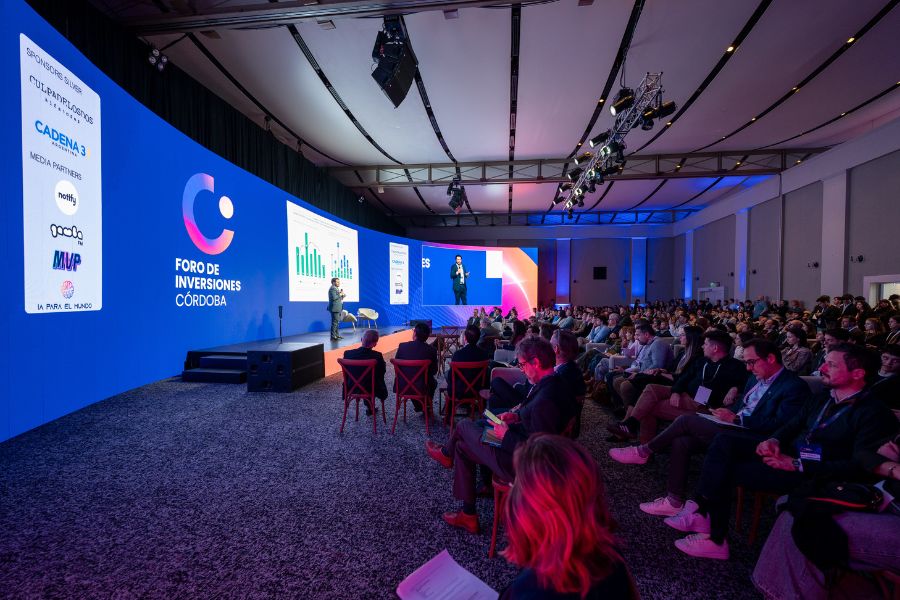
In July 2026, the Foro de Inversiones Córdoba expanded the historic VC Summit’s scope to include private equity and capital markets. Organized with ARCAP, the two-day gathering reported more than 800 participants. Scheduled investor meetings gave entrepreneurs a more direct reason to attend than collecting another conference badge.
Núcleo gives that convening work a permanent address. Opened in August 2025, the coworking space includes more than 25 workstations and a multifunctional area for 100 people. At the launch, president Manuel Ron acknowledged that demand for agency programs exceeds what every first application can secure. Access is selective, even when the invitation is broad.
The agency has also adjusted its priorities under pressure. In 2020, Economix reported that it redirected its attention toward 30 projects addressing the pandemic and its aftermath. That is a documented change in the brief. It offers a firmer account of adaptation than inventing a dramatic founder epiphany.
The next useful question is measurable
Data.ie, the agency’s information platform, publishes investment studies, program monitoring and regional research. Its 2026 provincial entrepreneurship survey draws on 837 complete responses. Other work examines incubation and the ventures supported by co-investment. These publications create material for asking whether support is reaching the people and problems it intends to reach.
Readers can borrow the questions as readily as the program designs. Did a private match unlock financing? Did an industry meeting change a research project’s application? Did an incubation process produce a business capable of serving customers? Those questions require follow-up beyond a launch event or a photograph of selected teams.
Córdoba’s proposition is concrete enough to examine: bring a backer, bring a technical problem, or bring the capacity to support a cohort. The agency has built different routes for each. For a founder or business, choosing the right route begins with an honest description of what is missing and who else needs to be involved.