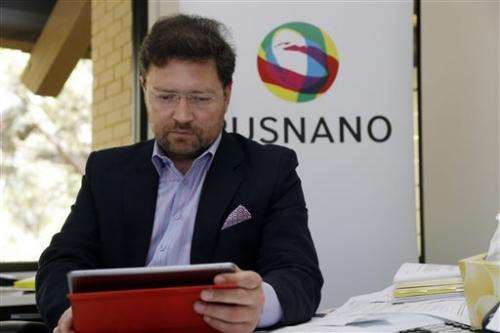
At his desk in Menlo Park in April 2014, Dmitry Akhanov held a tablet in a red case. Papers occupied the other side of the desk. Behind him stood the RUSNANO sign. It was an ordinary office scene for an unusually complicated job: representing a Russian state-backed technology investor in the middle of American venture capital.
His career had brought him from electricity-sector restructuring in Russia to the boards of companies making the components of modern communications. The geography had changed. The work still involved capital, industrial capacity and agreements between people whose interests did not automatically coincide. A semiconductor company and an electricity holding company have very different products. Both require someone to make the institutions fit together.
Akhanov’s public career is easiest to understand at that junction. He occupied the space between a technical project and the people expected to fund, govern and commercialize it. The technology could be tiny. The arrangements around it seldom were.
Before the chips, the grid
Akhanov studied at the Peoples’ Friendship University of Russia, earning a bachelor’s degree in economics and law and a master’s degree in economics. Those subjects put markets and rules beside each other. In the work that followed, neither would be optional.
From June 2002 to October 2007, he headed the Strategy Department of RAO UES. He participated in developing and implementing the restructuring of Russia’s electricity sector, including a new industry structure and electricity-market model. His responsibilities also included projects involving the separation, merger and acquisition of major energy companies.
The unit of change was an industry. There were existing assets, existing organizations and an existing obligation to keep the electricity flowing. Restructuring had to operate within that reality. The clean diagram of a future market was only one part of the task; actual companies had to get from the old arrangement to the new one.
In October 2007, he became head of the Russian Federal Energy Agency, serving until August 2008. The agency implemented national energy policy and managed state-owned assets across oil and gas, coal and electricity. Before he was associated with nanotechnology, his professional world included some very large machinery.
Sand Hill Road gets a Russian address
In December 2010, Akhanov became president and chief executive of Rusnano USA. The American subsidiary represented an organization whose mandate was to develop Russia’s nanotechnology industry. Its work connected American technology companies with an investor pursuing an industrial objective overseas.
By March 2012, he had moved to Silicon Valley and opened a full-time office on Sand Hill Road. At that point, Rusnano had invested a reported $600 million in 14 American companies, including Oakland-based BrightSource Energy. The address placed the organization among venture capital firms; the portfolio already reached beyond a single narrow interpretation of nanotechnology.
The location mattered as a place to meet people who could turn a technical possibility into a company. Rusnano USA also managed American portfolio relationships and helped market Russian nanotechnology products internationally. Money could travel in one direction while commercial opportunities travelled in another.
For Akhanov, the executive title came with a translation problem. An American company needed to understand what this investor expected. The investor needed to understand how the company could deliver. A meeting could start with a promising technology and finish with questions about where the research would happen, who would own the rights and what the next stage would cost.
RAO UES
Federal Energy Agency
Rusnano USA
The museum meeting
On July 20, 2011, Akhanov was scheduled to join an innovation briefing at the Computer History Museum in Mountain View. The panel included retired Intel chief Craig Barrett, Russian Venture Company chief Igor Agamirzian and venture capitalist Tim Draper. Alexandra Johnson moderated.
The event’s title was “Access Russia: Tapping the U.S.-Russia Innovation Collaboration.” Its stated purpose included discussing obstacles as well as opportunities. That choice of words suited the work. Access was something to arrange, and collaboration required more than a room full of people who liked technology.
The museum was an apt setting for a discussion about bringing another country into the Valley’s investment networks. Its very subject is the distance between an idea and the machines that eventually make it familiar. Akhanov’s part in that discussion concerned the business arrangements that could help close a similar distance across countries.
A board seat with an industrial purpose
Akhanov joined NeoPhotonics’ board in July 2013. The company developed and manufactured optoelectronic technology. His appointment followed an agreement giving Rusnano the right to nominate a director, subject to suitability and governance requirements.
For the company, his relevant experience included Russian business, complex technology projects and operations across borders. Those qualifications describe a particular kind of board member: someone who could help a technology business navigate the organizational demands surrounding its international investor.
The relationship also had concrete industrial terms. Rusnano’s investment came with a $30 million commitment toward NeoPhotonics’ Russian operations. A later revision included transfers of intellectual-property licensing rights and existing equipment, alongside remaining milestones. The arrangement reached beyond a shareholding into the practical question of building an operating presence.
That is where the biography becomes more revealing than a list of titles. The board seat and the industrial commitment belonged to the same transaction. Akhanov’s earlier experience rearranging energy companies had a recognizable application here: complex organizations still needed to agree on assets, responsibilities and a workable sequence of events.
Technology transfer, spelled out
In August 2013, Akhanov described technology transfer as a significant task for Rusnano. He pointed to research centers and laboratories already opened in Russia with companies including NeoPhotonics and Quantenna, and to a planned microelectronics venture with Crocus Technology.
“One of the most significant tasks for RUSNANO is the transfer of technology.”
Dmitry Akhanov, August 2013
The statement gave a plain account of what the investment program was trying to produce. A financial return mattered within a broader effort to establish technical activity in Russia. Research centers, laboratories and manufacturing projects made that ambition tangible.
Akhanov also spoke about open communication and the trust needed to develop innovative businesses. In his account, relationships were part of the operating mechanism. The parties needed enough confidence in one another to undertake commitments that would last longer than a conference or a financing announcement. A handshake might open the conversation. The laboratory still needed equipment.
Small components, long commitments
His board work extended to Aquantia, which he joined in April 2013, and Quantenna, where his service began in February 2014. The Quantenna appointment ended on October 27, 2016. These were separate businesses and separate tenures, rather than interchangeable entries in a technology portfolio.
Aquantia’s account of his qualifications emphasized strategic planning, corporate finance, investor relations and the management of complex technology projects. The combination is useful to understanding his occupation. His contribution was grounded in finance and organizational experience, alongside familiarity with the conditions of doing business in Russia.
In 2019, Aquantia shareholders elected him again. Later that year, Marvell’s acquisition closed, and the entire Aquantia board resigned under the merger agreement. Akhanov’s tenure ended with that change of control on September 19.
The ending is a reminder that a board role belongs to a particular stage in a company’s life. Financing, governance and ownership can all change. A career assembled through those roles moves with the companies, and each appointment needs its own beginning and end.
A processor with several passports
Soft Machines offered another version of the international model. In 2014, the semiconductor startup had operations in the United States, India and Russia, about 250 employees and more than $125 million in funding. Rusnano and RVC were among its investors.
Akhanov sat on its board alongside a representative of RVC. The Russian research-and-development center employed roughly 60 people. The company’s development effort combined an American headquarters with engineering teams in several countries and an international investor group.
The useful detail is the operating arrangement. Cooperation meant people doing development work in different places, with financing and licensing relationships supporting the project. The nationality of the headquarters supplied only part of the picture.
It also helps explain the territory Akhanov inhabited professionally. A technology company could have a home address and still depend on expertise, capital and agreements from elsewhere. Making that arrangement function was an ongoing business responsibility, rather than a slogan about globalization.
When the room changed
In April 2014, political tensions between the United States and Russia were slowing the Valley’s investment relationships. Akhanov argued that business connections had a durability of their own, grounded in direct contact between people.
His belief in personal contact had a biographical edge. He recalled growing up in the Soviet Union with fear of Americans. As an adult, working with them had changed the terms of the encounter. Familiarity replaced an inherited distance.
The contrast gives the office photograph its tension. A person could be sitting at an ordinary desk, working through ordinary business, while the significance of his national affiliation changed outside the room. The same relationships that made investment possible were now being tested by events they could not settle.
Akhanov’s public argument placed trust close to the center of doing business. It was also an argument made from a position with something at stake: years of relationship-building, portfolio commitments and an institutional mission dependent on activity across borders.
The hardware question remains
In October 2020, Akhanov appeared on the Russian Science, Technology and Education Conference program with a talk titled “Is There a Place for Hardware Driven Startups in the Modern World.” The session concerned commercialization, a theme that ran through his earlier investment work.
The title was phrased as a question. After a career spanning power-sector reform, government energy assets and semiconductor boards, the question belonged comfortably within his professional history. Hardware needs an organization capable of carrying it from development into use.
It is a fitting place to leave his story: with the practical demands of making things. His public record connects economics, law, industrial restructuring and technology investment. Across those settings, an idea needed people willing to accept obligations to one another.
The tablet on his Menlo Park desk was already a finished object. Much of the work around him concerned getting other technologies to that point. Between the prototype and the everyday device lay companies, capital, research teams and agreements. Akhanov made his career among those arrangements, where trust had to survive contact with the paperwork.