Nishant Shah needed a sign. The people who sold signs had already gone home. He was working in technology in the United States, running a small car wash on the side, and discovering that buying a few banners could require a schedule almost as elaborate as running the business they were supposed to advertise. Local print shops closed before his working day ended. Minimum orders assumed an appetite for printed material his car wash did not possess.
It is a pleasingly unglamorous beginning for a company: a customer, an inconvenient closing time, and a quantity requirement that made the purchase awkward. Shah eventually left his technology job and built BannerBuzz around online ordering. Customers could design, customize, and buy the quantity they actually needed. In 2011, the venture that became Group Bayport began turning that irritation into an operating business.
Today, Shah leads a group whose range stretches from trade-show displays to furniture covers and outdoor cushions. The distance between a car wash banner and a patio cushion looks considerable until you consider the purchase: somebody wants a particular size, material, or design, and would rather order it without a negotiation. Shah has spent years building around that preference.
The customer came before the company
His entrepreneurial history reaches back to an eco-friendly car wash in South Carolina in 2003. Long before he became a supplier to other businesses, he was responsible for getting attention for his own. The signage problem arrived with that job. A banner was a practical purchase, something meant to bring customers through the door, and the difficulty of acquiring one became an education in its own right.
Shah also had a connection that made the economics visible. During visits to family in India, he used his brother’s website design service for banner designs and had the work printed locally. The printing cost less than it would have in the United States. He could see a route between a customer’s requirement in one country and production in another. Making that route reliable would occupy far more time than spotting it.
Group Bayport’s account of its beginning preserves a particularly modest detail: a $14 order in 2011. There is something useful about retaining a number that small. It keeps the early transaction in view. Before there were multiple brands, facilities, and acquisitions, a person had to place an order and receive something worth paying for.
The order remembered in Shah’s company biography. Small enough to fit on a receipt; consequential enough to keep in the story.
A website still needs a factory
The attractive part of online customization happens on a screen. The awkward part begins when the customer presses order. Dimensions, materials, colors, finishing, and delivery dates have to survive the journey into production. A website can accept a request immediately. Making the requested object takes a system.
Between 2011 and 2015, the business worked on the connections behind that screen: supplier relationships, information sharing, waste reduction, and the supply network between India and the United States. Shah described a deliberate progression, first understanding the market and integrating operations, then expanding internationally. Flexibility mattered alongside price. A low unit cost offers limited comfort when the production line cannot accommodate what the customer ordered.
That history helps explain his attachment to manufacturing. Keeping design, production, and customer service together made the promise easier to manage. It also made the company responsible for more of the work. The trade-off is visible in the business he built: an online storefront supported by an organization with machines, materials, people, and delivery deadlines.
- 01DesignChoose dimensions, artwork, and material
- 02MakePrint, finish, and check the order
- 03DispatchPackage and send the finished product
The years between banner and cushion
The expansion came through a mixture of new brands, production capacity, and purchases. The business entered the UK in 2013 and introduced Best of Signs in the United States. In 2014, annual revenue passed $3 million. Covers & All followed in 2017, bringing the same interest in individual specifications to protective covers.
By 2019, the group had completed its purchase of Giant Media and acquired Vivyx. In 2020, it moved from Magento to a custom microservices architecture. Neon Earth arrived in 2021; Tarps&All followed in 2023. These are different kinds of milestones. A new brand is easy to announce. Replacing the software beneath an ordering business is less picturesque, but the customer’s options still depend on what the machinery behind the page can handle.
The pattern gives Shah’s career a practical continuity. He kept extending the kinds of things customers could specify, while expanding the organization needed to produce them. A printed message, a protective covering, and a piece of home decor each brought another version of the original question: can I get this made the way I need it?
Buying the next piece of the puzzle
In August 2024, Group Bayport announced a majority investment in Optamark, the Norwalk, Connecticut business serving customers in print, promotional products, and apparel. Shah framed the combination around customers who needed both wide-format products and those additional categories. Optamark brought an established business-to-business operation to a group experienced in selling custom products directly.
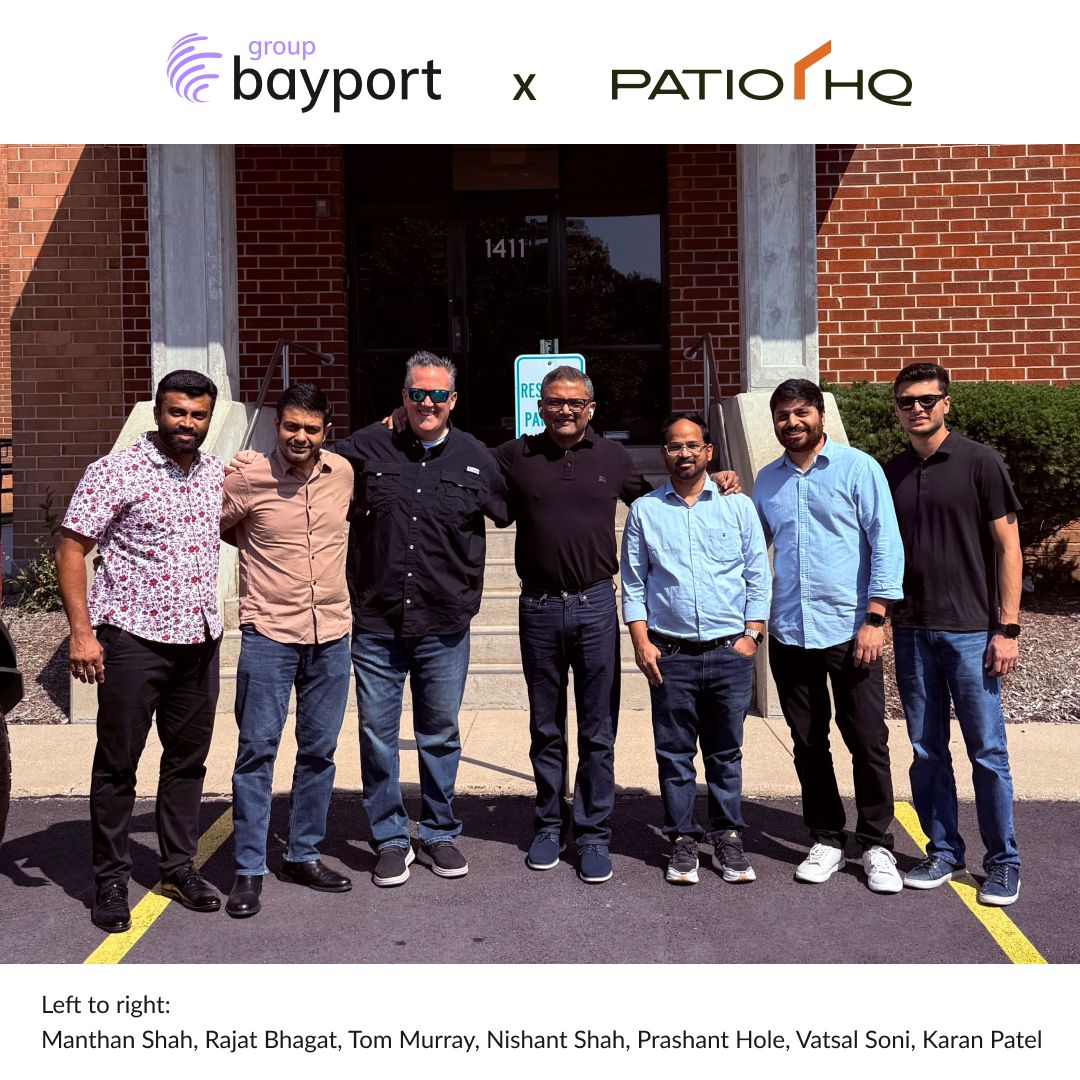
That same month, the group announced its acquisition of NorthCape, a Chicago-based furniture and cushion business with a network of retail partners. Here, the additions were tangible: furniture, cushions, and relationships with dealers. NorthCape president Tom Murray described plans for a furniture-cover and cushion program that customers and suppliers had requested.
Rajiv Bhatt, responsible for strategy and acquisitions, connected the purchase to the group’s production model and NorthCape’s sales expertise. The announcement placed Shah alongside other people with specific pieces of the operation to run. Expansion meant adding their experience as well as adding products. A founder who once needed to arrange his own signs was now bringing together businesses that already knew their customers.
Taking the argument outdoors
PatioHQ, launched in June 2025, made the outdoor ambition explicit. The new retail site offered furniture and accessories with customization central to the purchase. NorthCape’s cushions and the group’s experience with covers gave Shah a way to connect several existing capabilities in one setting: the space outside someone’s home.
“We are, by DNA, a custom company,” he said. His interest was in gaps in the outdoor market and in shortening the wait for products. He described a fourfold increase in cushion-production capacity after the NorthCape acquisition. He also acknowledged delays associated with tariffs and discussed reducing lead times for dealers and customers. The original sensitivity to waiting had acquired a larger stage.
There is a certain persistence in this move. The person trying to buy a banner and the person waiting for replacement cushions have different shopping lists. Both care whether a supplier can accommodate their requirements and deliver. Shah’s expansion into outdoor living carried that old concern into a new category, complete with a fresh set of production and delivery problems.
A larger receipt, the same obligation
Group Bayport appeared at No. 4,425 on the 2025 Inc. 5000 list. Shah thanked his team and customers publicly when he shared the news. The recognition put an external marker on the growth of a business whose first remembered transaction cost less than many lunches.
In May 2026, BannerBuzz announced $64 million in revenue for 2025. The announcement tied that result to in-house design processing, sourcing, printing, finishing, and packaging. It also described same-day shipping for eligible orders. Eligibility matters: a production capability has conditions, and a customer’s deadline is attached to an actual product. The useful achievement is making the machinery support a promise with enough consistency that people return.
The group now presents a portfolio of twelve brands. Shah’s own anniversary reflection put the emphasis on creative expression across workplaces, homes, and outdoor spaces. That is a much wider remit than promoting a car wash, although the underlying transaction remains recognizable.
The founder learns to step back
As the business grew, Shah’s work shifted toward building systems and giving teams responsibility. In his account of leadership, customer focus sits alongside speed, resilience, decisions informed by data, and ownership. The combination asks employees to act, while remaining accountable for what happens afterward.
He uses the word “Cobsession” for customer obsession. Coinages can do only so much; the more revealing statement is his warning about what happens when the relationship fails. He argues that trust is harder to recover than financial performance after a difficult quarter. It is a restrained measure of success for someone whose company sells the materials other people use to attract attention.
“Businesses recover from difficult quarters. Trust, once lost, is far harder to rebuild.”
Nishant Shah
A small car, another beginning
At the Ridansh Centre of Design & Innovation, Shah appeared as a jury member for a student project called F1 Full Speed. Children in grades three through five had worked through a miniature version of building a venture: logos, company names, mission statements, sponsors, prototypes, and a final car race.
In his remarks afterward, he lingered on the detail the children had worked through. He was impressed by the depth of the project and by hearing their presentations. It is an agreeable place to leave him: watching young people connect an idea to something they could actually make and test. For a founder whose own business grew from the troublesome purchase of a sign, there was plenty in the assignment to recognize.