A startup gathering usually comes with a familiar bargain: sit through the speeches and perhaps meet somebody useful afterward. Startup Büro gives the gathering a more demanding job. Sometimes participants have to build a game. Sometimes they have to explain a business idea to a jury. Sometimes the person with the microphone has to talk about a professional failure. The meeting has a task, and the task changes the meeting.
Founded in 2018 by Guri Koiava and Hayk Asriyants, the Tbilisi company organizes entrepreneurship programs and events across Georgia. Its audience stretches from early-stage founders to product managers, creative professionals and regional businesses. On the other side of the table sit banks, companies, universities and development organizations looking for ways to work with those people. Startup Büro supplies the program that brings them together.
That makes it an interesting business to examine in a startup economy. Its output includes workshops, introductions, prototypes and presentations. The practical question is what those activities let someone do next. A handful of its projects offer a better answer than any sweeping promise about innovation.
A gardening problem, with a deadline
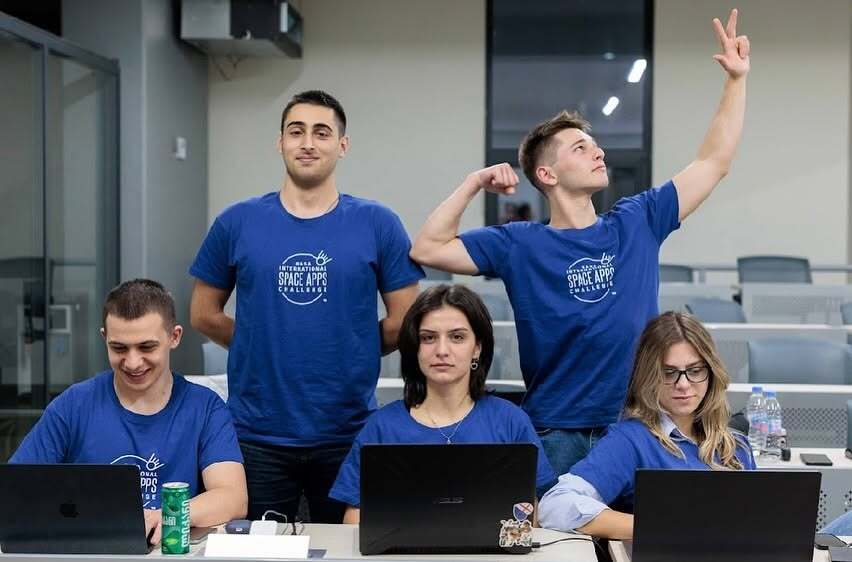
Consider the GreenTech Hackathon held from February 28 to March 2, 2025. Startup Büro worked with the Japan International Cooperation Agency, JICA, on a brief about digitizing gardening services. The specificity is refreshing. “Build something innovative” can swallow an entire weekend before anyone agrees on what the words mean. Gardening services give a team a starting point: a real activity, with practical problems to investigate.
The first two days took place online, with mentors including Hill Inn chief executive and angel investor Maia Verdzadze, financial consultant Irakli Arjevanidze and business consultant Beka Baiashvili. Teams then presented at Georgian National University SEU. The judging panel brought together investment, entrepreneurship and agricultural development experience.
The sequence is worth borrowing: define a domain, give participants access to people who understand its commercial realities, and set a presentation deadline. It lets a team test whether its explanation survives contact with somebody outside the team. For a participant, that can be the first useful return on the time spent attending.
The work after opening night
A weekend provides urgency. A business idea may need considerably more time. Go Green, delivered with EFES Georgia and Impact Hub Tbilisi, shows how Startup Büro’s work can extend beyond a short event. Its public launch used PechaKucha storytelling, with speakers working on subjects including waste, recycling and sustainable products.
Then came the slower part. EFES Georgia’s account of the July 12, 2023 demo day describes a 12-week program in which participants developed their business knowledge. Nine startups presented at the finish. The difference between the launch and the final presentations matters: attracting interest and helping someone develop an idea are separate jobs, with separate demands on an organizer.
Different stages, different jobs. Figures refer to the 2023 program.
For a founder choosing where to spend scarce hours, this is a useful distinction. A talk can introduce a subject. A structured program can create repeated opportunities to work on it. Neither format automatically produces a viable company. The sensible choice depends on whether the founder needs an introduction, feedback on a specific decision, or a longer period of preparation.
Please keep your failure to the point
Startup Büro also works with recognizable international formats. PechaKucha gives speakers 20 slides, each advancing after 20 seconds. That is six minutes and 40 seconds to make a point. Anyone who has watched a presenter announce “just one more slide” can appreciate the appeal of an automatic clock.
ProductTank Tbilisi serves a more occupational audience: product managers, designers, developers and founders discussing how products get made. Its mix of expert talks, discussion and networking creates a place to compare decisions with peers. A moderator’s account of one local event describes collaboration involving Startup Büro, Bank of Georgia and 500 Georgia, with founders sharing their experience.
Fuckup Nights changes the subject matter. At its June 19, 2026 Tbilisi edition, held during Global Tech Weekend, the company brought speakers to D Block Spaces to discuss setbacks and difficult decisions. The format makes room for material that a conventional success talk can edit out: the launch that disappointed, the assumption that gave way, the decision that looked sensible until circumstances changed.
“We turn ideas into communities, programs, and opportunities.”
Startup Büro’s description of its work
The value of a failure talk depends on the detail. What broke first? What did the speaker try before abandoning the approach? What evidence changed their mind? Those are useful questions for the audience to bring. A polished confession can become another performance; an account with decisions and consequences gives a listener something to examine against their own situation.
A weekend with something to show for it
Game creation adds another kind of discipline. Startup Büro’s Global Game Jam offering brings programmers together with designers, artists, writers and other contributors to make playable games over 48 hours. A shared theme and a deadline supply boundaries. A game has to do something when another person tries it, which gives the presentation a wonderfully unforgiving prop.
There is a practical benefit for people who have never worked together. They can discover who finishes a task, who communicates a problem early and who can simplify an idea when time is running out. That is a more informative introduction than exchanging job titles. The exercise also leaves behind an object participants can discuss, revise or include in a portfolio.
A separate competition, Game Jam Georgia Cup 2026, used online qualification followed by a live final. FogCult won, earning an opportunity to represent Georgia at Poznań Game Arena with Lenovo Georgia’s support. That provides a specific next step beyond the local presentation: exposure to another game industry audience. It also illustrates why the choice of partner can matter as much as the choice of format.
The sponsor has a job, too
Startup Büro’s commercial offering is visible in its partnership menu. For ProductTank, organizations can contribute through sponsorship, expert participation, venue support or branded activities. They are offered access to product professionals, potential collaborators and talent. Custom programs give partners another route: design an event around a particular organizational goal.
Seen together, those offerings suggest a business built around program delivery and partner relationships. The participant and the supporting organization may want different things from the same room. One wants advice or a collaborator; the other wants useful connections, visibility or engagement with a professional community. Good program design has to make the exchange worthwhile for both.
Money can sharpen the invitation. The November 2025 AI and blockchain hackathon with Gagra Ventures advertised a $10,000 prize pool, alongside a separate 2,000 GEL award from White Square and a follow-on investment opportunity. Those numbers describe participant incentives. They should not be confused with the cost of staging the event, money raised by Startup Büro, or an investment guaranteed to every team.
For someone considering a similar program, the distinction is operationally useful. Prize money is only one part of the design. Mentors need time, a venue needs organizing, and teams need a clear brief. Before copying the headline award, decide what participants should produce and who will help them get there.
Beyond the usual startup room
The company’s reach also includes businesses whose everyday concerns extend beyond building a technology startup. Its regional conference portfolio includes ProCredit Bank meetings in Batumi, Kutaisi, Telavi and Zugdidi, addressing subjects such as tourism, agriculture, digital tools and finance. A public Kutaisi event announcement names the bank and Startup Büro as organizers.
That expands the meaning of entrepreneurial support. A regional business owner may need a useful conversation about marketing or access to finance before needing an investor pitch. Bringing the conversation closer to that owner is a practical choice about audience, geography and subject matter.
Other briefs are explicitly civic. Caucasus University’s account of a January 2025 Democratic Technology Hackathon names Startup Büro among the organizers, alongside Forbes Under 30, AXEL and Impact Hub Tbilisi. The winning team, “Tbilisi Loves EU,” developed a proposed response to poor internet connectivity during mass protests. Here the immediate problem shaped the prototype, and the university described support packages intended to help selected teams develop their ideas.

Bring a problem worth sharing
Startup Büro occupies the space between entrepreneurship education, event production and community organizing. Georgia also has dedicated accelerators and other founder communities. The boundaries overlap: Impact Hub Tbilisi, for example, appears repeatedly as a collaborator. For a prospective participant, the useful comparison is between the actual programs, their audiences and the work each requires.
The most portable lesson is modest. Give people a reason to assemble and a concrete task once they arrive. Bring in expertise that matches the problem. Make the next step visible, whether that means another workshop, a prototype review or a presentation to a new audience. The gardening hackathon, Go Green and the game competition each use parts of that approach.
It depends on the conditions. A short event suits a bounded experiment; a business requiring months of research needs a longer commitment. A sponsor’s interests need to fit the participants’ work. Advice needs to be relevant enough to change a decision. The attendee has a responsibility, too: arrive with a question, something to test or a skill to contribute. Startup Büro can organize the room. The people inside it still have to make the meeting count.
Find your next room
Explore upcoming programs, meet the community and read more about the work.