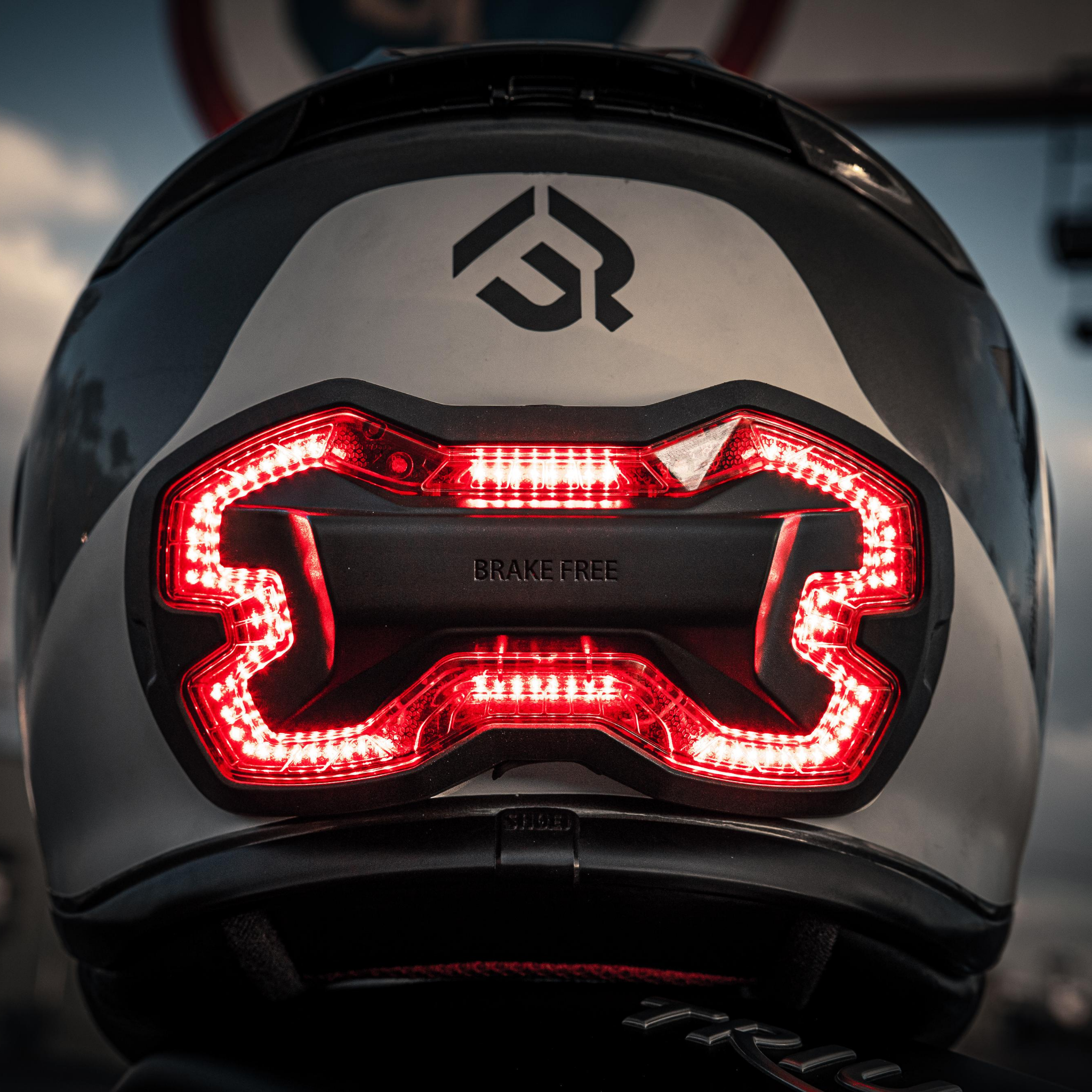
Ask any motorcyclist about the phrase they dread most and you will not hear anything about weather, gravel, or deer. You will hear four words a driver says after a collision: I didn't see you. Brake Free Technologies built an entire company to make that sentence harder to say. Its product is a wireless brake light that clips to the back of your helmet and lights up 100 LEDs the moment it senses you slowing down - not wired to the bike, not paired to a phone, just watching how you move.
The insight at the center of the company is almost annoyingly simple. A motorcycle's brake light sits low, near the rear fender, roughly at the height of a car's front bumper. When traffic is heavy and a driver is following close, that light can fall below their sightline or hide behind the car ahead of them. Brake Free's founders asked what would happen if you moved the brake light up to where a driver is already looking - eye level, on the rider's head. That relocation, more than any single component, is the product.
01 / WHAT IT DOESA brake light that reads the road, not the wiring
The Brake Free unit is a curved, aerodynamic pod that mounts to full-face, three-quarter, and half helmets in sizes XS to 4XL. Inside sit an accelerometer and a gyrometer feeding a patented algorithm. Instead of tapping into your motorcycle's electrical system, it reads deceleration directly. That distinction matters more than it sounds: the device lights up not only when you squeeze the brakes, but also when you downshift or let engine braking scrub off speed - the exact moments a bike's factory brake light stays dark while you are, in fact, slowing down.
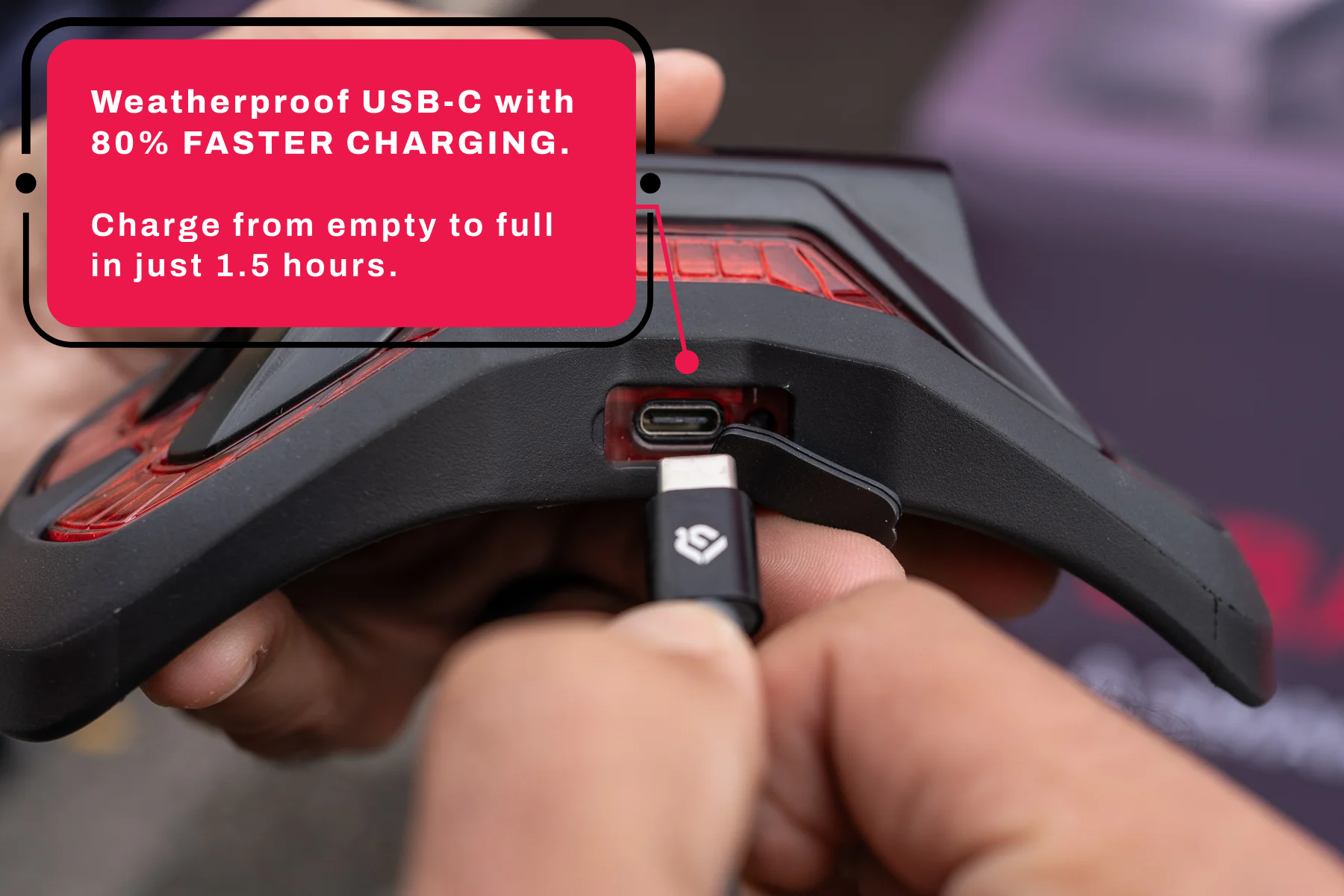
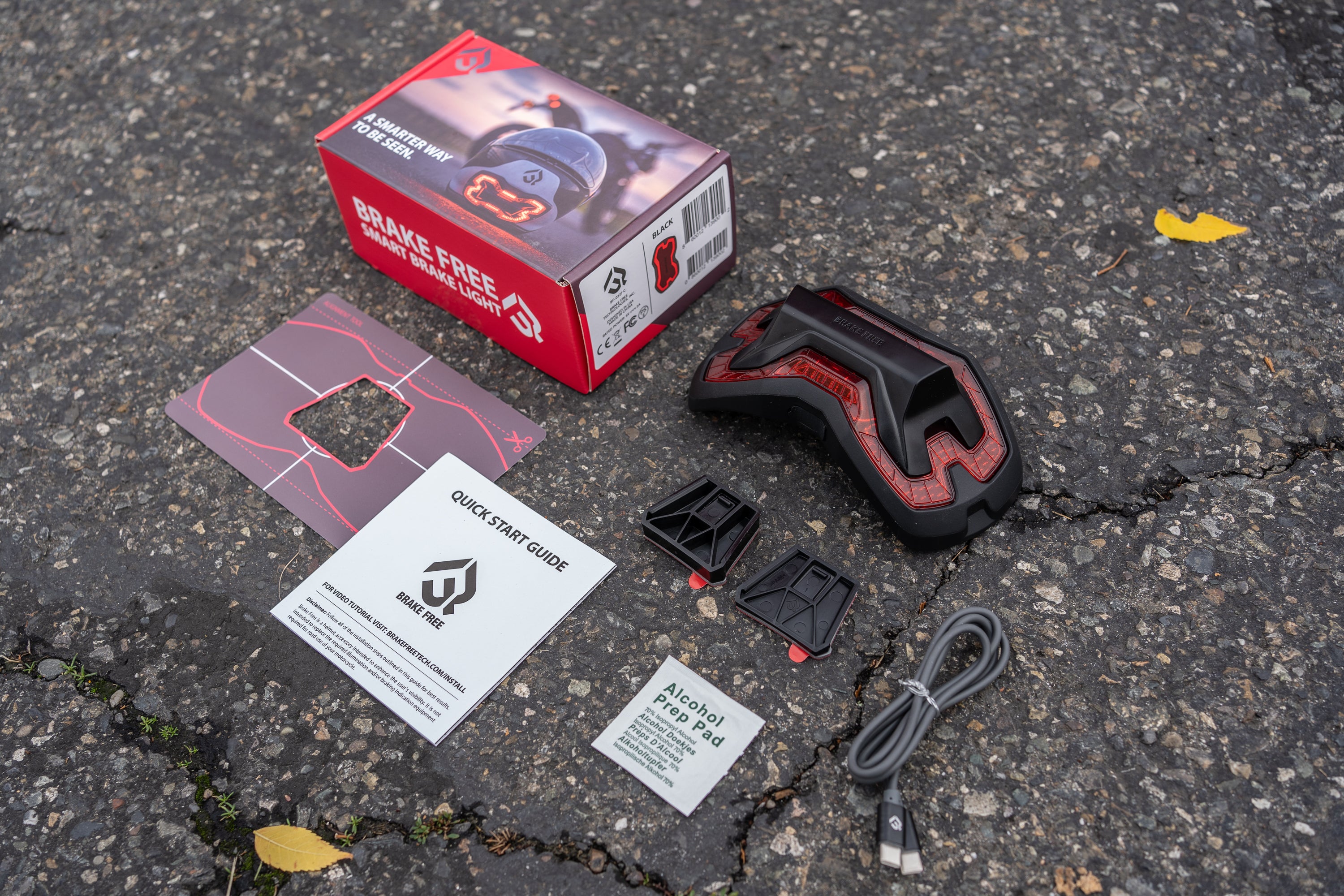
There is a deliberate restraint here. A different team would have shipped a companion app, Bluetooth pairing, a subscription, and a dashboard of ride analytics. Brake Free shipped none of it. You charge it over USB-C, stick the mount to your helmet, press a single button, and ride. That refusal to bolt on software is not a shortcut - it is the pitch. Fewer things to fail, nothing to update, nothing that drains at a stoplight while you fumble with a phone.
02 / WHERE IT CAME FROMBuilt by riders who had the near-misses
Brake Free was founded in 2014 in the San Francisco Bay Area by Alex Arkhangelskiy alongside co-founders Henry Li, Ian Dunn, Trevor Leger, and Johan Boot. The origin story is the kind investors like because it is not a market-sizing spreadsheet - it is personal. The founders rode, they understood how often drivers simply fail to register a motorcycle, and they set out to fix the communication gap rather than the crumple zone. The company's shorthand for this is stamped across its storefront: made by riders, for riders.
Demand showed up before the sharks did. In 2017 the team ran an Indiegogo campaign and pulled in $259,797, comfortably past its goal - proof that riders would pay for visibility before a single retail shelf carried the thing.
03 / THE SHARK TANK CHAPTERPitched for 10%, walked out with two sharks
In December 2020, on Season 12 of Shark Tank, the founders asked for $200,000 in exchange for 10% of the business. After passes from several sharks, Robert Herjavec offered the full amount for 20%, and Mark Cuban joined the deal. The founders took it. On paper, giving up double the equity looks like a loss; in practice they left with two investors, national exposure, and a valuation that would look conservative within a couple of years.
Reported cumulative sales, per public post-show coverage. Figures are approximate.
The post-air numbers followed the familiar Shark Tank spike, but they kept climbing after the bump faded. By mid-2021 the company reported roughly $1.1 million in revenue on about 7,000 units. By January 2023, reported cumulative sales had crossed $3.9 million. The company now says it has improved the safety of more than 60,000 riders and shipped over 25,000 units, with its flagship light holding a 4.9-star average across more than 1,700 reviews.
04 / WHO BUYS ITCommuters, tourers, and the merely cautious
Brake Free's customer is not a niche racer. It is the everyday commuter threading rush-hour traffic, the weekend tourer logging highway miles, and anyone who has felt a car drift too close on a downshift. Because the light works across helmet types and swaps between them via adhesive mounts, a single household with several helmets can share one unit - or a rider can keep one light across a touring lid and a summer half-helmet. The product sells direct through the company's Shopify store, a European storefront, and retail channels including Amazon and RevZilla.
What you can actually do with it
- Signal deceleration you'd otherwise hide - downshifts and engine braking included.
- Run it up to 8-12+ hours per charge, or longer in battery-sipping stealth mode.
- Move one light between full-face, 3/4, and half helmets with stick-on mounts.
- Ride through rain, fog, and dust with IP65 weatherproofing.
- Pick a mode - standard, pulsing, or stealth - to match traffic and taste.
05 / HOW IT'S DIFFERENTPrevention instead of protection
Most motorcycle safety gear is built for the moment of impact - helmets, armored jackets, airbag vests. That gear assumes the crash happens and works to keep you intact through it. Brake Free sits one step earlier in the timeline. It is a bet that the cheaper, better crash is the one that never occurs because the driver behind you registered your slowing in time. Compared with wired third-brake-light kits or LED modulators that live on the bike, Brake Free's advantage is location and independence: it rides at eye level and owes nothing to the motorcycle's wiring.
06 / THE HARDWAREAn automotive-grade sensor doing one job well
The engineering choices reinforce the same theme of doing less, better. Brake Free leans on an automotive-grade Bosch sensor for its acceleration and gyrometer readings, the sort of component tuned to survive vibration and temperature swings on a vehicle. The USB-C battery is a 3,350mAh cell that the company says charges roughly 80% faster than its earlier design, reaching full in about 90 minutes. The housing carries an IP65 weather rating, and three lighting modes let a rider trade brightness for battery. It is a short spec sheet, and that is the point.
07 / WHERE IT FITSA small team in a stubborn market
Brake Free is a compact operation - a team of around six - competing in a market where the incumbent solution is often no solution at all. Its real competitor is the status quo: riders relying on a factory taillight, hi-viz jackets, and hope. That is a large, diffuse opportunity and a hard one to convert, because it asks riders to add a habit (charge it, mount it, turn it on) rather than swap one product for another. The company's decade-long, slow-burn arc - idea in 2014, crowdfunding in 2017, Shark Tank in 2020, a USB-C refresh in 2025 - reads less like a viral hardware hit and more like a category being built one convinced rider at a time.
Where it goes next depends on the same lever that has moved it so far: whether more riders decide the safest place for their brake light was never on the bike. On the evidence of 60,000 helmets, a fair number already have.