The Bose Engineers Who Refused to Let Sleepbuds Die
Bose discontinued its beloved Sleepbuds in 2020. Three of the engineers who built them bought the idea back, raised roughly $28M, and rebuilt it as a sleep-data company hiding inside a pair of earbuds.
In 2020, Bose quietly discontinued a product that people genuinely loved. The Sleepbuds were not headphones in any normal sense - no music, no calls, no bass drop. They were tiny plugs that pumped soft masking sound into your ears so you could stop hearing a snoring partner, a highway, a hotel ice machine. When Bose walked away from them, customers didn't shrug. They stockpiled the discontinued units on eBay and posted eulogies. Three of the engineers who had built the thing watched all of this happen and reached an uncomfortable conclusion: the product wasn't the problem. The company's roadmap was.
So they left, and they took the idea with them - legally. NB Patil, Brian Mulcahey, and Charlie Taylor founded Ozlo Sleep in 2022, secured rights to the relevant sleep technology (including the well-loved StayHear ear-tip design), and set out to finish a job their former employer had abandoned. The name comes from Ozlo, a small character built around the idea of restful sleep. The ambition is not small at all.
01What Ozlo actually makes
The flagship is the Sleepbuds 2, marketed as the smallest earbuds designed specifically for sleep. They stream audio - podcasts, sleep sounds, spoken word - and then do something most earbuds don't: they detect the moment you fall asleep and switch on their own from streaming to noise masking, using precisely tuned sound to blunt disruptions like snoring and traffic. There is no microphone array, no transparency mode, no step counter. You can't take a call on them, and that omission is deliberate. Ozlo built a device that does one job.
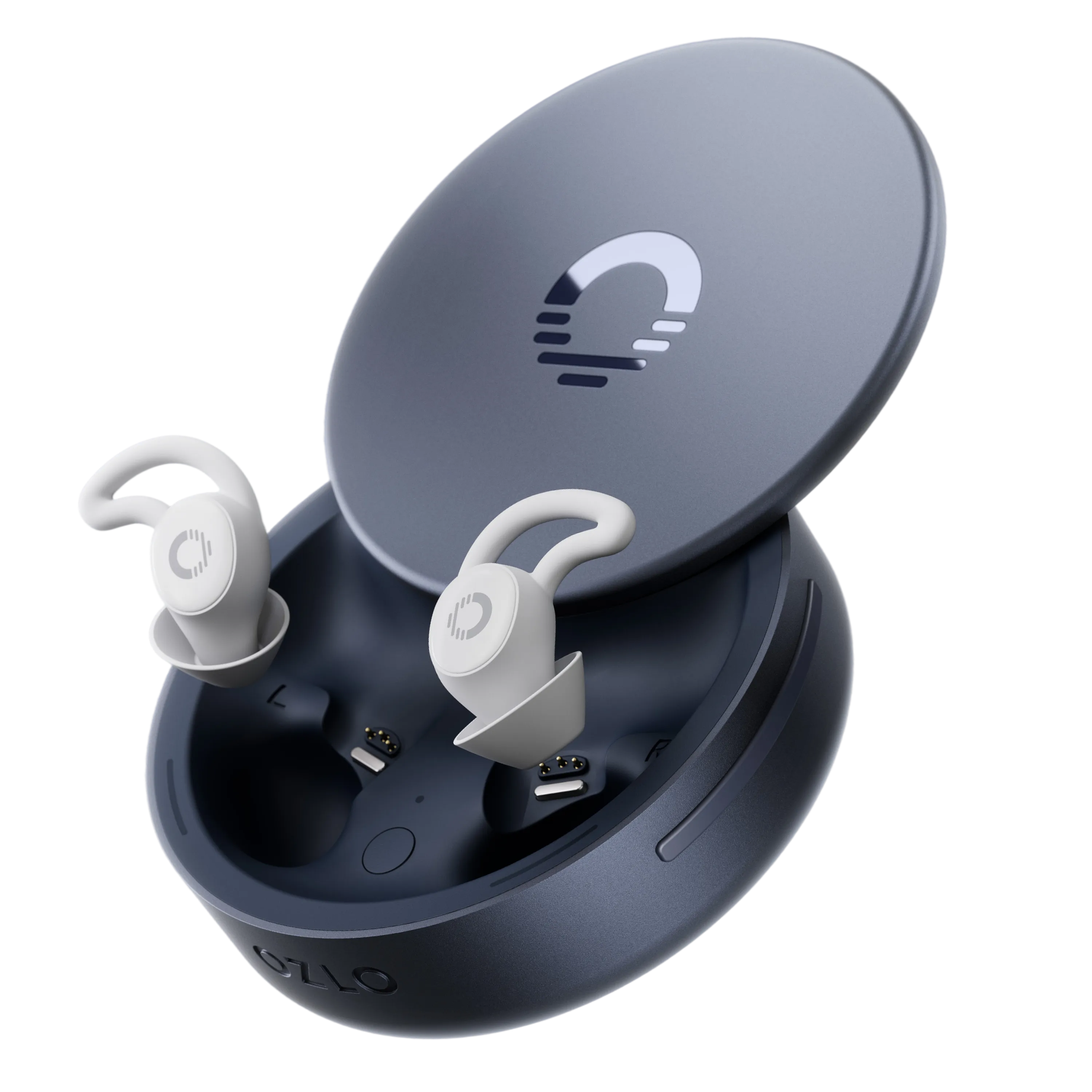
The sensors are the part worth slowing down for. Inside each earbud, biometrics track breathing and movement. Inside the charging case, a separate set of sensors monitors the bedroom environment - sound levels, light, and temperature. The buds tell Ozlo about your body; the case tells Ozlo about the room. A companion app, on iOS and Android, ties it together, offers personalized sound tuning for modes like Spoken Word, Airplane, Focus and Balanced, and syncs with Apple HealthKit and other wearables. Battery life runs up to 14 hours, among the longest in the category.
Detects sleep onset and moves from streaming to masking without you touching anything.
Breathing and movement tracked from inside the ear, not from a wrist.
The case logs light, temperature and noise around the bed.
Blocks incoming calls, alerts and notifications once you're down.
02Who it's for
Ozlo's customer is anyone whose sleep gets wrecked by something outside their control: light sleepers, side sleepers who can't wear bulky headphones, people whose partners snore, frequent travelers, shift workers. Reviewers have repeatedly singled out comfort for side sleepers as the standout, since the buds sit nearly flush in the ear. There's also a use case the company didn't fully plan for - roughly 15% of customers use the buds for tinnitus relief rather than sleep, and Ozlo has begun building a tinnitus-therapy subscription around them. A forthcoming bedside sensing speaker is aimed at a different group entirely: families with young children and elderly users who won't wear anything in their ears.
"They don't understand, actually, how it works in the field because there is no data."
NB Patil, co-founder & CEO - on why sleep content has never been measurable03The quiet pivot: from earbuds to a data platform
Here is where Ozlo stops looking like a gadget company. In early 2026, the team laid out a plan to become a platform for sleep data. They built iOS and Android SDKs that let third-party apps read Ozlo's sleep-state signals. The first marquee partner is Calm: with Ozlo's sensors detecting body movement and respiration, the meditation app can finally tell whether a piece of content actually put someone to sleep - something the entire sleep-content industry has never been able to measure. A hardware sale becomes a data relationship.
On top of that sits a coming AI layer - a "Sleep Patterns" agent, a kind of sleep buddy you can text about last night, plus integrations with wearables and smart-home devices like thermostats. And in the most telling move of all, Ozlo acquired Segotia, an Irish neurotech firm specializing in EEG, to push from movement-and-breathing sensing toward brain-level insight and medical-device certification, with EEG products targeted for 2027. The $279 earbud is the wedge. The clinic is the roadmap.

04How it's different from the competition
The obvious rival is the ghost in the room - Bose's original Sleepbuds, now discontinued, whose fans became Ozlo's ready-made audience. Among the living, Ozlo competes with Soundcore's Sleep A-series, QuietOn's noise-cancelling sleep earbuds, and Kokoon, plus the broader sleep-tracking world of Oura and Eight Sleep. Ozlo's separation is its refusal to be a general-purpose earbud. It doesn't chase active noise cancellation as a headline spec; it leans on masking plus fit. It doesn't bolt on fitness tracking; it doubles down on sleep-specific sensing from two vantage points, ear and room. The strategy is subtraction where competitors add.
05The business, and the bet
On the surface Ozlo is a direct-to-consumer hardware brand: sell Sleepbuds 2 at $279 through its own site, Amazon and retail, plus accessories and refurbished units. But the model is layered. Under the one-time hardware sale sit recurring lines - the tinnitus-therapy subscription, SDK and data licensing to app partners, and eventually certified medical insight from the EEG work. Each layer rides on the same tiny pair of earbuds. That is how a hardware company tries to escape the trap of the single transaction.
The team is about 60 people in Boston - audio engineers, sleep researchers and product designers, many pulled from the same Bose lineage as the founders. The company has raised roughly $28M since 2022, starting with a $10M Series A from LifeArc Ventures and ARTIS Ventures, followed by an unattributed venture round in late 2024, with a Series B reported to be closing. Press coverage has come from TechCrunch, CNN Underscored, Forbes, The Verge and Rolling Stone, and the next-generation buds were crowdfunded first on Kickstarter, where the resurrected product proved demand before a single retail unit shipped.
"Your best tomorrow begins tonight."
Ozlo's brand line - the whole thesis in five words06What the reviewers found
Independent reviews have been broadly positive, with a consistent caveat: the price. CNN Underscored wore the Sleepbuds 2 to bed for a week and landed on the same verdict as most others - a comfortable, effective sleep tool that asks a premium for the privilege. SoundGuys framed them as successfully carrying the torch from the Bose originals while adding custom audio playback. Tom's Guide and others praised the fit for side sleepers and the noise handling. The recurring critiques are predictable for a single-purpose device: at $279 they are an investment, they won't double as your commuting earbuds, and the value depends on how badly noise wrecks your nights. For the person who actually has that problem, reviewers tend to say, few things come closer.
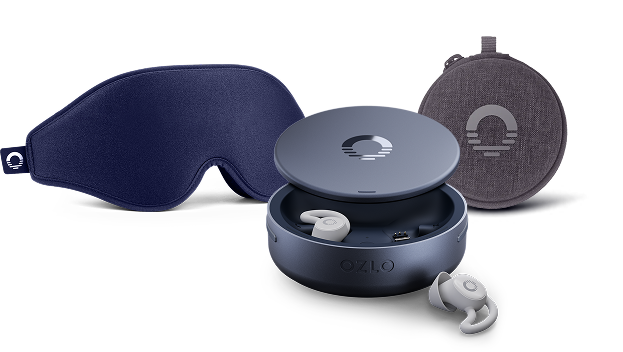
That single-mindedness is also the risk. A device built to do one thing extremely well lives or dies on whether enough people have the exact problem it solves, and whether they'll pay flagship-earbud money for a product they can't wear anywhere but bed. Ozlo's answer is the platform underneath: if the earbuds are also a sensor, and the sensor feeds an app, a partner ecosystem, subscriptions and eventually a medical roadmap, then the hardware doesn't have to carry the whole business alone. Whether that stack materializes on schedule is the open question. The pieces - Calm, the SDKs, Segotia, the AI agent - are announced; the compounding is still ahead.
07The through-line
Most startups begin by inventing something new. Ozlo began by refusing to let something old disappear. The founders had proof of demand that most companies would kill for - a discontinued product people were still hunting for online - and they had the rare advantage of knowing exactly how it was built, because they'd built it. What they've done since is quietly reframe the category: sleep, they're betting, is a data problem wearing the costume of an audio problem. Buy the earbuds, and you've handed them the sensor.