Somewhere in Beaufort, South Carolina, a marketing director is fielding the same question she has heard for years: is this the bed people actually cool down to 55 degrees? The answer is yes, and the machine that does it has one of the stranger corporate lineages in consumer hardware - a family tree that reaches back to the person credited with inventing the modern waterbed, and a company that has been renamed four times, funded by KKR, killed off once, and quietly brought back to life.
Chilipad by Sleepme sells a deceptively simple thing: a mattress pad that circulates temperature-controlled water under your body. A thin pad sits on top of your mattress. A bedside dock holds a reservoir and a pump. You set a target temperature, and water moves through the pad to hold your side of the bed there - cold enough to feel like a cool cave, or warm enough to feel like a heated blanket. No blowing air. No room air-conditioner. Just water, doing what water does better than air: moving heat.
One Bed, Two Extremes
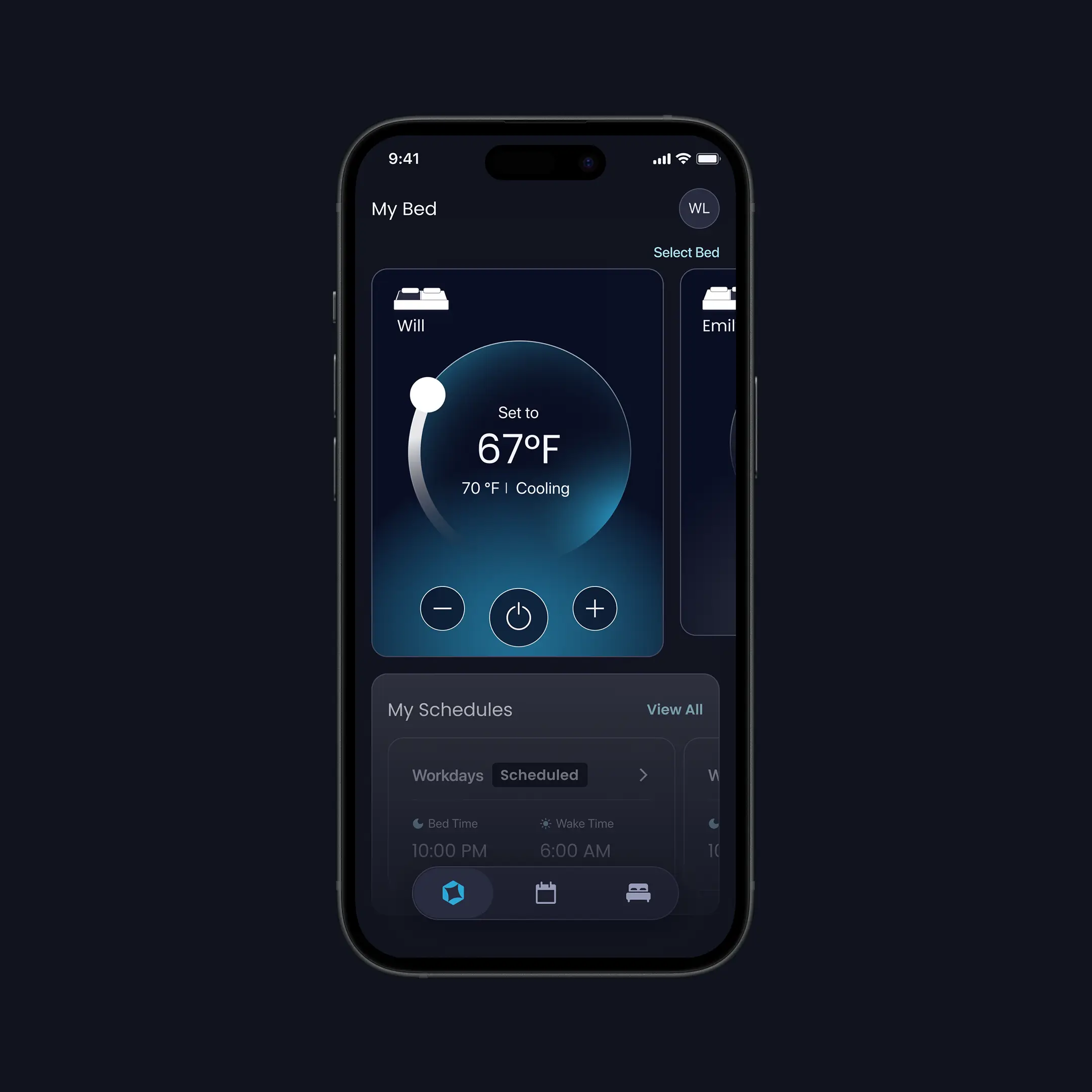
The physics is the whole pitch. Water transfers heat far more efficiently than air - Chilipad likes to cite roughly 25 times - which is why the company circulates fluid instead of running a fan. The practical payoff shows up in the detail that sells the most beds: dual-zone control. Each side of a shared bed can be set independently. One partner runs 55°F while the other runs 115°F, and the oldest argument in every shared bedroom - too cold, too hot - becomes a settings screen.

A night-sweats problem and a physicist's answer
The company that became Chilipad started in 2000 as T2 International, founded by Todd and Tara Youngblood. Todd had chronic night sweats. Tara had a physics and math degree and a habit of reading her way into new fields - Chinese medicine, neuroscience, sleep science. The first chiliPAD shipped in 2007 under the name Chili Technology, out of North Carolina. The origin the founders tell is domestic before it is technical: they wanted to be comfortable, and then, as Todd put it, found "the magical connection with temperature and sleep."
There is a piece of folklore that follows the brand everywhere. Charles Hall, widely credited with inventing the modern waterbed in the 1960s, is reported to be a relative of Todd's - a great-uncle, in most tellings. It is repeated in interviews and reviews more often than it is documented in a legal filing, so treat it as the good story it is. What is not in doubt is that the water-under-the-body idea has been in this family's orbit for half a century.
What you actually buy
Strip away the branding and Chilipad is a pad plus a dock. The current flagship, Chilipad 2.0, launched in 2026 with a quieter redesigned dock, a larger water reservoir, in-bed detection, and - notably in an app-first era - a physical nightstand remote. It cools to 55°F, heats to 115°F, and comes in single or dual-zone. It starts at $1,599, is financed through Affirm, and is HSA/FSA eligible, which is its own quiet argument: the US healthcare system will help you pay for it, because temperature-regulated sleep is being filed under health rather than luxury.

The product line before it reads like a museum of sleep-tech naming: the original chiliPAD and Chilipad Cube (2017), the app-controlled OOLER (2019), the Wi-Fi Dock Pro that debuted at CES 2022 and now sells as Chilipad 1.0, the chiliBLANKET that married cooling to a weighted blanket, and Sleepme Insights, a non-wearable sleep tracker and software layer. The hardware evolved; the promise did not.
Why it isn't Eight Sleep
The obvious rival is Eight Sleep, and both use circulating water, so the difference is in the business model as much as the hardware. Eight Sleep sells whole-bed systems with AI "Autopilot" auto-adjustment and a monthly subscription. Chilipad lets you buy a single side, set an exact number, skip the fee entirely, and - a detail owners bring up unprompted - machine-wash the pad. On the other flank sits BedJet, which is cheaper, air-based, and louder. Chilipad's positioning is a deliberate refusal: no subscription, no wearable, one dial.
| Chilipad | Eight Sleep | |
|---|---|---|
| Buy one side? | Yes | Whole bed only |
| Subscription | None required | Monthly fee |
| Set exact temp | Yes, degree by degree | AI auto-adjust |
| Pad cleaning | Machine washable | Spot clean |
| Method | Circulating water | Circulating water |

Athletes, executives, and the hot-sleeper underground
Chilipad's customer list reads like a group chat between an NFL locker room, a NASCAR garage, and a biohacking podcast. The through-line is recovery: cooler cores are associated with deeper sleep, and deeper sleep is currency for anyone whose job is physical. Tim Ferriss is a documented user; the brand has circulated in athlete and executive circles for years. But the least glamorous customer may be the most important - people managing night sweats, including hormonal and menopause-related temperature swings, for whom a programmable bed is less a gadget than a medical convenience.
That breadth is also the market position. Chilipad does not compete for the shopper who wants a new mattress; it competes for the layer on top of whatever mattress you already own and refuse to replace. That is a narrower, stickier slice of the roughly multibillion-dollar sleep-tech category - closer to a health accessory than a furniture purchase, which is exactly why HSA and FSA eligibility matters and why retail placement in Best Buy sits beside gadgets rather than beds. The company's expertise is not textiles or foam; it is thermodynamics and the small, unglamorous engineering of a pump that has to run silently every night for years.
Four names, one shutdown, one rescue
The corporate story is where it gets interesting. The parent renamed itself to Kryo in 2016. In December 2020 it merged with Pittsburgh's Ebb Therapeutics, a clinical sleep-tech firm with a cooling headband, and raised $37 million led by KKR's health-care growth fund. In 2021 it rebranded again, this time to Sleepme Inc., and launched a SaaS platform. Then, in May 2023, Sleepme Inc. ceased operations. For most consumer hardware brands, that is the end - warranties evaporate, docks become paperweights.
Instead, in July 2023, Sleep Solutions Inc. acquired the assets, consolidated ChiliSleep, OOLER, and Chili Technology under the single "Chilipad by Sleepme" banner, and kept honoring warranties. The product refused to stay dead. It is now operated out of North Carolina, still shipping, still stocked at Best Buy, and still - three years on - launching new hardware.
What a founder can steal from this
Three moves are worth copying. First, pick a physics fact your competitors can't argue with - water beats air, full stop - and let it carry the marketing. Second, turn a universal domestic conflict (the thermostat war) into a product feature (dual zones) instead of a lifestyle promise. Third, when everyone else adds subscriptions and wearables, subtract them; "one-time purchase, no fee, wash the pad" is a position, not just a price. The conditions where it breaks are honest too: at $1,599 it is a real purchase, docks are mechanical parts that will eventually need service, and if you want hands-off AI that adjusts for you overnight, Chilipad's dial-it-yourself philosophy is a feature to some and a chore to others.
The last thing worth noting is philanthropy that predates the marketing team. During 2020 the Kryo Cares program donated more than $600,000 in sleep systems to first responders, healthcare workers, and military, and the company partnered with the veterans' non-profit Grey Team to help veterans sleep. A brand that has been renamed four times kept that thread through every logo - which, more than any spec sheet, is the part that tells you what the founders thought they were building.