The alarm clock has not really changed in about a hundred years. It gets louder, it moves from a nightstand to a phone, it learns a few new ringtones, but the basic deal is the same: a machine startles you awake, and you spend the next ten minutes recovering from being startled. A small group of students at UC San Diego looked at that arrangement and asked the obvious question nobody was asking. Why does waking up have to hurt?
Their answer is PAQ Wear, a San Diego sleep-tech company, and its first product, VibeRise. It is not a smartwatch, and it is not trying to be. It is a soft fabric band you wear on your wrist to bed, and instead of noise it wakes you with vibration - a gentle, escalating buzz timed to your sleep cycle. Quiet enough that the person sleeping next to you never stirs. The company sells it directly on its website for $55.
01 / The ProblemWhy the loud alarm is worse than annoying
Most of us treat the morning jolt as a personal failing - proof that we are not morning people. PAQ Wear's pitch starts somewhere more physical. A loud alarm does not just interrupt sleep; it triggers a small stress response before you are even conscious. Heart rate climbs, blood pressure rises, and adrenaline shows up to a party you did not want to attend. Then comes the fog, the grogginess that researchers call sleep inertia, which can linger for a while after you have technically woken up.
The company's argument is that the tool is the problem. If the alarm is the thing spiking your stress, no amount of willpower fixes it. You need a different mechanism. That reframing - from "you are bad at mornings" to "your alarm is badly designed" - is the whole reason PAQ Wear exists.
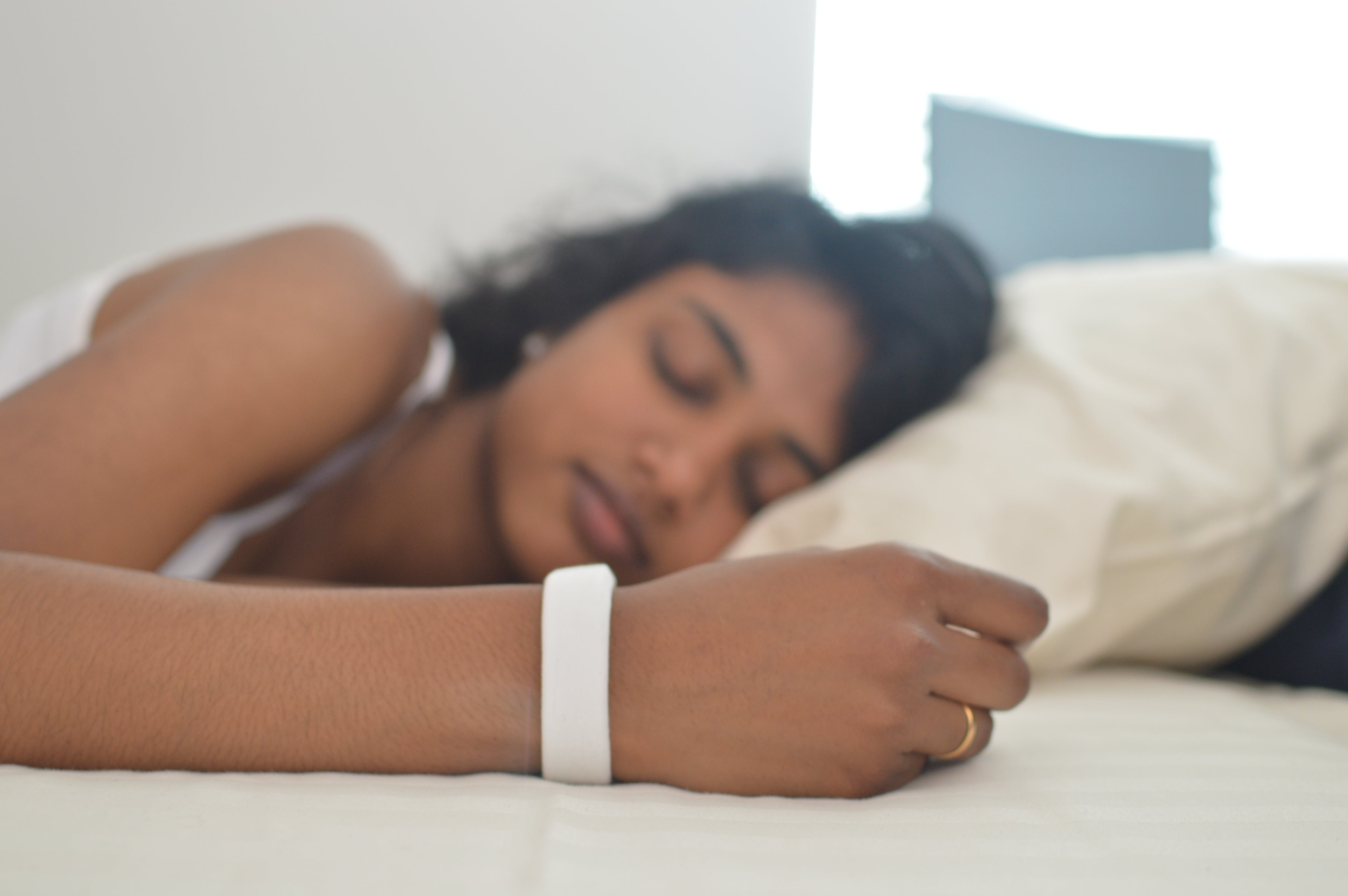
02 / The ProductA wearable you actually want to wear to bed
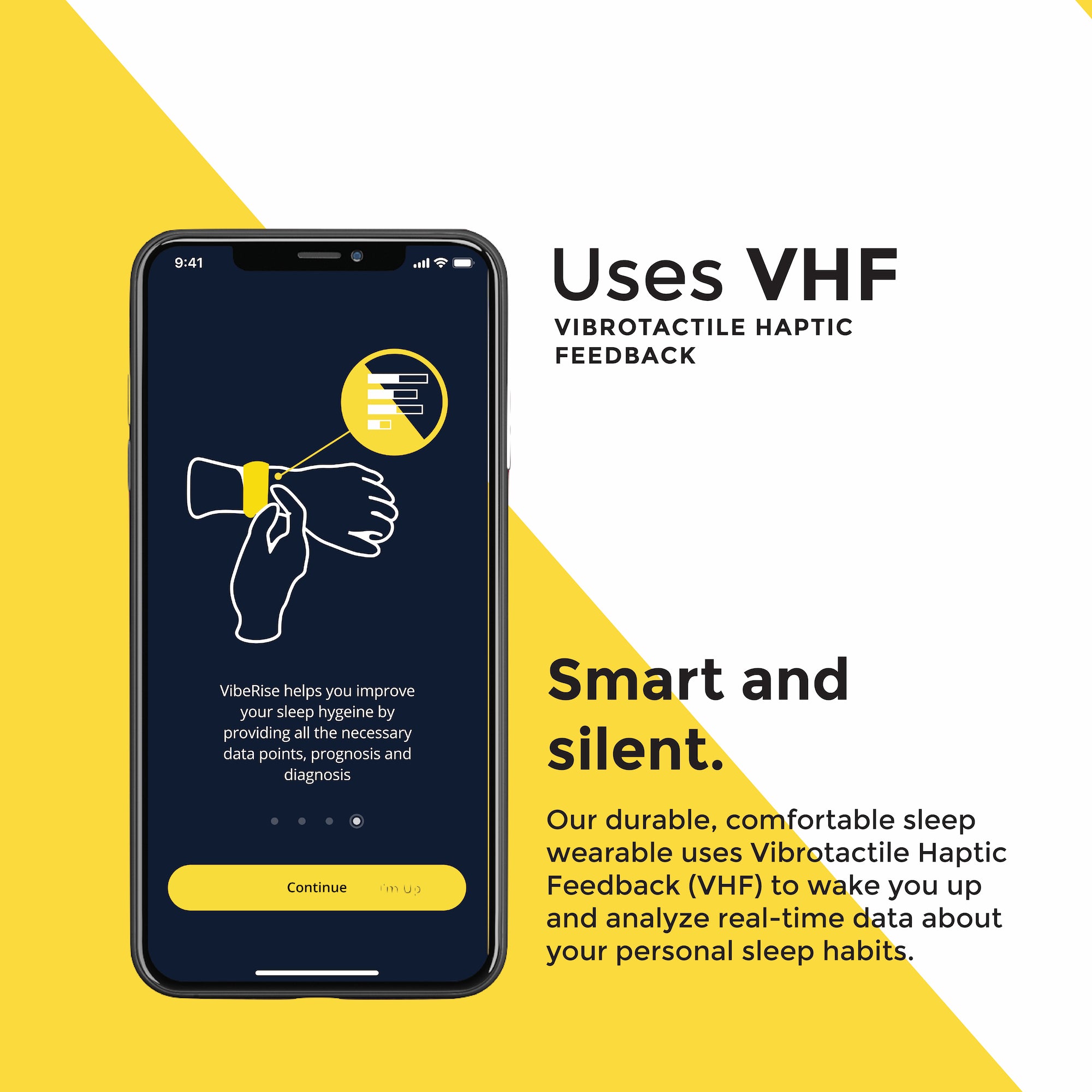
The mechanism has a clinical name - vibrotactile haptic feedback, or VHF - but the idea is simple. Tiny motors sit against the wrist and vibrate in a low range, roughly 1 to 15 Hz. Those pulses register in the part of the brain that processes touch, the same region tied to your basic sleep cues, and they coax you out of your current sleep stage gradually rather than yanking you out all at once. Set against your circadian rhythm, the goal is to have you surface at a moment when waking is easier, feeling closer to rested than ambushed.
What makes VibeRise unusual is less the electronics than the fabric. This is not a rigid plastic tracker with a rubber strap. PAQ Wear built the band out of soft, breathable, antimicrobial material that is meant to disappear on your wrist overnight. It is made with recycled birch bark and is biodegradable, which is a strange sentence to write about a piece of consumer electronics and exactly the point. Comfort is not a nice-to-have here. If a device is uncomfortable, you take it off before bed, and a sleep wearable you do not wear is worthless.
People deserve to optimize their lifestyle without having to make compromises on comfort and their relationships.- PAQ Wear
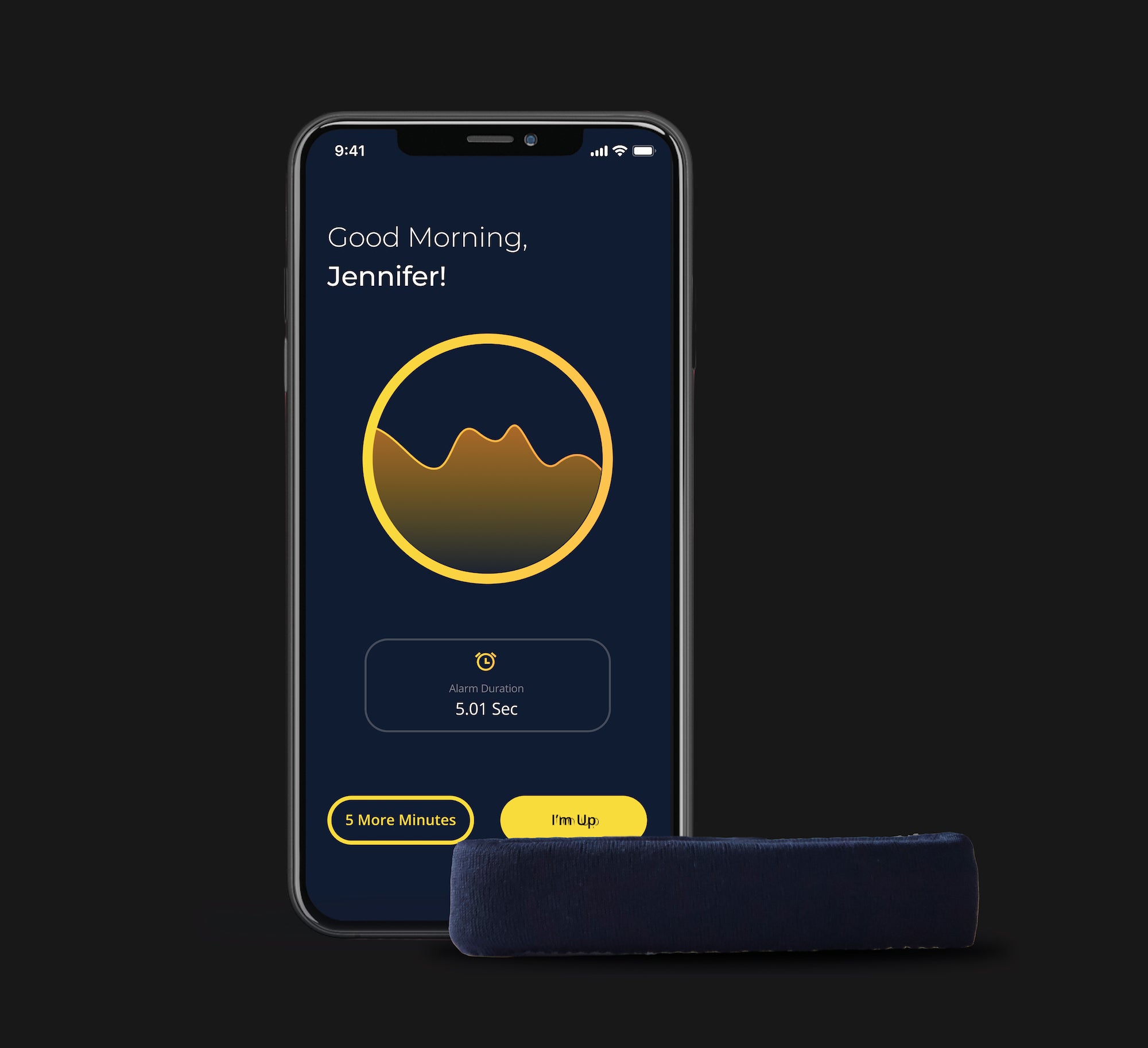
The band is paired with a companion app on iPhone and Android. It tracks how long you sleep, how much time you spend awake in bed, and - the metric that tends to land - how much sleep debt you are quietly accumulating. Rather than lecturing you, it hands you the smallest possible fix: add thirty minutes tonight. That is the behavior-change philosophy in miniature. Less friction, not more guilt.
03 / How It WorksFrom wrist to wide awake
Slip on the fabric band at night. It only needs to be worn while you sleep.
The app logs sleep length, time awake in bed, and accumulated sleep debt.
At wake time, motors pulse at 1–15 Hz, easing you out of your sleep stage.
You surface gradually - no sound, no jolt, no waking your partner.
04 / The DifferenceThe case for doing one thing
Walk into the wearables aisle and everything competes on breadth. The Apple Watch, Fitbit, and Oura Ring all measure steps, heart rate, blood oxygen, workouts, and sleep, and they buzz or beep you awake as a side feature. PAQ Wear went the other way. It picked one job - wake you up gently, without sound - and built the entire product around it, down to the fabric.
That focus is the differentiator. A general-purpose smartwatch treats the silent alarm as one setting among hundreds. PAQ Wear treats it as the reason the thing exists. For the specific person this is built for - a heavy sleeper, someone who shares a bed, someone who would rather not strap a glowing computer to their wrist at night - narrow beats broad.
It is worth being honest about where the pitch has limits. A single-purpose device asks you to buy and charge one more thing for a job your phone technically already does. If you sleep alone and a quiet phone buzz on the nightstand already gets you up, the case is softer. And a gentle wake-up is a feature for light and medium sleepers - the very heaviest sleepers, the ones who can snooze through a fire drill, are also the hardest crowd for any silent alarm to win over. PAQ Wear's answer is comfort and consistency: a band you never take off will always be there at wake time, and the app keeps the pressure on your habits rather than your eardrums.
Waking up: loud alarm vs. silent buzz
Illustrative comparison of the wake-up stress response PAQ Wear designs against. Loud alarms trigger heart-rate and adrenaline spikes; VHF aims for a gradual rise.
05 / The BusinessSold direct, funded by the crowd
PAQ Wear is a direct-to-consumer business. There is no retail middleman and no carrier deal - you buy VibeRise on the company's Shopify storefront, and the app is free. The band comes in a few muted colorways, the kind of palette that reads bedroom rather than gym.
The origin story is pure student startup. The team crowdfunded VibeRise on Indiegogo in 2020, and by their account launched the campaign during finals week at UC San Diego - roughly the worst possible time to run a fundraiser. It worked anyway. They hit more than 70% of their goal in the first three days and were fully funded inside the first week. It is a small detail, but a telling one: a sharp, specific problem raises money faster than a broad, hedged pitch.
We're passionate because what we do is going to help people's quality of life.- PAQ Wear
06 / The PeopleA dorm-room problem, scaled up
PAQ Wear grew out of UC San Diego's student entrepreneurship scene, with a founding team drawn from communication, cognitive science, and mathematics. They describe themselves less as hardware veterans than as people who were tired of miserable mornings and could not find a product that fixed it, so they built one. That is the honest version of a lot of good startups: the founders were the first customers.
The company remains small - the kind of early-stage team where everyone does several jobs. What it lacks in scale it makes up for in a clear point of view. The mission it states is not modest in ambition even if the team is: to optimise sleepwear that brings better sleep health and happiness for millions of people. Whether PAQ Wear gets there is an open question. But the framing - sleepwear as technology, comfort as a feature, quiet as a product - is a genuinely different bet in a market crowded with screens.
07 / The MarketWhere PAQ Wear fits
The customer for this is easy to picture. It is the person who sets three alarms and hates all of them. It is the couple where one is an early riser and the other is not, and the 6 a.m. buzzer has quietly become a relationship issue. It is the wellness-minded buyer who already tracks steps and water and would like their mornings to feel less like an assault. PAQ Wear says VibeRise has shipped to more than fifteen countries, which for a team this small is less a scale claim than a signal that the problem is not regional. Bad mornings are universal.
The broader story here is a market that keeps confusing more data with more value. Sleep-tech has trained us to wake up and immediately check a score. PAQ Wear's quieter thesis is that the point is not the dashboard, it is the rest - and that the most valuable thing a sleep product can do is nothing dramatic at all. Wake you without a fight. Let the person beside you stay asleep. Nudge you toward thirty more minutes when you need them.
There is a lesson in it for anyone building consumer hardware. You do not have to invent a new sensation. Vibrotactile feedback already existed; PAQ Wear just aimed it at a problem everyone has and nobody had solved well, and wrapped it in a material people would actually tolerate against their skin all night. The band is $55 and the idea is older than the company. What is new is the focus.