The Guy Who Bet $22M That You'll Never Buy AA Batteries Again
Dennis Bertken spent nearly two decades researching why flashlights fail. His answer - Infinity X1 - is a light that carries two power sources so it never leaves you in the dark, and it has already sold more than 15 million units.
Reach into almost any junk drawer in America and you will find a flashlight that does not work. The batteries are dead, or corroded, or missing, borrowed months ago for a TV remote and never returned. This is the quiet failure of an entire product category: the flashlight is the one tool you buy specifically for emergencies, and it is the one tool most likely to let you down during one. Infinity X1, a San Diego company, was built to fix exactly that.
The fix sounds almost too simple to be a business. Instead of asking you to pick a side in the rechargeable-versus-disposable battery debate, Infinity X1's flashlights carry both. A rechargeable core handles daily use. When it runs down and there is no outlet in sight, you pull the core and drop in a tray loaded with standard AA batteries. The light keeps running. The company calls this "hybrid power," and it is the entire reason the brand exists.
Behind that plain idea is an unusually long runway. According to the company, the research into consumer lighting and portable power began around 2005 - nearly two decades before its products filled retail shelves. The founder and CEO, Dennis Bertken, is a consumer-products veteran who previously ran Life+Gear. He did not chase a trend. He picked a boring, universally owned object that routinely disappoints its owner, and treated it as an engineering problem worth a career.
What Infinity X1 actually makes
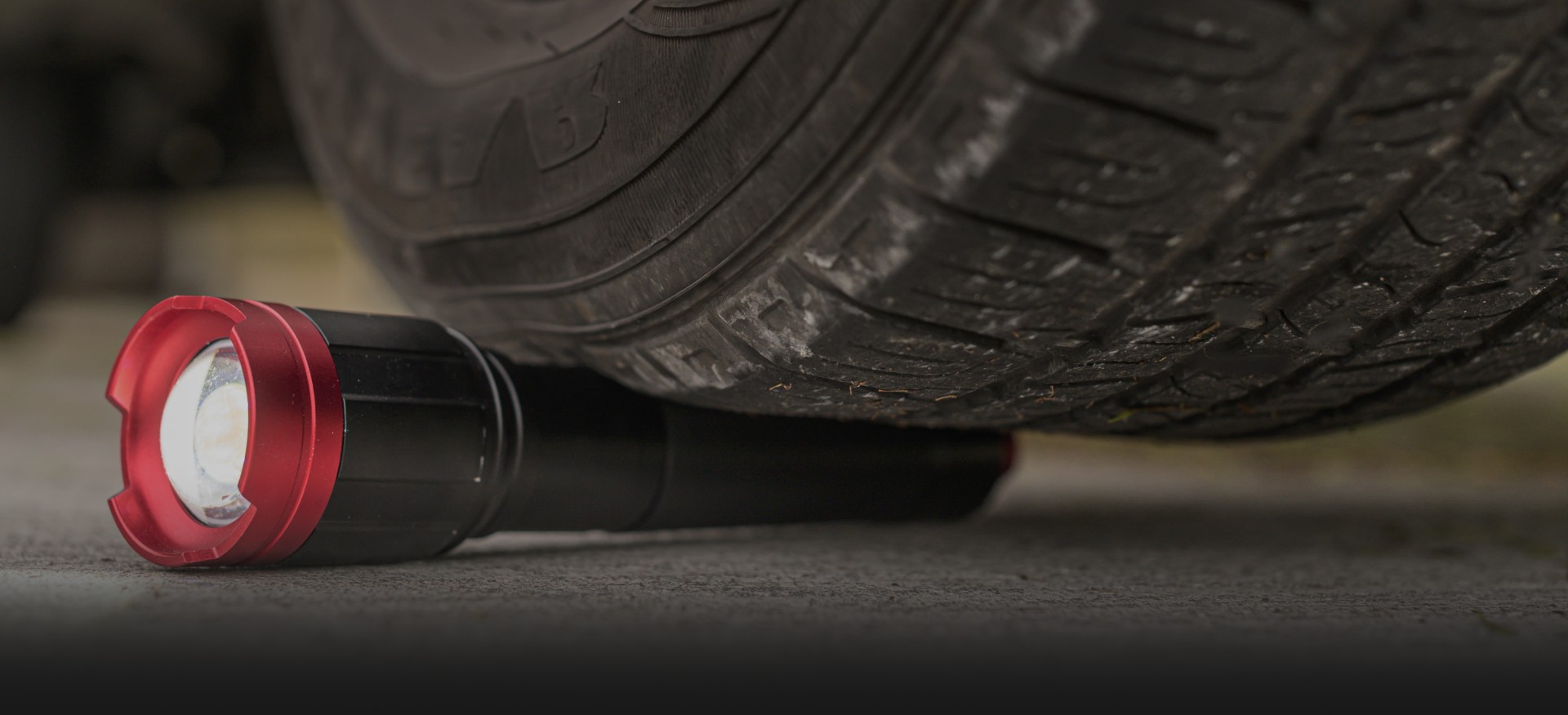
The catalog is narrow on purpose: flashlights, headlamps, lanterns, and work and auto lights. Within that, the flashlights are the headline act. Models range from roughly 3,500 to 7,000 lumens, with twist-to-focus beams, multiple brightness modes, and bodies machined from aircraft-grade aluminum. The higher-end lights throw a usable beam a long way - the company cites up to about 656 feet on its brightest model. Several double as a power bank, with a USB port so the light in your glovebox can also revive a dead phone.
How "hybrid power" works
The headlamp line carries the brand's other signature. Infinity X1 markets a feature it calls Broadview Vision, which it describes as the first wearable light to deliver a full 220-degree viewable spectrum. The pitch is not "brighter" - it is "wider." Most headlamps punch a single cone straight ahead; a broad field is more useful when you are working with your hands, reading a trail map, or cooking at a campsite and want to see the whole scene, not one bright circle of it.
Who buys a light like this
The customer is easy to picture because it is most of us at one point or another. Campers and hunters who cannot risk a dead light miles from the truck. Anglers rigging line before dawn. Motorcyclists and drivers who keep one in the vehicle. Tradespeople who need a work light that survives a drop onto concrete. And the largest group of all: households buying for the storm, the outage, the "just in case." Reviewers in outdoor and gear publications have generally praised the brightness and the dual-power design, with the usual caveats any hardware product collects over a large enough sample.
That first and third number, side by side, are the interesting part. Fifteen million units and a lifetime warranty is a bold pairing - it only works if the products are durable enough that the warranty rarely gets called. It is also a positioning statement. In a category where store-brand lights race one another to the bottom on price, Infinity X1 is trying to compete on reliability and the promise that it will still work the night you actually need it.
"Infinity's rapid growth and innovation in the personal lighting space have positioned the Company as a leader in the sector."
Nick Cipiti, Director, CriticalPointThe problem it is really solving
Strip away the lumens and the aluminum, and Infinity X1 is selling the removal of a specific anxiety: the fear that your light will die at the worst moment. The rechargeable-versus-disposable argument has a hidden cost on both sides. Rechargeables are convenient until you forget to charge them. Disposables are reassuring until you are standing in a blackout with no fresh batteries in the house. By carrying both, the hybrid design quietly deletes the trade-off. You do not have to have planned ahead.
There is an environmental angle stacked on top. The company frames part of its mission around keeping single-use batteries out of landfills and shrinking packaging waste - it says it developed compostable, water-soluble packaging. Whether a buyer cares about that or simply wants a light that works, the same product serves both. That is a cleaner alignment of incentives than most "eco" hardware manages, because the sustainable choice and the practical choice are the same object.

How the business is built
For a brand that has moved more than 15 million units, the operation is deliberately lean - roughly seven employees. The leverage comes from the model: Infinity X1 designs, manufactures, and distributes both branded and private-label lighting. It sells direct to consumers through its own online store and wholesale into the biggest retailers in the country, with products stocked at Walmart, Costco, and Amazon. Design and proprietary technology stay in-house; volume manufacturing and retail reach do the scaling.
The technology is where the moat is meant to be. Infinity X1 holds what it describes as patented Sustainable Power Management - the hardware and software that governs switching between power sources inside a single light, across its Hybrid Single-Core, Hybrid Dual-Core, Hybrid AC/DC, and rechargeable products. Broadview Vision is likewise described as patented. In a commodity category, a defensible mechanism for "the light that never dies" is worth more than another few hundred lumens.
"CriticalPoint took the time to understand our business model and to position Infinity to achieve a successful transaction."
Dennis Bertken, CEO, Infinity X1The capital story fits the company's unglamorous confidence. In April 2023, Infinity X1 completed a recapitalization with Main Street Capital Corporation, which provided first-lien senior secured term debt plus a direct minority equity investment, partnering with the existing owners and management team. CriticalPoint served as the exclusive financial advisor. Reported financing around the company totals roughly $22 million. There is a small investing lesson buried in that timeline: in a year when money chased anything with "AI" in the pitch deck, a lender wrote a check to a flashlight company - because it sells millions of units of something people genuinely need.
Where it fits in the market
Infinity X1 lives among familiar names - Energizer, Coast, Streamlight, Fenix, Olight, Nebo, Duracell-branded lights, and the endless private-label options on every hardware aisle. It does not try to out-spec the enthusiast brands on raw performance or undercut the store brands on price. Its wedge is the combination: dual power so the light never dies, aircraft-grade construction, the wide-field headlamp, sustainable packaging, and a lifetime warranty that signals the company expects its products to last. That is a narrow lane, but it is a real one, and it is aimed squarely at the buyer who has been burned by a dead flashlight before.
The honest limits are worth stating too. Hybrid design adds cost and complexity a bare-bones light does not carry, so the value only lands for buyers who prize reliability over the lowest sticker price. Any dual-power system depends on the rechargeable pack holding up over years, and a lifetime warranty is only as good as the service behind it. Infinity X1 is betting that enough people, often enough, will pay a little more to never again reach into a drawer and find a light that will not turn on.