A flashlight is supposed to be the opposite of fashion. You buy one, throw it in a drawer, and rediscover it during a blackout beside three batteries that expired during the Obama administration. Olight rejected this melancholy fate. The portable-lighting company turned a cylinder with a button into an object people anticipate, collect, photograph and debate. Its American operation, OLIGHTSTORE USA INC in Marietta, Georgia, runs the storefront and distribution end of a global hardware system built for everyone from campers and mechanics to everyday-carry obsessives and tactical users.
The product catalog still speaks fluent hardware: lumens, candela, throw distance, battery capacity, water resistance. But the selling system speaks culture. There are anniversary events, livestreamed launches, seasonal finishes, loyalty perks and a fan base called O-Fans. A customer-submitted color named Dream Blue escaped a design contest and appeared on multiple lights. The object has utility; the release calendar supplies theater.
That theater gives an ordinary tool a date, a conversation and an audience. In a sleepy durable-goods aisle, attention is an operating advantage.
That combination makes Olight more instructive than another story about a brighter LED. It also makes the company's 2022 product recall impossible to treat as a footnote. When performance is designed to live in a pocket, heat is not an abstract engineering variable. It is touching somebody's leg.
The product is readiness. The SKU is a flashlight.
Olight began in 2007 with a torch called the T20. It moved into tactical lighting with the M20, then broadened through compact Baton lights, Warrior tactical models, headlamps, lanterns, bike lights, clip lights and weapon-mounted products. Today, the useful way to understand the range is not by model number but by the moment of anxiety each product removes.
A camper wants a headlamp that leaves both hands free. A technician wants a magnetic work light that stays on a steel surface. A runner wants visibility without a brick on the forehead. An EDC buyer wants a small tool that sits flat, does not roll away and survives rain. A tactical customer wants immediate controls and a focused beam. Parents want a lantern when the power goes out. Collectors, meanwhile, want Tuesday's light in copper and next Thursday's light in a color that resembles a sports car.
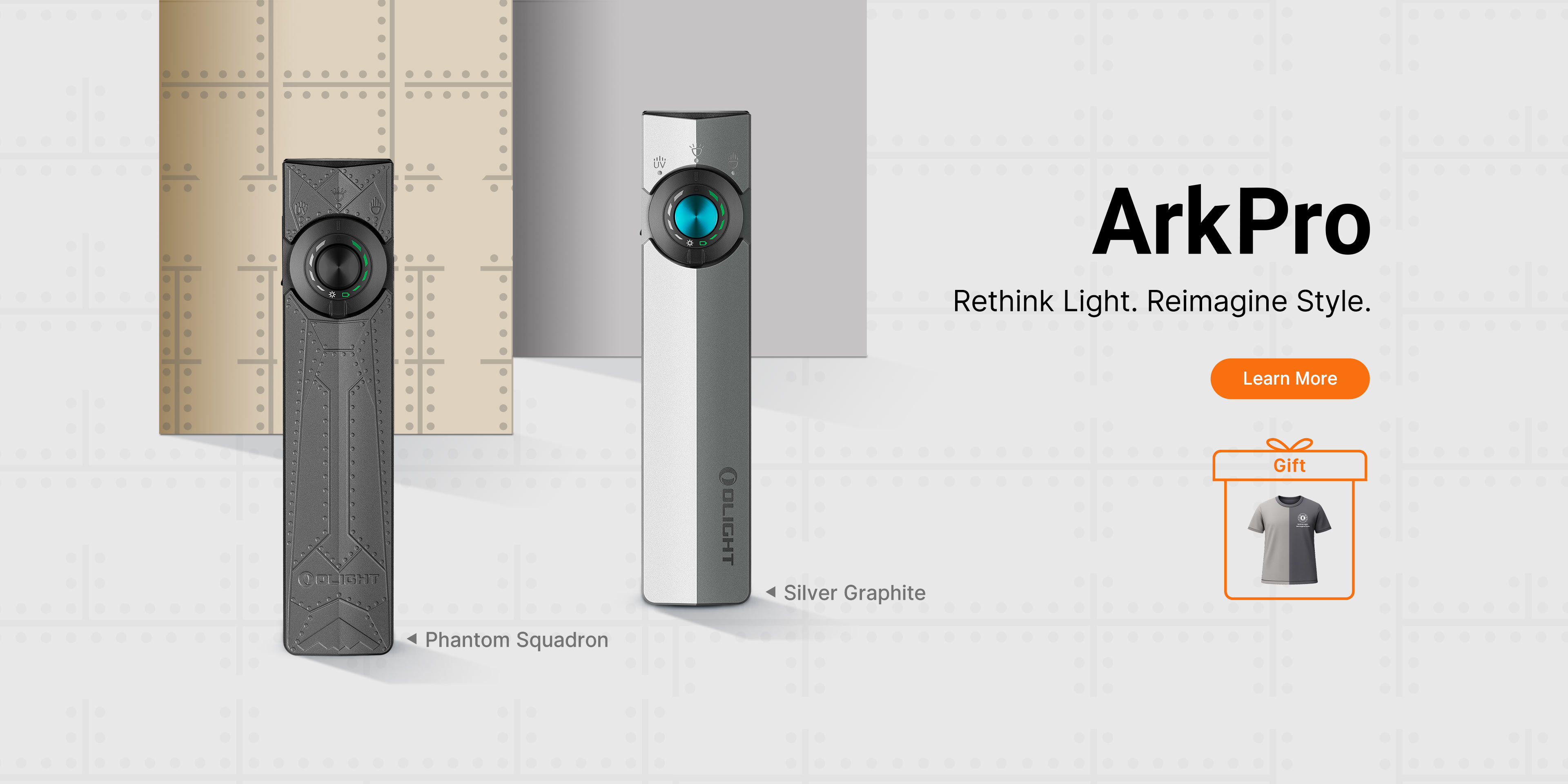
The Arkfeld family made the design argument visible. Instead of the classic round tube, it uses a flat pocket shape and combines functions such as white light, ultraviolet light and a green laser. The newer ArkPro line adds distinct flood and spot beams on some models. The idea is not merely more output. It is fewer separate tools rattling around in a bag.
Then the pocket got hot
On March 9, 2022, the U.S. Consumer Product Safety Commission announced the recall of roughly 215,100 Olight M2R Pro and Warrior Mini flashlights. The lights could switch on inadvertently and overheat while stored in a holster or pocket. Olight had received 127 reports of activation and overheating, including 22 burn injuries. Three were reported as second-degree burns. The affected lights had sold from November 2019 through November 2021 for $48 to $120.
This was the first thing to fail in the business story: the assumption that instant, high-output access and safe pocket carry naturally coexist. A feature can be correct on a test bench and wrong in context. The recall offered a full refund as store credit or a free replacement, and the company contacted known purchasers. That response addressed units already in the field. The tougher job was changing what came next.
The funnel nobody wants
Later Warrior Mini models used proximity sensing to reduce output near an obstruction. That created a new problem: users said the sensor sometimes dimmed the light during ordinary use, including through glass. Olight's Warrior Mini 3 introduced what it called a pre-activated proximity sensor, designed to intervene only when the light begins near an obstruction rather than policing every reflection. The sequence matters. Safety hardware came first; field complaints then made the safety hardware less intrusive.
A U.S. lifetime warranty for qualifying purchases made after January 1, 2023 added another promise. Core components such as the structure, built-in battery, LED and lens are covered under the published terms. A warranty is not absolution, but it is a measurable claim on future operating costs. If reliability is bad, the repair queue collects the bill.
A launch machine disguised as a lighting company
Olight makes money chiefly by selling products directly online, with Amazon, independent shops and a physical U.S. experience store adding reach. Direct sales preserve the customer relationship. Accessories, chargers, limited finishes and frequent new releases create reasons to return even though a good flashlight should last for years. This is the central business-model trick: sell a durable object without behaving like a once-a-decade appliance company.
The first American experience store, opened in 2024, fits that logic. Olight described it as a bridge between online and offline, with product handling and pickup layered onto an ecommerce base. This is a store as community interface, not a confession that direct-to-consumer failed.
The community program also extends beyond product polls. Since 2020, Olight has used pink-edition charity sales and product donations to support breast-cancer organizations, including the National Breast Cancer Foundation in the United States. The company reported raising $192,902 worldwide in 2020 and $167,205 in 2021, followed by Platinum Partner recognition in 2022. The mechanism is familiar - a limited product creates a reason to gather - but the beneficiary changes. For a brand built around preparedness, linking a release to practical support is more credible than hanging an unrelated cause on a checkout page.
The competitive set is crowded: Streamlight, Fenix, Nitecore, Acebeam, SureFire, Maglite, Nebo and a wilderness of marketplace brands. Some rivals lean harder into professional credibility, emitter choice, standardized batteries or price. Olight differentiates through industrial design, magnetic charging, bundled functions, polished direct marketing and a participatory release cycle. The trade-off is ecosystem friction. Enthusiasts regularly debate proprietary batteries and magnetic chargers because convenience inside one brand can feel like lock-in outside it.
The $1.14 million change of mind
Ostation X shows the company testing a move beyond illumination. The countertop device accepts loose rechargeable AA or AAA batteries, checks them, charges healthy cells, rejects bad ones and stores the ready supply. Bluetooth links it to an app. It is less glamorous than a 200-meter beam and arguably more ambitious: Olight wants to remove the small recurring hassle that keeps households buying disposable batteries.
What changed the company's mind about scaling it? Evidence. Olight said it had built 20 working prototypes but considered the category risky enough to seek market scrutiny before full production. Kickstarter became a product referendum. The 2024 campaign set a $100,000 goal, then raised $1,142,494 from 5,845 backers, an average pledge around $195. The direct cost to participate varied by reward; one early public offer put entry around $99. For Olight, the more consequential cost was committing a novel mechanism, tooling plan and delivery promise in public.
The campaign did three jobs at once: funded inventory, measured demand and recruited the first cohort of opinionated users. Ostation X later became a 2025 CES Innovation Awards honoree in sustainability and energy transition. By 2026, Ostation 2 broadened the idea with combined AA and AAA storage; the Pro model also added magnetic ports for compatible Olight flashlights. The adjacency is coherent. A customer already trained to recharge a flashlight is more likely to appreciate a battery-sorting appliance than a random smart-home buyer.
What a reader can copy
Five useful thefts, no flashlight factory required
- Build a release rhythm around a stable customer job.
- Let customers leave visible fingerprints on colors, features or bundles.
- Use crowdfunding as a go/no-go test for a risky adjacency.
- Turn warranty terms into a concrete confidence signal.
- Treat complaints as inputs to the next control system, not a moderation problem.
The copyable lesson is not “make more colors.” Novelty without a reliable core product becomes clearance inventory. Community co-creation also fails when customers cannot see their contribution, when launches arrive faster than quality controls, or when scarcity becomes manipulation. Crowdfunding is a poor fit when the technical risk is still unknowable, delivery estimates are theater, or the company needs secrecy more than feedback.
Where it works
A product used often, shown socially and improved in visible increments; customers care about identity as well as utility.
Where it breaks
Safety-critical complexity outpaces testing, proprietary convenience becomes lock-in, or launch velocity outruns service capacity.
Olight also cannot simply claim that every customer segment wants the same thing. A flashlight collector may enjoy limited titanium. A fire department needs procurement support, standardized parts and documentation. A new parent wants a simple lantern that turns on during an outage. The closer the use gets to professional duty, the less launch theater can substitute for service, interoperability and proven performance.
There is another condition: the economics need room for service. Frequent launches, free gifts and long warranties are attractive only when gross margin, spare parts and support staffing can carry them. Public revenue and valuation figures for the private company are not available, so the cushion cannot be measured from the outside. A younger hardware brand copying the spectacle without Olight's manufacturing network or installed customer base could discover that every exciting launch creates a quiet tail of returns, firmware questions and replacement shipments.
Still, Olight occupies an interesting market position: more designed and community-driven than commodity lighting, more mass-consumer than the narrow professional brands, and broad enough to turn charging into an ecosystem. Its expertise sits at the seam between portable-light engineering and direct retail. The machines illuminate things. The business keeps attention.
The best version of the Olight playbook is therefore not speed for its own sake. It is a loop that can admit embarrassment. A fan chooses a color; a technician reports a sensor problem; a safety agency records an injury; thousands of backers validate a new category. All of those signals travel back toward the product. The recall remains the hard fact in the middle of the story. The reason to keep watching is whether the feedback loop continues to outrank the launch calendar.
Explore the beam