A career built on objects that fit in a pocket
There is a particular kind of professional who is nearly impossible to write about, because he has spent two decades doing the work instead of describing it. Jacob Knudsen is one of them. Search his name and the internet coughs up a LinkedIn headline, an org-chart tile, and two YouTube videos. That is the entire public record of a man who sits in the C-suite of a company with more subscribers than most magazines have readers.
The headline reads: Chief Marketing Officer, Blade HQ. The org chart agrees. Beyond that, the biographical trail runs cold with a speed that, in 2026, borders on the eccentric. No newsletter. No conference keynote circuit. No thought-leadership carousel about the future of retail. Just a job, done for a very long time, at a knife store in Utah.
Let us establish the facts, since there are pleasingly few of them and each one earns its place.
Utah, 2001 to 2007
Knudsen enrolled at Brigham Young University in 2001 and left in 2007 with a Bachelor of Fine Arts in industrial design. This is worth pausing on. Industrial design is the discipline of deciding how a physical object meets a human hand - the radius of a corner, the weight of a hinge, the click of a mechanism doing what it promised. It is a training in tactility. It is also, on paper, an odd springboard into running marketing for an ecommerce company.
Except it isn't, not here. Blade HQ does not sell software. It sells folding knives, fixed blades, multitools and flashlights - objects whose entire commercial appeal is how they feel when you pick them up and how satisfying they are when they close. A marketing chief who instinctively thinks in detents and pivot tension has an unfair advantage in that category. He is not translating the product for the customer. He simply is the customer, with a budget.
The company he walked into
Blade HQ launched in March 2003. Its own About page tells the origin with a bluntness most corporate histories sand off: a small loan, a dream, and an overabundance of confidence. The founder, Cam Hughes, was a college-age obsessive who could not find an online knife shop that met his standards, so he built one. A first-party company blog post from 2013 recounts the part that most origin stories quietly delete - the business nearly went bankrupt about two years in, and the founder slept at the store to keep it breathing.
Knudsen arrived on the other side of that near-death experience, joining around 2007 as Chief Creative Officer. He would hold that title for the next sixteen years.
Sixteen years. In an industry where the average marketing leader changes companies roughly as often as most people change phone plans, this is either a failure of ambition or an act of quiet defiance. The evidence favours defiance. During his run in the creative chair, Blade HQ appeared on the Inc. 5000 four separate times - 2009, 2010, 2011 and 2014 - and expanded to well over 100,000 square feet of warehouse space split between Pleasant Grove, Utah and a large facility in Marion, Virginia. The company also consolidated its sister storefronts, folding Bladeplay.com into the Grindworx brand in a rebrand announced on 29 March 2018.
In January 2023 the title changed. Chief Creative Officer became Chief Marketing Officer. Whether the job changed as much as the business card is a question only the org chart could answer, and the org chart is not talking.
The channel that ate the trade press
The most striking thing about Blade HQ is not its warehouse footprint. It is the YouTube channel, which joined the platform on 28 February 2011 and has since published more than 1,100 videos to an audience north of 580,000 subscribers. The tagline is exactly as restrained as you would expect: "The world's most epic knife store!"
Consider what that number means. A retailer in a niche hardware category has assembled a larger standing audience than the trade publications that cover it. The shows have names - Knife Banter, Week One Wednesday, The Weekly Pick, Collector's Corner - and formats and recurring hosts. It is a small television network attached to a shopping cart.
The content strategy behind it is not clever, which is precisely why it works. People who genuinely like knives film knives, at length, for other people who genuinely like knives. There is no attempt to be a lifestyle brand. Nobody is drinking coffee on a mountaintop. It is a man at a table explaining why the lockup on a particular folder is or is not acceptable, and 580,000 people find this worth their evening.
The balisong drawer
Which brings us to October 2024, and the only occasion on which the internet has been permitted a proper look at Jacob Knudsen.
Blade HQ's Collector's Corner is a format built on a simple premise: put a collector in front of a camera and let them show you the things they love more than is strictly reasonable. On 25 October 2024 the collector was Knudsen, and the collection was balisongs - butterfly knives - including pieces from the early era of the format. The company's own video description is characteristically deadpan: "Blade HQ CMO, Jacob Knudsen, talked us through his balisong collection including pieces from the early era of butterfly knives."
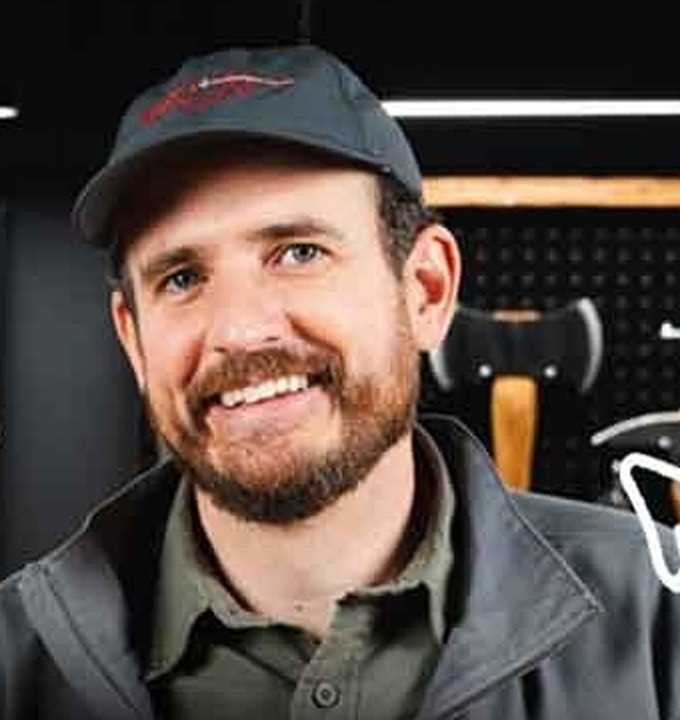
The thumbnail is more theatrical. A hand-drawn arrow points at a bearded man in a dark cap, next to text reading: YOU WON'T BELIEVE HIS BALISONG COLLECTION. He is smiling in a way that suggests he knew exactly what he was walking into.
Balisong collecting is its own particular subculture, with its own arguments about tang pins and zen pins and washers, and a strong tendency to divide the room. That the marketing chief is a serious participant in it - not a curious observer, a participant - explains rather a lot about why the company's content reads as authentic. You cannot brief that into an agency. There is no research budget that buys it.
The podcast that lasted one episode
On 21 October 2023, Blade HQ launched Steel and Stories: The Blade HQ Podcast. Episode 1 featured Knudsen and George Muhlestein sitting down with Dave Wattenberg of Pro-Tech, a genuinely significant figure in American production knifemaking.
There is no Episode 2.
It would be easy to file this as a failure, and slightly more interesting to file it as a decision. A great many companies, having launched a podcast with fanfare, will limp through a dozen episodes purely to avoid the social cost of stopping. Blade HQ tried a format, judged that it did not earn its slot next to shows that were already working, and went back to those. Discipline is rarely photogenic. It is usually the correct call.
The absence as a strategy
The most modern thing about Knudsen is how thoroughly unmodern his public profile is. He is a C-suite marketing executive at a consumer brand with an enormous social following, and he has no discoverable personal Twitter account, no Instagram, no personal website, no Substack, no author page on his own company's blog. He is not even listed on Blade HQ's Media Team page, which names the on-camera regulars.
You may read this as invisibility. It is more usefully read as a division of labour. The brand has the audience. The hosts have the faces. The CMO has the job. In a decade where the received wisdom insists every executive must also be a media property, someone declining the invitation is worth noticing.
Oscar Wilde observed that there is only one thing worse than being talked about. He had not met an executive who had genuinely opted out and still shipped a nine-figure operation, and one suspects he would have been intrigued.
What the record actually shows
Strip away the interpretation and you are left with a short, tidy list. A design degree from BYU. Roughly nineteen years at a single company. A promotion earned rather than negotiated between employers. Four Inc. 5000 listings during his tenure in the creative chair. A retail brand that turned itself into a media brand and then into a product brand, via an Exclusives programme that produces limited runs and colourways with Benchmade, Spyderco, Kershaw, CIVIVI and others - the point at which a store stops being a shelf and starts being a collaborator.
And a drawer full of butterfly knives, some of them old, all of them accounted for.
It is not a story with a third act or a dramatic pivot. It is the far rarer kind: someone found the thing they were suited to at twenty-four, and then stayed. Lehi, Utah gets written about for software unicorns. A few miles away, a knife store built a two-state warehouse operation, a half-million-strong audience and a product line, without a funding round or a press tour. Its marketing chief would presumably prefer you looked at the knives.

