The easiest way to misunderstand MAAK is to call it a power-bank company. Yes, the Santa Barbara-area hardware outfit made its consumer entrance with Scout, a 10,000mAh battery in a thick, weather-sealed shell. It charges a laptop, tablet and phone through two USB-C ports and a Qi2 wireless pad. It survives the sort of dust, water and drops that make an ordinary charger look like a desk ornament. But the battery is the invitation, not the whole party. MAAK is selling a physical operating system for carrying, mounting and powering the devices people now drag into places where outlets do not exist.
That distinction explains the clips, locking cables, phone and tablet cases, chest rigs, vehicle mounts, pouches and downloadable 3D files. A customer can start with one object, then build a kit around a hike, an off-road vehicle, a workday or a tactical assignment. In hardware, where every new product brings tooling, inventory and warranty risk, a shared attachment system is not decorative cleverness. It is the business model.
01 / ORIGINThe field came before the feed
MAAK did not begin with a mood board of campfires. It grew out of Bunker Supply, a Goleta company that develops on-body, mission-critical gear for frontline personnel. MAAK says the original equipment was used by frontline agents, search-and-rescue teams and remote medical crews. Those users do not tolerate a loose cable, a blocked charging port or a mount that turns into a rattle after the third bump.
That history gave co-founders Ryan Olson, Marco Vanella and Jared Naito an unusually demanding first customer. Olson leads as CEO, Vanella spans product and marketing, and Naito leads technology. Their wider design group says it has helped bring hundreds of products to market since 2014. The MAAK trademark itself was filed by Bunker Supply in 2022, entered commercial use in January 2024 and was registered that August. The consumer brand arrived with a tactical family tree already attached.
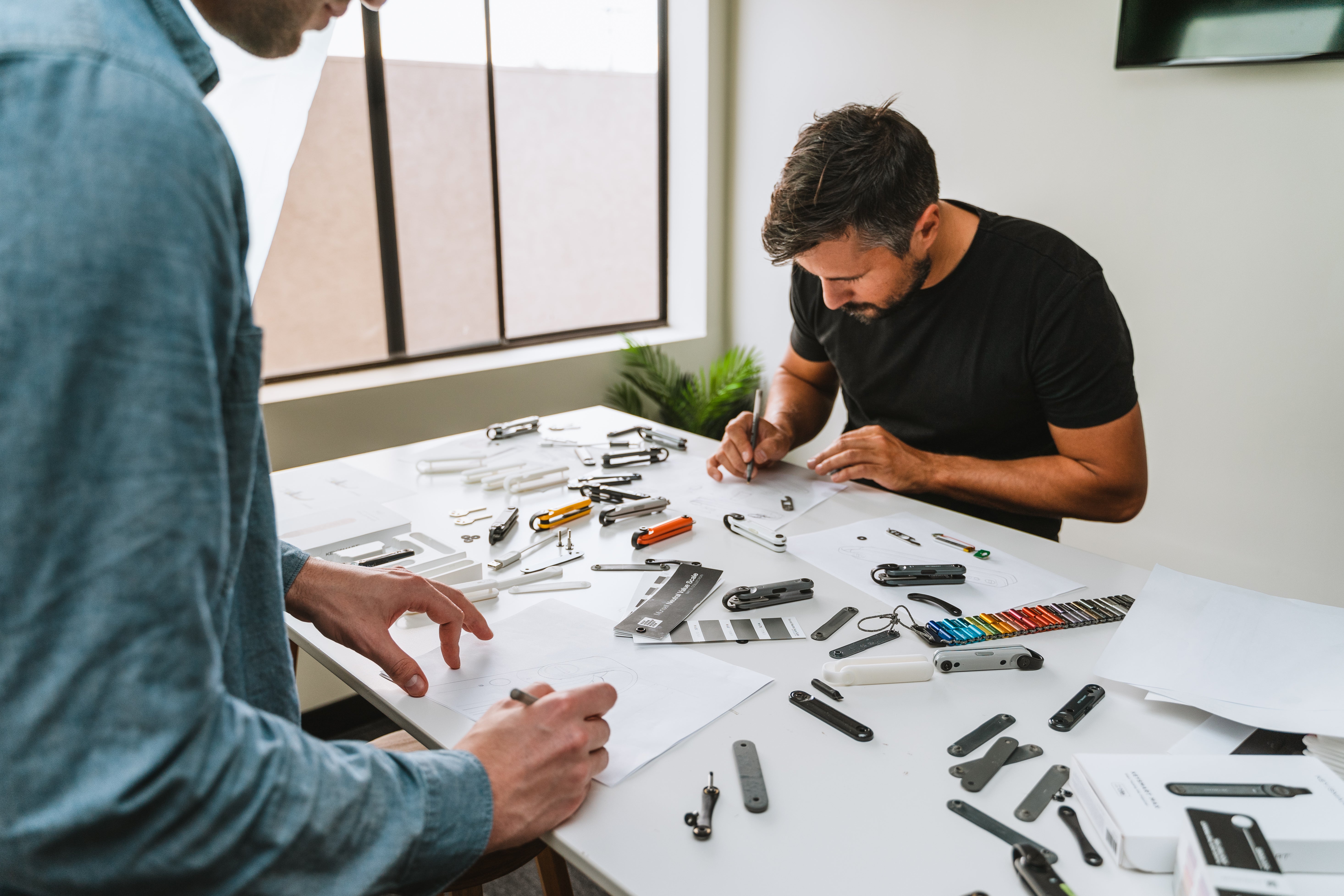
The change of mind was not a retreat from that market. It was an expansion of it. A person running mapping software in the field, a medic keeping communications alive and a traveler filming for a day all meet the same blunt problem: their electronics outlast neither the weather nor the battery meter. MAAK kept the engineering logic and changed the context. Its phrase, “Made for Operators. Designed for Everyone,” is less a slogan than a concise market map.
02 / PRODUCTOne battery, many places to put it
Scout is the center of the current story. The production specification lists a 10,000mAh capacity, 75 watts of total output, 35-watt input, two USB-C ports and up to 15 watts of Qi2 wireless charging. The 300-gram body carries an IP67 rating and a MIL-STD-810 ruggedness claim. An included Adventure Clip attaches it to a pack or other equipment. A locking cable keeps a wired connection from shaking loose while preserving the enclosure's protection.
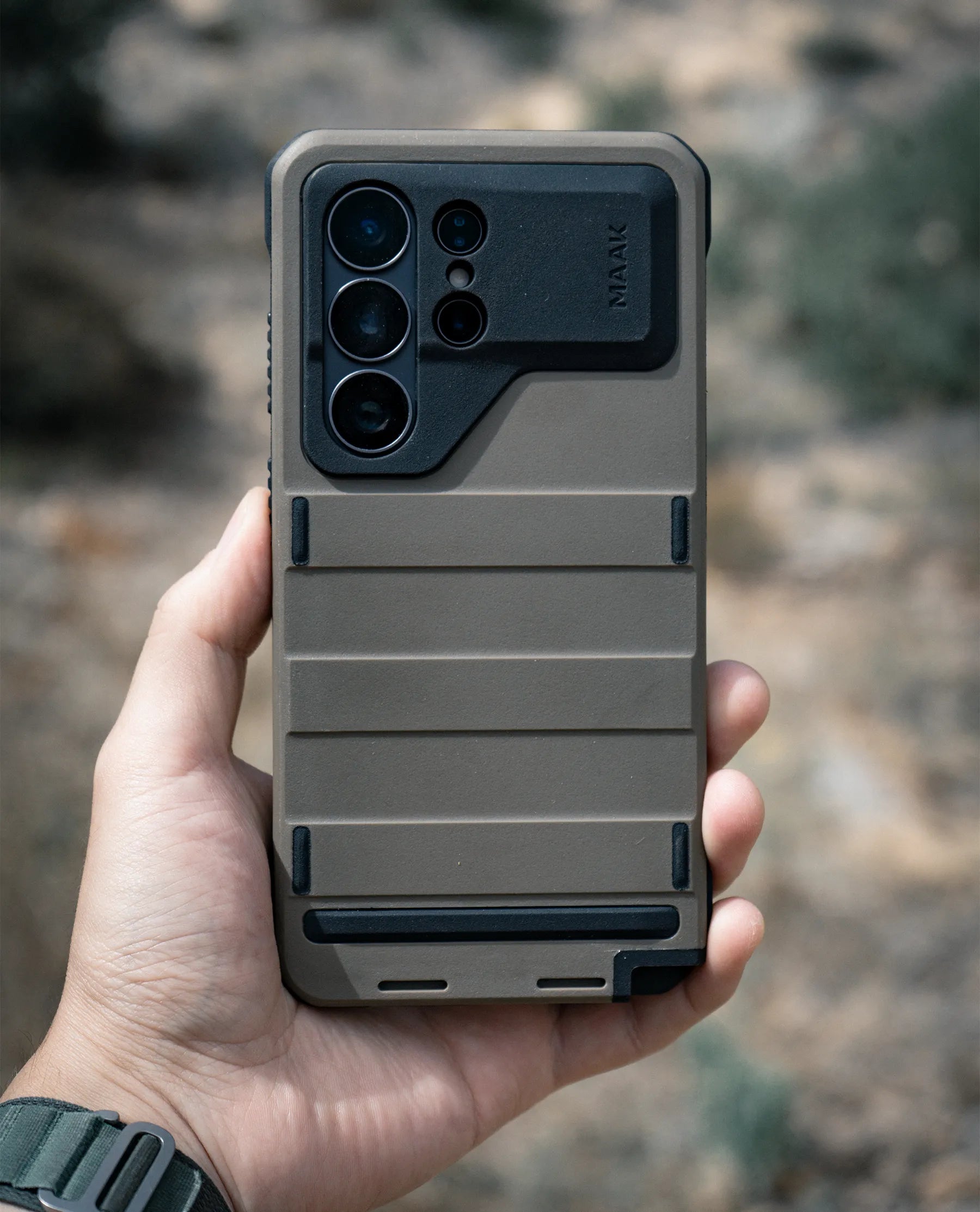
Forge cases make the other half of the connection. They use a rigid polycarbonate structure, shock-absorbing thermoplastic material and mounting points for accessories. Current options cover selected Samsung Galaxy, Google Pixel and rugged tablet models. The Chest Mount then puts a Forge-protected device on MOLLE gear, lets the screen open to an adjustable viewing angle and can hold a Scout behind it for wireless charging. Vehicle, belt and clip products move that same protected device to another surface.
The prices make the ladder visible. Forge phone cases are commonly listed at $79. The Chest Mount starts at $129 and reaches $178 in a current configuration. Small adapters begin around $9 to $19; more specialized cables and mounts move toward $59 to $98. Scout was promoted at $125 during crowdfunding and is listed at $169 on Shop. This is not a low-cost substitute for a generic case and battery. It is a system for buyers who put a premium on secure attachment and fewer loose parts.
03 / VALIDATIONThe $5,000 question got a $101,486 answer
On January 30, 2025, MAAK put Scout on Kickstarter with a modest $5,000 goal. It funded in under an hour. Thirty days later, the campaign had collected $101,486 from 568 backers - 2,030 percent of the target. The average pledge was $178.67, notably higher than the $125 campaign price cited in early coverage. That suggests the useful behavior was already beginning: backers were buying bundles and accessories, not merely the center object.
Crowdfunding did three jobs at once. It produced working capital, forced MAAK to explain a complicated product in one visual story and exposed the team directly to buyers. Vanella wrote that he spent the first day engaging with backers and watching them validate the need for reliable expedition power. Campaign updates quickly previewed the Chest Mount and unlocked a black color, a glow-in-the-dark strap and more ways to attach Scout. The comments were not just applause. They were live product research.
The first thing to fail, at least in the campaign narrative, was the idea that Scout could be explained as a battery alone. MAAK describes years of development, hundreds of prototypes, compressed schedules and the familiar friction between design, engineering, manufacturing, marketing and logistics. As backers responded to clips, straps and mounting possibilities, the product story widened into a platform.
“The battery is the receipt. The attachment points are the strategy.”YesPress analysis
04 / MARKETThree crowded shelves, joined together
MAAK competes across categories that stores usually separate. Portable-power brands sell output and capacity. Rugged-case companies sell impact protection. Mounting specialists sell clamps, arms and plates. A shopper can assemble a workable kit from those shelves, often for less money and with broader phone compatibility. MAAK's argument is that the seams are where trouble lives: the cable pulls out, the battery swings from a pack, the case does not fit the mount, or the useful screen is buried when both hands are occupied.
The company responds by controlling the connection points. MAAKLOCK lets accessories share a geometry. The Chest Mount swaps hardware as devices change. Scout can power a mounted phone without occupying the phone's data port. In Bunker Supply's tactical work, the same architecture extends into fleet provisioning and field modules. In consumer language, it becomes a camera adapter, an adventure clip or a tidy pouch. The expertise is not chemistry alone; it is mechanical integration.
The open-source page is the most interesting proof of that posture. MAAK offers free 3D-printable files for an ID wallet, universal plate, storage box and Scout-to-GoPro adapter, and says it will update them from community feedback. Giving away the small plastic edge can make the paid core more useful. It also lets a 10-person company explore niches that would be uneconomic to tool and stock itself.
05 / PLAYBOOKWhat another founder can copy
Start with the fussy customer.
MAAK learned around frontline users, where a weak connection is obvious. Find the segment that notices quality fastest, even if it is not the largest market.
Launch a doorway, not a catalog.
Scout gave Kickstarter a single object to understand. The cases, clips and mounts created expansion after the first promise landed.
Standardize the boring geometry.
A shared rail or interface is easy to overlook and hard to replace. The durable value may sit in the dimensions every accessory follows.
Let the community build the long tail.
Free printable modules turn obscure requests into experiments without forcing the company to carry every possible SKU.
When this playbook breaks
A system loses its advantage when customers need only one part, change phones faster than cases can ship, or prefer universal mounts over a proprietary interface. It also fails if the core is merely rugged-looking. Premium prices, tactical associations and a growing web of components increase the burden of testing, support and backward compatibility. Modularity compounds value only when the parts remain available and genuinely fit.
06 / NEXTThe campaign was a beginning, not an achievement badge
MAAK now has the less photogenic job of becoming an operating company. The store lists returns, warranty support and shipping from Santa Barbara. The catalog has moved into current Samsung devices, Pixel models, a rugged tablet, vehicle hardware, the Terra Pouch and dozens of small components. Through Bunker, Scout has also appeared in tactical deployment kits and at a 2026 soldier-technology conference. That gives MAAK two feedback loops: professionals who punish equipment and consumers who punish checkout friction.
The opportunity is to make those loops reinforce each other without confusing them. An overlander does not need a defense brochure. An operator does not need lifestyle theater. Both may want a device that stays put, stays powered and moves cleanly from body to vehicle. If MAAK keeps solving that plain mechanical problem, the strange collection of batteries, cases, straps and downloadable boxes starts to look coherent. Not a gadget brand. A place for gadgets to work together.