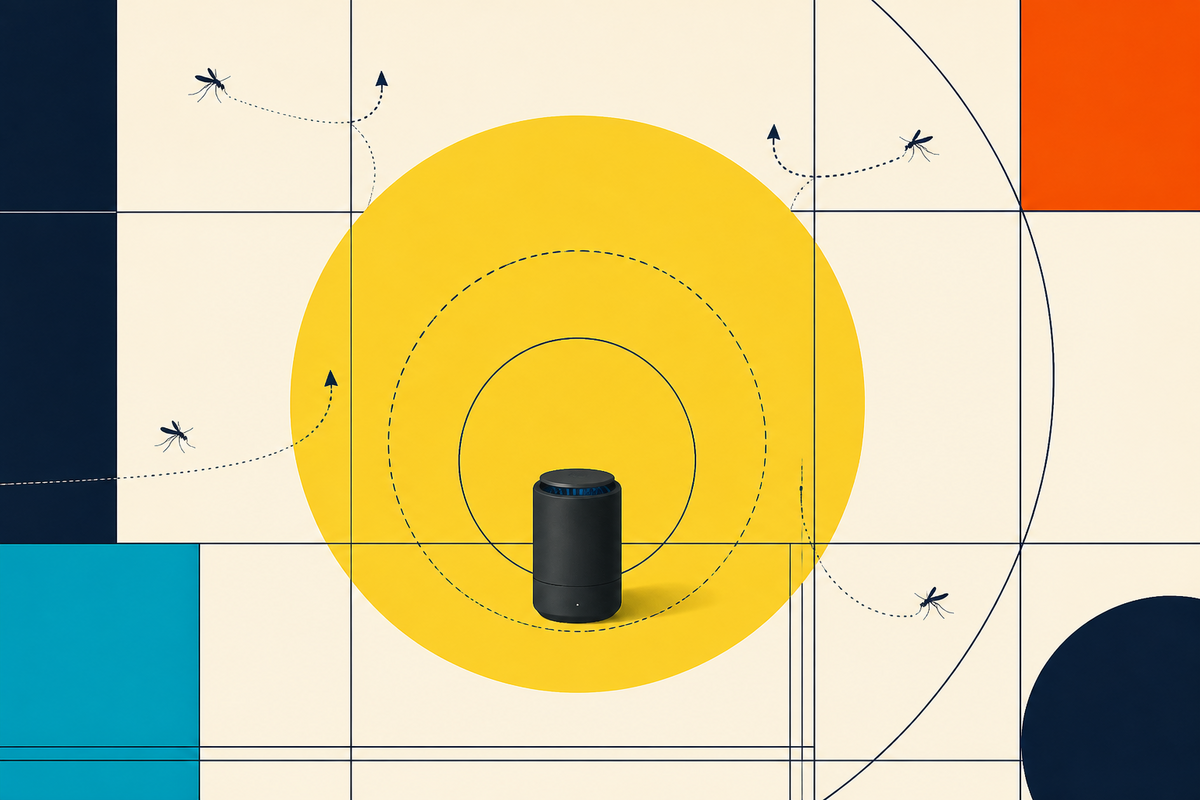
At dusk, a Thermacell repeller performs a peculiar bit of domestic theater. The black cylinder sits low on a patio table. A light comes on. Nothing sprays, smokes or buzzes. After a few minutes, the company says, heat has carried enough repellent into the surrounding air to make a circle roughly 20 feet across less inviting to mosquitoes. The product is visible. The effect is not. Yet the boundary is the whole proposition.
That circle is a clever unit of commerce. It is larger than a person, smaller than a yard and easy to picture beside a grill, at a campsite or under a soccer sideline tent. Thermacell has spent more than two decades turning it into a category: spatial mosquito repellent, protection for a place rather than a coating for skin. The idea now supports rechargeable and fuel-powered hardware, liquid cartridges and mats, a tick-control line, direct ecommerce, shelves at major retailers and a professionally installed smart system.
The appliance in the insect aisle
Thermacell's origin story begins far from the swamp. Bill Schawbel, a former Gillette executive, formed the Schawbel Corporation in 1981 after acquiring appliance businesses from Gillette. His team developed a portable butane heat source for cordless products: curling irons, glue guns, soldering irons and even bottle warmers. The useful asset was not any one appliance. It was controlled heat without a wall socket.
SC Johnson later approached Schawbel's group about mosquitoes. Engineer Jim Bonnema developed a prototype in 1994, and a four-year development effort followed. When the larger partner wanted more market research, Schawbel's team launched under the Thermacell name. The first repellers reached consumers in 1999. A power system that once warmed hair tools now warmed a repellent mat.
The mechanism remains disarmingly simple. Fuel-powered models heat allethrin in a replaceable mat. Rechargeable models heat metofluthrin from a liquid cartridge. The vapor diffuses through the nearby air and interferes with mosquitoes' willingness to enter the zone. Thermacell says its formulas and devices undergo EPA review, and its label instructions govern where and how each product should be used. The devices are for outdoors. Air movement matters. A stiff or shifting breeze can thin the plume or carry it away.
Heat rises
Repellent diffuses
Zone forms
That limitation clarifies the job. Thermacell is most useful when people are staying put: talking around a table, fishing from a bank, waiting in a blind or sleeping near a tent. Someone hiking through moving air still has good reason to use topical DEET or picaridin. The company is not abolishing the mosquito. It is furnishing a room that happens to have no walls.
A ladder from campsite to cabana
The range divides by setting and power source. Butane models appeal to hunters, anglers and campers who value long runtime away from electricity. Rechargeable E-Series devices make sense on patios and at games, where one-button operation matters more than off-grid endurance. The 2025 E65, priced at $39.99 at launch, added a drop-in dock, a two-hour charge, 6.5 hours of battery life and a 36-hour refill. Tick Control Tubes use an entirely different biological route: mice carry permethrin-treated cotton into their nests, exposing immature ticks that feed on them.
Then comes LIV, the point where a consumer gadget starts acting like property infrastructure. Low-voltage cable connects cast-aluminum repellers placed around an outdoor area. An app handles schedules, timers, light colors, refill status and system access. LIV 2.0, launched in June 2026 through professional installers, supports up to ten repellers and four branches per hub. Thermacell says one hub can cover as much as 3,140 square feet and now carries registered claims for no-see-ums as well as mosquitoes.
The price changes the comparison. Thermacell gave an example of a three-repeller configuration covering more than 900 square feet at about $1,746, though every property is quoted separately. At that level, the alternative is no longer a bottle of spray from the drugstore. It is a seasonal yard service, a misting system or accepting that a pool deck will be occupied by mosquitoes after dinner. More than 8,000 residential and commercial LIV installations preceded the new version, according to the company.
Hardware opens the door. Refills keep it open.
Thermacell's business model has the familiar geometry of razors and blades, with seasonality added. A household buys a device, then returns for timed mats or cartridges. The company's website offers refill subscriptions; major chains including Walmart, Target, REI, Bass Pro Shops and Dick's Sporting Goods supply reach; distributors take the brand into international markets. LIV adds installation partners and larger professional refills. Hardware earns a place in the yard. Consumables monetize the hours spent there.
This structure also explains Thermacell's design obsession. If the heater fails, if a cap leaks, if the battery dies before dessert or if the customer cannot tell whether the invisible zone is active, refill economics do not matter. Product director Adam Goess described repeated observation and testing behind the E55: how people carried it, how strong the magnetic top should be, what sounds and lights should signal warming, protection and low battery. The experience had to narrate chemistry people could not see.
Science as factory work
Thermacell's position sits between consumer goods and applied entomology. The company says its entomologists and researchers have more than 100 years of combined mosquito-fighting experience. In 2024 it opened a Science & Research Center in Hampton, Florida, bringing a seven-person science team in-house. In 2025 it opened a 256,000-square-foot manufacturing and distribution facility in Buford, Georgia, staffed by more than 60 full-time employees. Bedford remains the corporate headquarters.
The company reports 125-plus employees across those three hubs. Its public culture language leans on collaboration, learning and employee ownership; its careers page adds a less polished data point: dogs are welcome in the Bedford office, complete with a gallery of canine colleagues. Thermacell made Fortune's 2025 Best Workplaces in Manufacturing & Production list for small and medium companies in its first year applying.
Independent attention has followed the category. Wirecutter has repeatedly recommended Thermacell rechargeable models for spatial protection. A 2024 WIRED review gave the first LIV system 8 out of 10, praising its discreet performance while noting price, configuration limits and imperfect notifications. Popular Science named LIV 2.0 the Best Mosquito Defense in its 2026 Home of the Future awards. None of those endorsements turns a repellent plume into a force field. They do show that Thermacell has made the category legible enough to test and compare.
Where the circle can grow
Thermacell competes with more than other repeller devices. Its alternatives include OFF! and Cutter skin products, Sawyer picaridin, mosquito coils, Tiki's spatial products, DynaTrap and Mosquito Magnet machines, yard sprays, pest-control subscriptions, screens, clothing and the humble electric fan. The company's distinction is a portfolio built around one heat-activated idea, spanning a $40 rechargeable cylinder and a four-figure installed network.
Customers now include resorts, restaurants and senior-living properties as well as families and outdoor enthusiasts. A 2024 partnership put the devices at three Kennebunkport Resort Collection properties. In 2025, Thermacell donated 150,000 repellers, valued at more than $4 million, to Convoy of Hope for disaster relief after storms - moments when standing water and lost electricity can make mosquito pressure especially miserable.
The strategic question is whether spatial repellent becomes a routine layer of outdoor design. LIV suggests Thermacell believes it can. A porch light is not purchased each time someone sits outside; it waits in place. So does a grill, a speaker and now, potentially, a network of repellers. The product disappears into the setting, leaving only the effect and the refill notification.
There is room to expand in both directions. At the simple end, faster charging, longer batteries and clearer status lights can remove small reasons not to switch a repeller on. At the property end, installers can treat patios, pools and dining areas as layouts rather than isolated circles. Thermacell also has to keep explaining responsible use, refill cost and the effect of wind without letting the promise become mushy. Its strongest claim is not universal control. It is specific comfort, on demand, in the places where people pause.
That is the company's durable trick: it gives an invisible chemical process a visible shape. The customer does not need to admire metofluthrin diffusion or low-voltage branching. The customer needs to understand the circle, press the button and get back to the conversation. When the mosquitoes stay outside that imagined line, the abstraction feels solid enough to stand on.