In Shanghai, air pollution had a way of becoming a family calendar. Grant, Dave and Charles, three fathers living there, describe chronic coughs and weekends spent indoors while the smog made an ordinary trip outside feel like a negotiation. They wanted cleaner air for their children. They also wanted to know, in plain terms, whether a machine in the corner was doing anything. The company they built, Mila Cares, is named after one of their children. A child’s name is a fairly stern reminder for a hardware team: the box can be pretty, but the air has to improve.
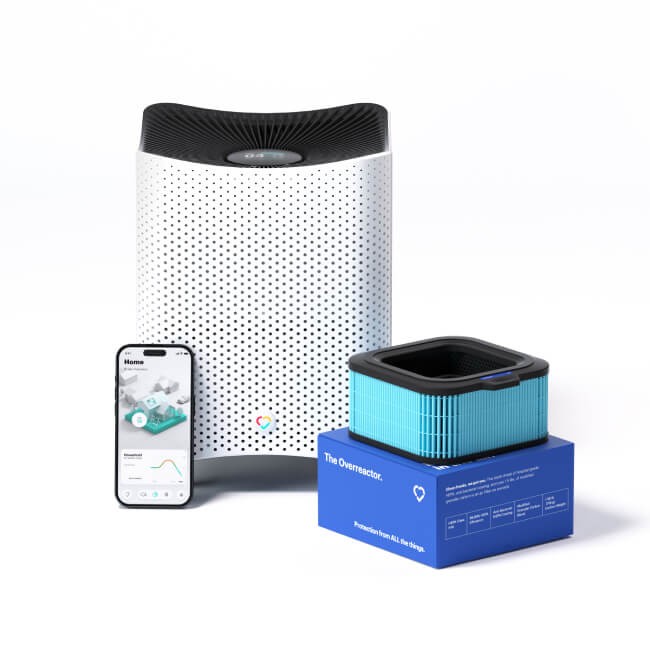
- Mila makes connected HEPA purifiers for homes, with air quality sensors, automatic modes and a companion app.
- Its filters are chosen by problem: pet dander, pollen, everyday particles, odors or the chemicals that can come with a renovation.
- The 2019 Kickstarter drew 3,636 backers and $1.16 million. Early shipments also exposed a noisy power supply.
- Today the line includes Air Mini and Air 3, with optional filter delivery every six months.
The invisible appliance problem
A conventional purifier offers the satisfying sound of a fan. That sound is not a measurement. Mila’s pitch is to pair the fan and filter with room sensors that show what the air is doing, then adjust the work accordingly. Its app reports conditions across rooms, and its automatic mode responds to changing readings. There are thoughtful domestic touches: the machine can quiet down when someone enters a room and clean more aggressively when it is empty. People who dislike apps can still use manual and automatic modes on the device without Wi-Fi.
This makes Mila a consumer electronics company as much as an appliance maker. It sells the promise of a quieter bedroom, a less dusty living room or a better-informed response to smoke outside, then tries to make that promise visible. A sensor reading cannot diagnose a house or substitute for fixing a pollution source. But it can turn an otherwise vague concern into a decision: close the window, run the fan, change the filter, or investigate why the reading keeps climbing.
A million-dollar vote, then a six-percent lesson
The first Mila arrived on Kickstarter in November 2019 with a $20,000 target. By the end of the 37-day campaign, 3,636 people had pledged $1,156,992. Those numbers demonstrate demand for the idea; they do not say what happens when thousands of machines travel from a factory to thousands of homes. Hardware has a gift for asking its hardest questions after the applause.
In a backer update, Mila said roughly 6% of early owners reported a “cricket” noise. The team traced it to a power supply susceptible to shock during shipping and said it was working with carriers and the factory on a stronger part. The company also had to deal with replacements. The event matters because it revealed a weak point outside the glossy product demonstration: delivery is part of the product. A purifier that reaches a home with a strange chirp has already begun arguing with its own promise of quiet.
“We’ve isolated the issue to a power supply that was susceptible to failure if it was bonked around hard during shipping.”Mila’s update to early backers
The practical lesson is almost comically unromantic. Test the last mile, not only the lab bench. Give customers a direct account of the fault, including its frequency and the proposed fix. And notice that a service team can become part of the engineering loop: Mila’s public updates contain requests about app controls as well as the power supply. The people living with a machine often discover its design brief after the designers have stopped drawing.
One machine cannot know every household
Mila’s filter menu is the company’s other strong idea. “Critter Cuddler” is aimed at pet homes; “Home Wrecker” addresses the dust, odors and chemicals that can follow a renovation. Other choices target general particles or allergies. The labels are cute, but the differences are physical: HEPA media catches particles, while carbon is used for gases and odors. A pet owner may need a different combination from someone unboxing new furniture. The wrong filter can still move air handsomely while leaving the buyer’s chief complaint untouched.
The current line separates room sizes too. Air Mini is sold for bedrooms and medium rooms. Air 3 is pitched for larger spaces and uses a redesigned fan and Nidec motor; Mila says it runs 16% quieter than the original at top speed. This is a company claim, not an independent lifetime test. The larger point is sound: noise matters most in the rooms where people live, and a powerful purifier nobody wants to turn on is a decorative appliance.
A simple loop, with one necessary limit: filtration works best when the source of a pollutant is also addressed.
The price of knowing
Mila sells directly to households and sells the filters again when they wear out. Its US store advertises Air Mini from $229 with its Auto-Refill plan; Air 3 listings start at $399, with the final total depending on the filter and purchase option. The refill plan sends a filter about every six months, can be skipped or cancelled, and comes with extended warranty terms. Individual filters also have prices and fit requirements. The ongoing cost is part of the product, so the right comparison is the machine plus years of replacements, not the initial sticker alone.
Room size, filter type, replacement interval and noise tolerance come before app features. Mila’s store lists Air Mini filters from $39 and original-size filters from $59 in the US. Local prices and promotions can change; the six-month schedule is a guide rather than a guarantee of filter life.
The model makes commercial sense. An appliance sale is episodic; filters bring people back. It also asks Mila to earn the second sale. The app, support service and named filters must make ongoing care feel useful rather than obligatory. Mila’s “Care Squad” language is playful, yet there is a sober customer need beneath it: a family buying an air purifier wants a working answer when a reading looks strange or a motor starts making a noise.
From the nursery to the balance sheet
Investors noticed the same opening. Electrolux backed Mila, Vulcan Capital invested in 2021, and Cercano Management led a $10 million Series A announced in December 2022. TechCrunch reported a $52 million post-money valuation for that round. In 2024, Mila appeared at No. 1,500 on the Inc. 5000. These are markers of a growing company, though none can tell a buyer what the air in a particular bedroom will be on Tuesday night.
That is where the company’s distinction remains. Dyson and other familiar brands can sell filtration, handsome industrial design or a phone connection. Mila has tried to make the invisible result the main event, with sensors, personal settings and filters matched to a home’s actual irritants. Its Mila Cares Packages program sometimes gives a nominated person a purifier or filter, a small extension of the founding idea that clean air is personal before it becomes a market.
There are limits. A purifier is most useful when the pollutant passes through it and when the chosen filter suits the problem. It cannot repair water damage, stop a gas leak or replace ventilation and source control. A household with several closed rooms may need several units. And any connected appliance adds software and service expectations to the usual mechanical ones. Mila’s case is worth copying where the customer needs proof, choice and ongoing support; it is less persuasive where a simple fan and a standard filter already solve the job.
The company began with fathers staring at a city sky they could not change. The useful thing they could change was a room, then a machine’s behavior inside it. Air is still invisible. Mila’s wager is that people will care for it more diligently once the appliance tells them what is happening.