The most important moment in Harbor's history produced no alarm. Kevin Lavelle woke, looked at the baby-monitor app on his phone and discovered it had crashed sometime during the night. His infant son was fine upstairs. The silence was the problem: a product purchased to reduce uncertainty had quietly manufactured more of it.
Lavelle did not immediately become a hardware founder. The idea bothered him for years while the market split into two unsatisfying camps. Old-school radio monitors were dependable but limited. New connected cameras promised intelligence and access from anywhere, while making a phone, an app, home Wi-Fi and somebody else's servers part of the critical path. Harbor, started in Dallas in 2022 with embedded-systems veteran and former Army helicopter pilot Charlie Hill, was built to combine the useful halves.
What Harbor actually built
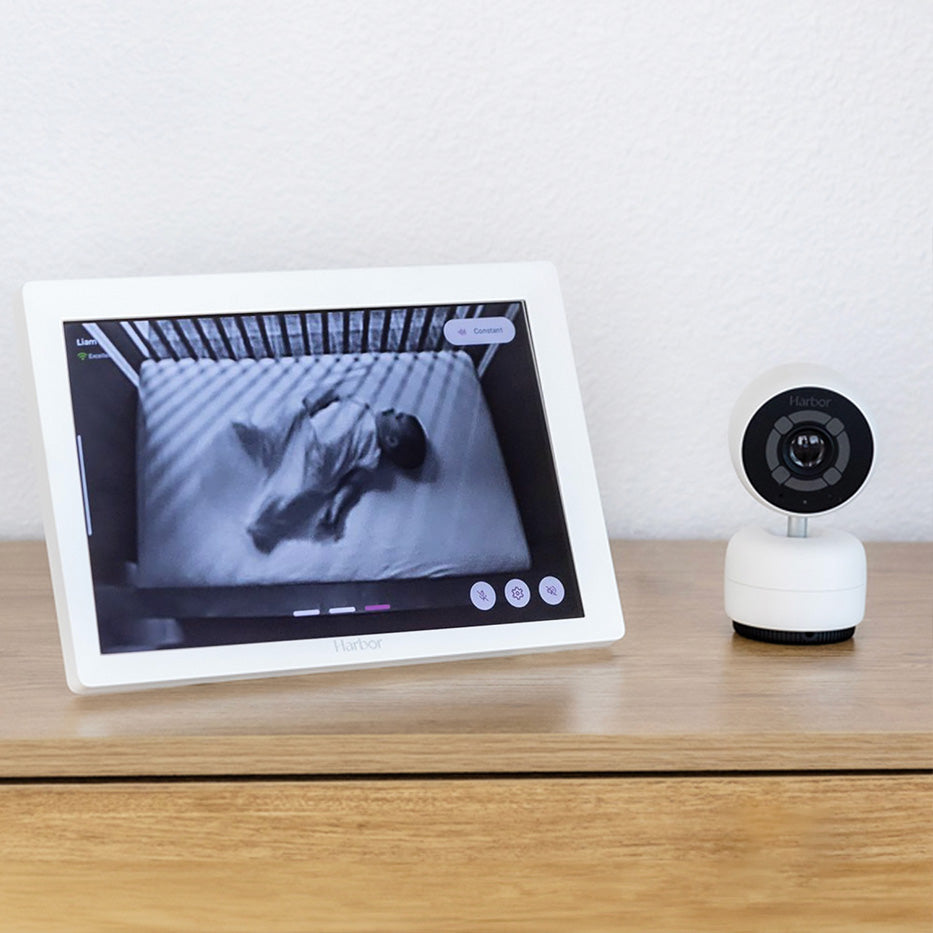
The current flagship is a $499 bundle: one 2K camera, one dedicated 10.1-inch monitor and access to mobile and desktop apps. At home, camera and monitor can communicate directly on the local network, even when the internet disappears. Video and audio are stored on the camera rather than in cloud storage, according to the company, and communication uses end-to-end encryption and mutually authenticated TLS. Away from home, a parent can still connect remotely through the app. The distinction is sensible, if less magical than the slogans: local when local is possible, encrypted remote access when it is not.
The device supports four camera feeds, separate volume and zoom controls, 24-hour history, saved moments, guest schedules, night vision, desktop picture-in-picture and alerts on Apple Watch. A camera-only version costs $250. The full system's advantage is not that a dedicated display is novel. It is that the display does one job, stays available when the parent's phone is busy, and gives the system somewhere else to complain when a connection breaks.
“My son was unmonitored all night. That is not why parents buy a baby monitor.”Kevin Lavelle, co-founder and CEO
The first thing to fail was the phone
Harbor organizes the product around a blunt observation: every extra dependency is another place for a quiet failure. An app can crash. A phone can update, lose charge or surrender its attention to a call. Wi-Fi can vanish. A remote server can wobble. Power can still fail, and Harbor does not abolish physics, but the direct camera-to-monitor route removes the internet as a requirement for basic viewing. Failsafe notifications make disconnection visible instead of polite.
At-home monitoring: dependency exposure
This graphic is conceptual, not a lab score. Its point is architectural: fewer required links mean fewer links can interrupt the basic job. Consumer Reports confirms that Harbor includes a non-Wi-Fi parent unit, picture-in-picture and split-screen viewing, although its detailed ratings sit behind a membership. Public owner discussions are less tidy. Some users praise fast local access and the privacy mode; others report disconnects, software frustrations or cameras failing after updates. Redundancy reduces certain failure modes. It does not excuse the ordinary pains of young hardware.
03 / From device to serviceThe camera is the wedge. Sleep is the market.
Harbor sells to parents who want a dedicated screen without giving up remote access, especially multi-child households, frequent travelers and buyers uneasy about nursery footage living in the cloud. That is a narrower customer than “every parent,” and the price makes the boundary visible. A family that needs only audio from the next room can solve the problem for far less. A family juggling two rooms, grandparents, travel and scheduled caregiver access can make more use of Harbor's stack.
The more ambitious product is a human service running through that stack. With Remote Night Nanny, parents complete an onboarding call, explicitly grant a trained pediatric or infant-care professional access for the night, then mute the bedside screen. The remote caregiver watches a small number of children and alerts the parent when feeding or soothing is needed. If the connection drops, the remote session ends and the home monitor turns its audio back on. The caregiver watches; the parent still does the hands-on care.
That service currently runs roughly $35 to $50 per night in weekly or monthly packages. Harbor compares it with $400 to $700 for an in-home night nanny. The comparison needs a bright line: remote eyes cannot change a diaper, prepare a bottle or pick up a child. They can filter the small noises from the moments that need a parent. For an exhausted household, the product being sold is permission not to react to every squeak.
A pricing change hiding in plain sight
At launch in 2024, Harbor described a $336 annual membership that included the hardware. The company now sells the complete system for $499 and says the core monitor features require no ongoing subscription. It has preserved recurring revenue for genuinely additive layers: AI alerts and sleep insights cost $14.99 a month, while human overnight coverage is purchased separately.
That shift matters. Parents tend to resent renting basic functionality from hardware already sitting in the nursery. Harbor changed the offer so basic monitoring, local storage, rewind and multi-camera viewing are included, while custom vision or audio rules are optional. The company did not abandon subscriptions. It moved the paywall away from the reason the device exists.
Hardware still anchors the model. Additional cameras, stands and monitors raise household value. Ecommerce and Babylist provide distribution. AI can add software margin. Remote Night Nannies add service revenue, and Harbor is now pitching the same hardware-plus-human model to pediatric providers, home-health agencies, Medicaid programs and rural-care organizations facing overnight staffing shortages. Harbor says more than 10,000 devices have shipped, a company-reported figure that signals an installed base but not yet a mass market.
Investors have funded the attempt. Trust Ventures led a first $3.7 million seed close in early 2024; by September, Harbor said the seed totaled $7 million. The group included Capital Factory, Morrison Seger, Tim Ferriss, Sam Parr and several sports families. TIME put the monitor on its 2024 Best Inventions list. Revenue and valuation remain private.
05 / What changed the founderThe useful lesson is not the baby monitor
Lavelle had built Mizzen+Main, the performance-dress-shirt company, by keeping the early idea close. Harbor required the opposite behavior. He has admitted that he knew nothing about hardware and software technology when he began. So he told people what he was working on, asked what they hated about their monitors and recruited the expertise he lacked.
Through the hard-tech network informal, Harbor found people who could assemble a rapid prototype, challenge vendors and visit manufacturers. Charlie Hill brought embedded systems, security and IoT experience. Sean McBeath helped vet manufacturing and became vice president of hardware. The cameras are now made in India and monitors in Vietnam, with processors from Ambarella and Qualcomm. Openness was not a founder-personality exercise. It was how a consumer-brand operator learned to ship an interconnected device.
What another founder can steal
- Name the emotional failure precisely. “The app crashed” is sharper than “parents need peace of mind.”
- Draw the dependency chain, then remove or expose every silent link.
- Sell the core job once. Charge repeatedly only for work that keeps happening.
- Borrow specialists before hiring an entire department, especially in unfamiliar hardware.
- Let the product create the next market. Harbor's camera made remote care possible.
Reliability has conditions
Harbor sits between inexpensive radio monitors and app-first smart cameras such as Nanit, Owlet and CuboAi. Eufy, Vava, Babysense and Momcozy compete for buyers who want a dedicated parent unit, often at lower prices. Harbor's distinction is the combination: premium local hardware, encrypted remote access, on-device storage and an optional human care layer.
- It does not work as a bargain. At $499, the system must replace several frustrations, not merely show a crib.
- Remote still means internet. Watching from outside the home and using overnight care depend on connectivity and Harbor's service.
- A remote nanny is not in the room. Parents must remain capable of waking and responding; this is monitoring, not hands-on childcare or medical supervision.
- Local-first is not failure-proof. Hardware, firmware, power and the camera-monitor link can still misbehave. Harbor's promise is fewer silent failures, not none.
- The AI tier is optional for a reason. Families uninterested in custom alerts or sleep analysis should keep the $14.99.
The company is at its most convincing when it is least futuristic. The camera does not claim to diagnose a child. The dedicated screen does not pretend to be entertainment. The backup route exists because networks fail. Even the remote nanny is a practical division of labor: let someone else listen, then wake the parent when hands are required.
Harbor began with a fright that ended harmlessly. Its business depends on treating that near-miss seriously without converting ordinary parental anxiety into spectacle. The $499 question is whether a household will pay for fewer dependencies, clearer failures and a screen that refuses to become anything more interesting than a baby monitor. At three in the morning, boring can be an excellent feature.