There are founders who introduce themselves with a funding round, a dazzling title or a sentence involving the word visionary. David Weiss once offered a less ornamental assessment: “I think I was a medium engineer, but a good explainer.” It is funny because it is modest. It is revealing because the second half of the sentence became the architecture of his career.
Weiss is the co-founder, president and chief operating officer of Hatch, the connected-device company he built with his wife, Ann Crady Weiss. Before bedside lights, sound machines and sunrise alarms occupied his days, he worked in software. Before senior leadership, he spent time teaching high-school mathematics and computer science. The progression looks zigzagged only until one notices the constant: he kept moving toward rooms where one group needed to understand another.
In the classroom, comprehension was brutally easy to audit. A fidgeting sixteen-year-old either followed the explanation or did not. Weiss learned to say a thing again, then say it another way, stripping away the context that an expert assumes everyone shares. When he returned to engineering, that practice made him useful beyond the engineering department. He was called into meetings to explain what the technical team was doing and how long it might take. Translation gave him a seat where products were being conceived, not merely implemented.
The translator asks to stay in the room
At BabyCenter, Weiss's remit widened. He led technology and product, and gained experience across marketing and design. He had wanted to participate before requirements were tossed over the proverbial fence to engineers. Now he could help decide what ought to be built. He also met Ann, who led consumer experience. Between them, the pair ran much of the machinery that turns an idea into something a customer can actually use: product, engineering, editorial, design, community and marketing.
They founded Hatch in 2014, first as Hatch Baby. Software had trained Weiss to think of hardware as another solvable problem. Hardware, with the impeccable timing of an expensive tutor, corrected him. A website can go down for maintenance and most users will return later. Weiss's preferred thought experiment is a microwave that refuses to heat lunch and suggests trying again tomorrow. People expect a physical object to work, immediately and repeatedly. The object, meanwhile, must survive home Wi-Fi, router updates, radio interference, mobile operating systems and all the domestic arrangements no test lab thought to imitate.
“I think I was a medium engineer, but a good explainer.”David Weiss
So the COO made house calls. When devices misbehaved in ways Hatch could not reproduce, Weiss drove to customers and asked if the team could wire up the product and investigate. This is an unfashionable image of a technology executive, which is why it is a useful one: a person in somebody else's home, looking for the interference that a clean laboratory had politely omitted.
Another early problem arrived in a batch of roughly a thousand units. Each one needed to be unboxed, opened, altered, closed and packed again. Hatch found tables. It found pizza. Weiss enlisted his children and some of their friends. The family business briefly became literal, an assembly line held together by tools, appetite and the absence of anyone more convenient to call.
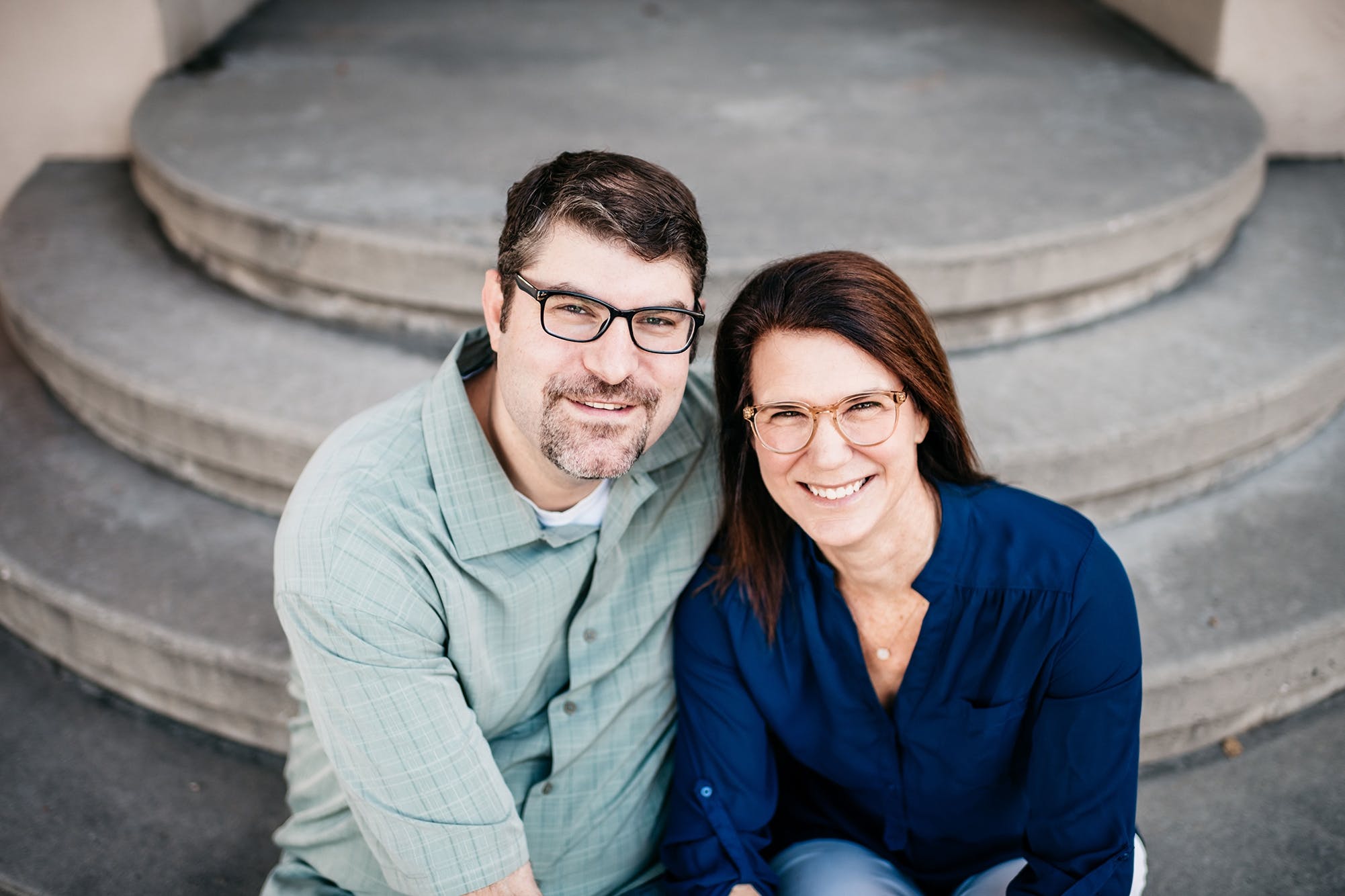
Two founders, different weather systems
Starting a company with one's spouse invites the sort of questions usually asked with a small wince. Weiss does not sell it as an enchanted arrangement. The work can crowd a marriage and test it. Yet it also creates a private archive of improbable scenes: appearing together on Shark Tank in 2016, opening a first booth at CES, sitting side by side while unscrewing products that needed attention.
Their professional contrast is part of the design. Weiss describes himself as steady and difficult to rattle. He describes Ann's excitement as contagious, the kind of energy that makes a new undertaking immediately feel possible. In fundraising meetings, he has joked, Ann does most of the talking while he waits to contribute one or two intelligent-sounding remarks at the correct moment. The joke works because the admiration is plain. The couple are not performing sameness. They have made use of difference.
Hatch's original connected changing pad brought the founders to television and attracted investment from guest Shark Chris Sacca. But the company's larger path emerged from Rest, a light-and-sound device made for children's routines, followed by adult products in the Restore line. By early 2022, Weiss said Hatch was in more than two million homes. In 2026, the company added Hatch Sleep Clock, a bedside device that pairs its familiar light and audio routines with contactless tracking and personalized suggestions.
The product catalog changed, but Weiss's preferred part of the company remained the team that builds things. As Hatch hired specialists for functions he had once run himself, he concentrated on product development across product, engineering, design and quality assurance. He had occupied nearly every departmental chair at some point. The chair nearest the workbench suited him best.
A shovel, some wet paint and a human being
As companies grow, instinct has to become language or it disappears. Hatch developed values with enough texture to be remembered. “Pick up a shovel” means noticing the ditch and beginning to dig, even when the job sits beyond one's formal expertise. Weiss gave the idea credibility with a detail that would be embarrassing if it were merely decorative: he still used his drill press to make access holes in products for programming ports.
“Believe in wet paint” argues for showing work before the grand reveal. Inside Hatch, the phrase became a minor visual gag, with dripping-paint motifs appearing in Figma. Beneath the joke is a serious operating preference: early work travels faster when people feel safe letting others see it. A polished surprise may protect its author from comment. It also protects the work from improvement.
Then comes “humans over process.” Weiss's formulation is characteristically plain: human relationships can bridge failures in a process, while the best process cannot bridge a failure in relationships. For a distributed company, that required deliberate social time rather than faith in the magic of a Slack channel. He described dropping a video link into a casual channel and asking whether anyone else was eating lunch. He urged leaders to keep track of people beyond their direct reports and make sure months did not pass without a conversation.
The classroom appears again here. Weiss remembered spending part of a Monday lesson asking students about their weekends, tennis matches and lives. The remaining minutes became more attentive because the room had become a group. Efficiency, pursued too greedily, can remove the conditions that make efficient work possible. A little conversation turns out to be infrastructure.
“Success is built on the backs of human relationships.”David Weiss
The comfort of knowing the facts
Weiss pairs relationships with unusually broad internal disclosure. Hatch held weekly all-company meetings. During fundraising, employees saw the deck. When quarterly financials arrived, employees saw those too. His argument is not that every fact is comforting. Some produce discomfort. But the fear produced by an unexplained silence can be worse, and owners of a business should understand how the business behaves.
This is where steadiness becomes practical. A leader who rarely appears rattled can show difficult information without making the disclosure itself feel like an alarm. Ann supplies the visible voltage when a new possibility arrives. Dave lowers the temperature when uncertainty does. Neither temperament is a corporate virtue by itself. Together, and supported by actual facts, they help people know what kind of day they are having.
Even disagreement gets translated. Weiss has described stepping back from friction, writing out the argument and asking which facts each side is missing. Smart people holding the same information often approach the same conclusion; when they do not, the gap becomes something to inspect. And when the difference is irreducibly judgment, somebody disagrees and commits. There is little romance in this method. There is also little fog.
The operator's unglamorous advantage
Weiss's story resists the customary founder mythology because its best scenes involve explanation, repair and maintenance. He did not leap from brilliant code to inevitable company. He moved sideways through disciplines, learned what he was not trained to do, hired people who were, and retained enough curiosity to understand their work. He regards the ability to make difficult ideas legible as a form of leadership. The evidence is a career assembled from rooms that normally complain about one another.
Asked what he would tell another operator growing a company, Weiss returned to scale's least quantifiable pleasure: enjoy the stage you are in. Read the customer notes. Notice the person on the other side. A larger company removes tasks a founder was never qualified to perform, which is a relief, but it also removes tasks the founder may unexpectedly miss. Growth is not a victory over the smaller company. It is an exchange.
The teacher's lesson survives the exchange. Find out who lacks context. Explain the matter without condescension. Show the unfinished work. Put the financials on the screen. Visit the house where the device will not connect. If the problem is a thousand screws, bring tables and pizza. If there is a ditch, the company already has a phrase for what happens next.