David Friedman learned to see technology from the spreadsheet outward. Before the patents, before a company was born in his kitchen, before anybody seriously proposed connecting thousands of artificial-intelligence processors with light, there was mergers and acquisitions at Chase Bank. Then came Intel, where he worked on microprocessor pricing. It is a wonderfully unromantic opening for a Silicon Valley career. No garage. No soldering iron on the family table. Just the cold arithmetic of what a thing costs, what a market values and where the margin goes when everyone wants the same scarce component.
That arithmetic became a compass. Friedman moved from finance into semiconductors, from semiconductors into wireless connectivity, from connectivity into cloud software, and eventually into the optical plumbing of AI data centers. The jobs changed. The question underneath them did not: where has the industry’s appetite grown larger than the system built to feed it?
Chapter oneA history major learns the price of silicon
Friedman calls himself an atypical technology founder. The description is fair. He studied history at Colgate University, graduating in 1990, and later earned an MBA from the University of Michigan’s Ross School of Business. His technical education happened beside engineers and inside companies: pricing microprocessors at Intel; selling and marketing three-dimensional memory at Matrix Semiconductor; building partnerships at ZeroG Wireless, a maker of low-power Wi-Fi chips for embedded products.
Matrix was acquired by SanDisk. ZeroG was sold after discovering that a capable chip could still arrive before the market wanted it in quite that form. Friedman did not treat the latter as a tragedy fit for violin music. He treated it as information. A chip alone was not the whole product. Manufacturers that wanted to connect appliances, controls and other everyday objects also needed networking software, cloud services, device management and applications. Asking every manufacturer to assemble that stack was an invitation to delay, expense and disappointment.
“I am not exactly your typical founder of a tech company.”David Friedman, reflecting on his path from history to hardware
The humanities background looks less unusual from this angle. History is the study of systems pretending to be stories. Pricing is the study of stories pretending to be numbers. Friedman became fluent in both, then spent his career interpreting engineers to markets and markets back to engineers.
The constraint keeps moving
M&A
pricing
Wi-Fi chips
IoT platform
photonics
The kitchen yearsAyla, four children and one avoided acronym
Around 2010, the next company took shape in Friedman’s kitchen. He and ZeroG colleague Phillip Chang believed the Internet was expanding beyond computers and phones into physical products. They also believed the value would sit in software and applications working with the hardware, not in the radio by itself. The company they co-founded, Ayla Networks, would provide an end-to-end Internet of Things platform for manufacturers.
Its name arrived through a small act of alphabetical triage. The founders tried combining the first letters of their children’s names: Samantha, Ryan, Alex and Sarah. The result was SARS, an acronym with rather poor brand warmth. The second letters produced Ayla. Corporate naming consultants everywhere may now take the afternoon off.
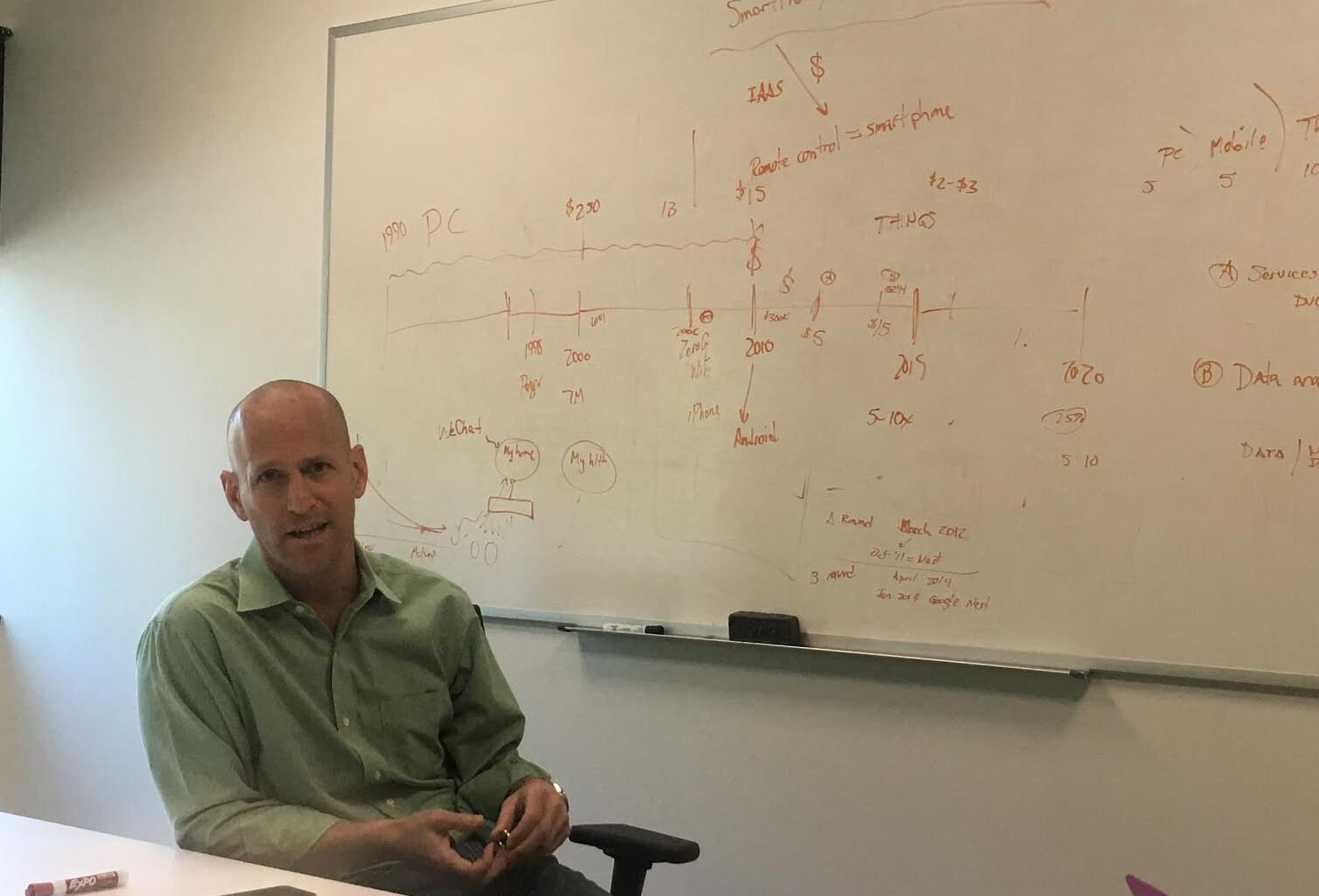
The joke contains the company’s more serious habit: adapt early. Ayla gave device makers embedded software, networking, a cloud service and application libraries designed to work together. Friedman spoke often about flexibility because customers rarely know every feature a connected product will require before the product meets real users. He also stressed security, availability and the cost of supporting devices long after the celebratory launch cake has gone stale.
He was CEO for eight years, during which Ayla expanded internationally and raised substantial venture capital. In 2018 he shifted into the roles of executive chairman and chief strategy officer, focusing on financing, company evangelism and product direction. The title changed from chief executive to the sort of work that makes executives appear unexpectedly in three time zones, discussing road maps before breakfast.
“Ayla was born roughly eight years ago in my kitchen.”Friedman, in a 2018 conversation about IoT platforms
Between actsThe operator refuses to specialize politely
After Ayla, Friedman’s portfolio widened. He worked on go-to-market strategy at imaging company Oyla, advised construction-simulation startup ALICE Technologies, and served as a board member and finance executive at autonomous-logistics company Venti Technologies. He also spent time as a venture partner at Berkeley Catalyst Fund. Public profiles list him as a co-founder of Aquatrino, too.
Read as a conventional résumé, this looks eclectic. Read as a search for operational friction, it is consistent. Autonomous vehicles do not become useful because a demo car navigates a tidy route once. They must work amid ports, factories and rail operations. Connected devices do not become a platform because one thermostat says hello to one cloud. They must be provisioned, updated and supported in fleets. Deep technology repeatedly discovers that the laboratory is only the first room of the house.
That may also explain why five US patents sit beside a career usually described in commercial and operating terms. One covers integrated systems using vertically stacked three-dimensional memory cells, issued in 2004. Friedman is neither merely “the business person” nor presented as the principal physicist. His useful territory is the border, a place where disciplines are forced to negotiate.
The light problemAI gets hungry enough to change the wiring
Lumilens was founded in early 2024 to address a new constraint. AI training clusters need large numbers of processors to communicate quickly enough to behave like a single machine. For years, attention stayed fixed on the GPUs. As clusters grew, the network around them began taking its turn as the bottleneck. Copper connections face limits in bandwidth, distance and power. Optical links can carry more data farther with less energy, but photonics introduces a demanding production problem of its own.
Friedman is VP Operations and one of five founders listed by Lumilens, alongside CEO Ankur Singla, Ritesh Kapahi, Samuel Liu and CTO Ted Schmidt. His presence is a clue to the company’s thesis. Lumilens does not describe manufacturing as the administrative epilogue to clever chip design. It treats manufacturability as part of the design.
What changes when the cluster grows?
Its LumiCore platform spans silicon photonics, mixed-signal integrated circuits, electrical-optical interposers and complete optical systems. The roadmap covers conventional pluggable transceivers, near-package optics and eventually co-packaged optics. In plain English: light moves progressively closer to the processors, reducing the distance that electricity must struggle across.
The company says its first scale-out pluggable product completed qualification and began shipping into a major hyperscaler’s production AI data centers in 2026 under a multi-billion-dollar agreement. It is developing near-package optical engines for direct processor and memory connections, with co-packaged optics intended to follow on the same platform.
When Lumilens emerged from stealth in August 2026, it announced more than $700 million in Series C funding, taking total announced capital above $900 million. The number is large enough to make a banker nostalgic. It also signals the scale of the production challenge. Optical networking for AI is not a weekend application with an amusing domain name. It demands silicon, packaging, robotics, testing, qualification, supply agreements and the patience to make identical complicated objects by the million.
The reusable ideaTiming is a feature. Operations is the proof.
Friedman’s career offers a lesson more portable than any one market prediction. First, look for the point where customers are being forced to assemble too much complexity themselves. Second, notice when a technical shift makes the old arrangement intolerable. Third, build the integrated layer that lets customers adopt the new thing without becoming experts in every component beneath it.
At Ayla, manufacturers did not want to become cloud-networking companies simply to sell a connected appliance. At Lumilens, data-center operators do not want photonics to become a science project every time optical links move closer to the compute package. The integrated platform is a commercial argument disguised as an architecture: we have already made the pieces negotiate.
There is also a gentler lesson in Friedman’s route from history seminars to patents. Technical companies need people who can cross borders without pretending the borders do not exist. The engineer, customer, factory manager and investor may use the same nouns while meaning four different things. Somebody must hear the discrepancy before it becomes a missed quarter.
The future may travel by light. It still needs an operator.
Friedman is now in his second major founding chapter, working on infrastructure far removed from the connected products that made Ayla’s name. Yet the view from the kitchen is still useful. Industries change when an ambitious idea encounters a practical constraint and somebody decides the constraint is the company.
The spotlight naturally falls on the miracle: devices joining the Internet, vehicles navigating themselves, processors conversing at the speed of light. Friedman’s work has tended toward the machinery behind the miracle. Pricing. Partnerships. Platforms. Production. The parts that determine whether a technical possibility becomes an ordinary fact.