Ralph Loura had projects, budgets and explanations. What he needed was an answer to Alan Lowe. As Lumentum’s chief information officer, Loura could describe why an initiative mattered. Lowe wanted him to explain why it mattered more than the other initiatives waiting for the same money. A perfectly respectable project could still come second. That was the awkward part.
“Why did you do that project and not the other one?” Lowe asked, in Loura’s recollection. Loura admitted that comparing the value of projects quantitatively was difficult. He described his boss as transparent, approachable and candid. The challenge came from a leader he had wanted to work for. Loura had to move beyond explaining each project and find a way to compare them.
The question makes a useful entrance to Lowe’s career. In November 2023, Lumentum completed its acquisition of Cloud Light, a transaction announced at approximately $750 million before adjustments. Here was a much larger allocation of money, with a particular answer attached: sell more of the optical equipment that cloud customers needed, and gain the people and manufacturing capabilities to make it.
“Why did you do that project
Alan Lowe, recalled by Ralph Loura
and not the other one?”
Before the cloud, the recording head
Lowe’s working life has run through the parts of technology that must be manufactured. He spent 1989 to 2000 advancing through Read-Rite, including customer-business and operating roles, then served as president and CEO from 2000 to 2003. Read-Rite made thin-film recording heads for disk and tape drives. He later led customer solutions at Asyst Technologies, which automated semiconductor and flat-panel display factories.
His education paired computer science with business economics at the University of California, Santa Barbara. He also completed the Stanford Executive Program in 1994. In September 2007 he joined JDSU’s commercial lasers business; in October 2008 he took charge of its communications and commercial optical products segment.
The sequence is revealing without requiring a romantic origin story. Recording heads, factory automation and optical products all involve turning a technical design into something customers can actually use. A good idea has to survive production. The person selling it has to understand what the customer expects. A component can be tiny while the consequences of getting it wrong are quite substantial.
When Lumentum separated from JDSU in 2015, Lowe became its founding president and CEO. The business entered public-company life with an established optical heritage. Its early proposition was a more focused organization serving communications and commercial laser markets. Lowe had already been running the underlying business for years; independence gave that business its own corporate identity and its own set of decisions.
The operating questions stay.
- 1989Read-RiteRecording heads
- 2007JDSUCommercial lasers
- 2015LumentumIndependent optical business
Three purchases, three different jobs
On December 10, 2018, Lumentum completed its purchase of Oclaro. Lowe’s explanation emphasized combining technology, people and resources to develop products for customers facing rising network bandwidth needs. The operating task began when the transaction closed. Putting two companies together produces a bigger organization immediately; making their capabilities useful to the same customer takes longer.
NeoPhotonics followed on August 3, 2022. Its lasers and optoelectronic products transmitted, received and switched high-speed optical signals. Lumentum linked the purchase to growth in cloud and network infrastructure and expected more than $50 million in annual run-rate synergies within two years. That figure was an expectation at closing, a promise about the work ahead rather than cash already saved.
Cloud Light changed the shape of the offering again. Before the purchase, Lumentum principally supplied laser components to transceiver manufacturers. Adding Cloud Light meant owning more of the design and manufacturing of the transceiver itself. The combined company could participate in a larger portion of what cloud customers bought. In plain English, Lowe was moving closer to the finished product.
The distinction matters. A transceiver sends and receives data using light. Selling a laser that goes inside one captures one part of that product’s value. Selling the assembled module requires additional expertise and responsibility, while opening another route to the customer. Vertical integration can sound like something invented to enliven an investor presentation. Here it meant a very concrete change in what left the factory.
At the announcement, Lumentum expected the combination to expand its served opportunity inside cloud data centers by more than five times. It also expected to more than double its revenue from that infrastructure over the following twelve months. Those were forecasts. They describe the scale of the bet, and deserve to keep their future tense.
More optical technology, talent and scale.
High-speed lasers and optoelectronics.
Transceiver design and manufacturing.
A cloud with a factory floor
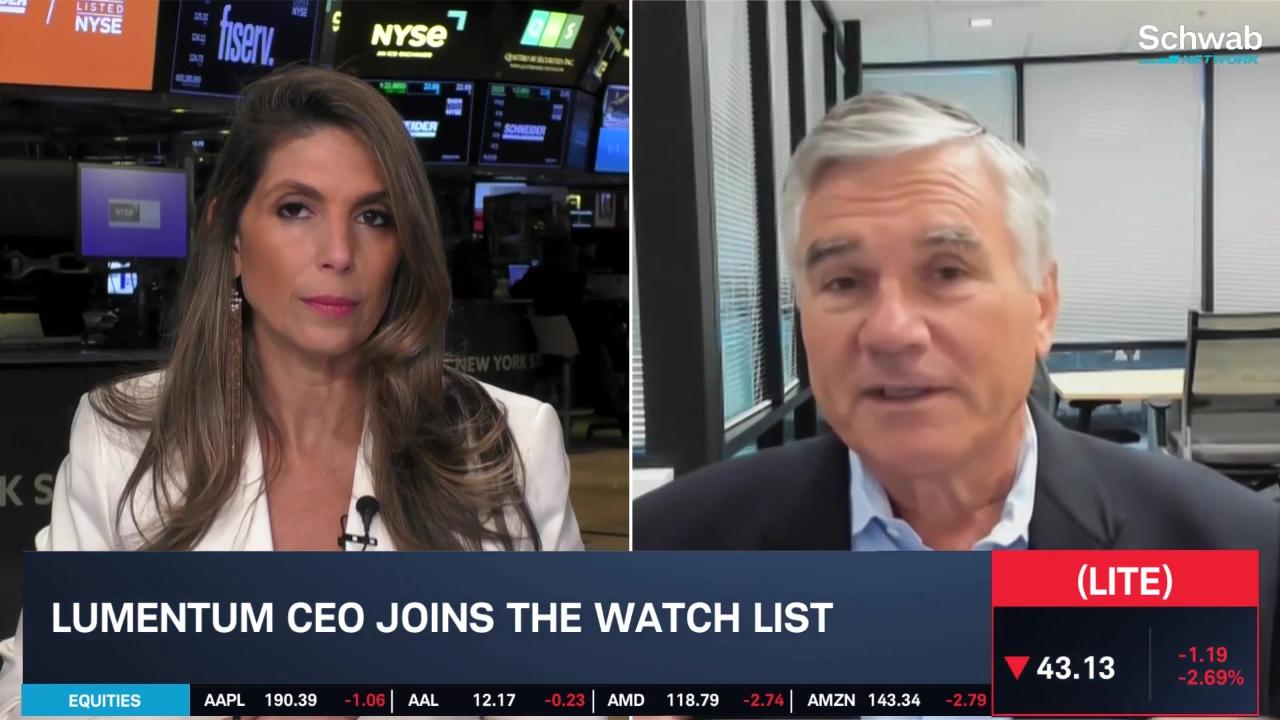
When Lowe discussed Cloud Light with Nicole Petallides in November 2023, the transaction had only recently closed. The interview put a face beside the financial shorthand. A chief executive explaining a cloud acquisition on television still had to account for a company making physical products. The cloud is a convenient name for something with an inconvenient number of parts.
Cloud Light contributed $59.5 million in revenue in roughly its first eight weeks inside Lumentum. More than half of the acquired unit’s December-quarter revenue came from 800-gigabit-per-second transceivers, with the remainder from 400G products. Lowe saw the next move toward 1.6-terabit products as an avenue for growth. His optimism had a product roadmap attached.
The product choices were varied. Lowe described silicon photonics, laser-based approaches and multimode options for the next generation of transceivers. That variety mattered to his ambition to diversify the customer base. Different customers could have different architectures, and Lumentum wanted the manufacturing and design breadth to meet them where they were going.
At a 2024 investor conference, he explained another attraction: Cloud Light could design and build its own precision equipment for aligning and manufacturing transceivers. He also described establishing more manufacturing infrastructure in Thailand. The purchasing decision was about the process as well as the product. Buying know-how included buying the ability to make the equipment that made the equipment.
In the same discussion, Lowe put Lumentum’s transceiver market share below ten percent and expressed an ambition to become one of the three largest manufacturers. He talked about qualification samples, customer feedback and the lag before meaningful revenue. That is a distinctly factory-shaped ambition. The order book, production capacity and customer approval must eventually agree with one another.
Bandwidth does not keep the same diary as orders
In 2024, Lowe was dealing with an unhelpful combination: excitement about AI infrastructure and a correction in telecom customers’ inventories. The company’s cloud and networking revenue in its fiscal second quarter rose about 25 percent from the preceding quarter while falling about 25 percent from a year earlier. Two true comparisons could create very different impressions of the same business.
“Carrier spending is down, but bandwidth requirements are growing,” he said. It was a compact description of the timing problem. More data eventually calls for more capacity, but customers can work through equipment they have already bought before placing another order. A supplier can be correct about demand over the long run and still face a difficult quarter.
The annual figures make the difficulty harder to smooth away. Lumentum reported fiscal 2024 revenue of $1.3592 billion, down from $1.767 billion in fiscal 2023. It recorded a fiscal 2024 net loss of $546.5 million. These are company results under Lowe’s leadership. A serious account of his tenure has room for the acquisition strategy and for the financial pressure that accompanied it.
Power added another constraint. Lowe described data-center customers putting a high value on lower electricity consumption, sometimes ahead of a lower purchase price. The relevant calculation increasingly included the watts needed to move each bit of information. A modest saving in an individual module could matter when multiplied across an installation.
He also discussed data centers moving farther apart to secure power, increasing the importance of the links between them. Faster optics had to work within that larger system of buildings, electricity and equipment. The language of the cloud can make distance seem abolished. The network designer still has to measure it.
Lumentum’s March 2024 product announcements show the practical response: optical technologies aimed at faster and more efficient AI and communications infrastructure. New generations of lasers and transceivers were being developed while the company managed the purchasing cycle of older markets. Lowe’s job required attending to both clocks.
Revenue change, FY2023 to FY2024.
Expansion plans met a difficult purchasing cycle.
Facts, snacks and a change of seat
There is a smaller scene that belongs beside the acquisitions. At a Lumentum event called “Facts and Snacks,” Lowe and chief operating officer Vince Retort met interns in San Jose. Lowe’s advice was to “work hard, ask questions, and be inquisitive.” For once, the corporate event title had the virtue of telling everyone what they were getting.
His advice fits the earlier exchange with Loura. The intern was encouraged to ask a question; the senior executive was expected to answer one. They occupied different places in the organization, but curiosity still had work to do. It could help a new employee understand a business, or make an experienced manager reconsider where the money was going.
On February 3, 2025, Lumentum announced that Michael Hurlston would succeed Lowe as president and CEO, effective February 7. Lowe’s statement described eighteen years with the business and its predecessor as “both a privilege and a joy.” The handoff closed nearly a decade as the independent company’s chief executive.
The transition extended beyond the title change. Lowe remained a director until June 30, 2025, and agreed to an advisory period through December 15. He had hired the management team and held important customer relationships. His continuing involvement helped support the company’s first strategic relationship with Nvidia and the transfer of other customer relationships to Hurlston. The work included making an introduction stick.
His board career was already developing. Qorvo elected him a director effective November 11, 2024. Its 2026 proxy lists him on the compensation committee. Modine added him to its board effective July 18, 2025, with audit and corporate governance responsibilities announced at the time. Radio-frequency and power products at one company, thermal management at another: more businesses where a technical promise must become reliable hardware.
For Lowe, the move from the executive chair to the boardroom changes the distance from daily operations. The underlying questions remain familiar. What can the company build? Who will buy it? Which investment deserves the money? His Lumentum years give those questions a history of actual products, acquired teams and difficult quarters. Even a $750 million decision begins with choosing what deserves to happen next.