A car hits a rough patch of road. Its passengers register a thump, a wobble, perhaps the little disappointment of an expensive machine behaving cheaply. A ride engineer hears a more specific complaint: the body needs controlling, but the wheels need freedom. Make the suspension firmer and one problem improves while another grows. BWI GROUP makes its living inside that argument.
- Magnetic fluid makes damping adjustable through software.
- Automakers buy components, complete systems and help making them feel right.
- Faster development still ends with a real car on a real road.
The company supplies brakes and suspension to vehicle manufacturers. Most drivers encounter its work without encountering its name. MagneRide, its electronically controlled damping technology, has appeared in Cadillacs, Corvettes and Ferraris. More recently, Polestar selected it for the Polestar 5 Performance. The product is hidden near the wheels; the result arrives through your seat.
01 / The laptop in the passenger seat
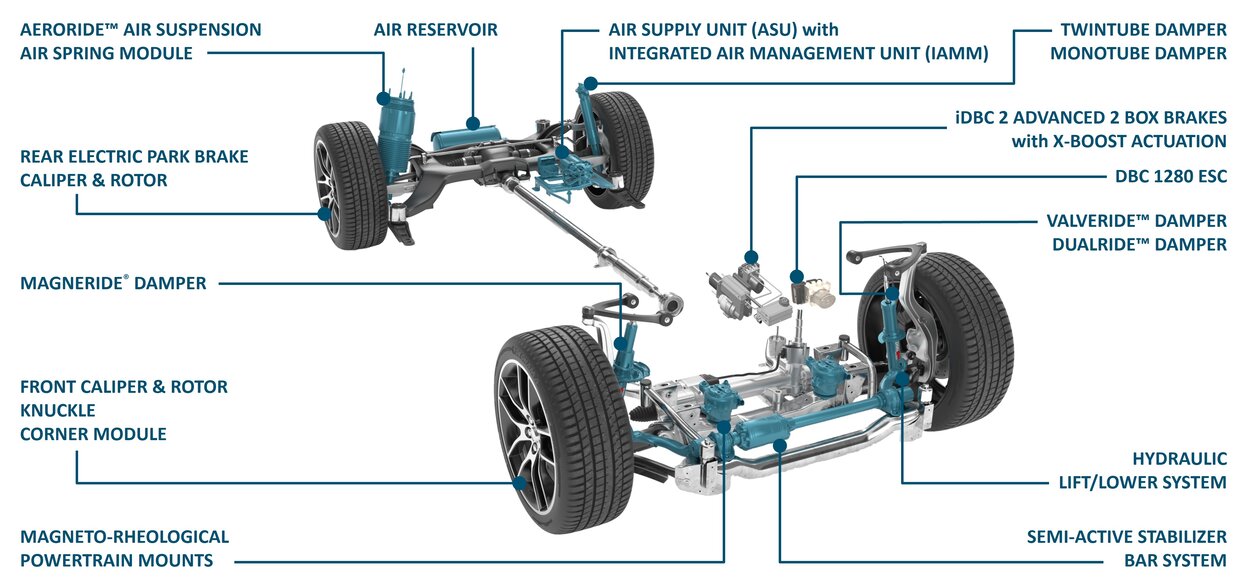
Inside a MagneRide damper is fluid containing iron particles. Apply a magnetic field and the fluid’s resistance to flow changes. The controller can alter damping as driving conditions change. This gives the engineer another way to manage the tension between body movement and wheel movement, with responses measured in milliseconds.
The development consequence is almost as interesting as the driving consequence. Traditional damper tuning can involve making and replacing physical valves. With MagneRide, BWI ride engineer Chris Goergen adjusts damping from a laptop. A calibration change becomes something the team can try without manufacturing another set of internal parts.
That flexibility extends to the sales conversation. BWI can supply dampers, sensors, an electronic control unit and software together. Or an automaker can take selected components and put BWI algorithms into its own electronics. A supplier that fits an existing vehicle architecture gives the customer fewer reasons to reject the technology.
02 / A business bought by the bolt
BWI’s history explains why this software conversation happens inside a manufacturing business. Its lineage runs through Delco and Delphi. MagneRide entered production in 2002, before BWI existed. In 2009, BWI acquired Delphi’s suspension and brake operations, taking over an established body of machinery, intellectual property and customer relationships.
The price was concrete. Delphi’s financial statements put the purchase price at approximately $90 million, subject to adjustments, and net proceeds at $82 million. Those figures describe the acquisition of a business with physical assets and contracts. They help explain BWI’s starting position: experienced production operations alongside technology already used in vehicles.
Its commercial proposition remains the supply of manufactured parts and systems, plus the engineering needed to integrate them. BWI’s portfolio includes ordinary passive dampers, air suspension, brake calipers and electronic braking. Polestar’s two specifications make the point neatly: the Performance model gets MagneRide, while the Dual motor version gets passive dampers with internal hydraulic rebound stops.
The alternatives vary by programme. ZF and Tenneco offer controlled damping; Bosch, Continental and ZF supply electronic braking. BWI’s distinctive pitch is the combination of magnetic-fluid damping, calibration flexibility and manufacturing experience. In October 2025, it announced its 11-millionth MagneRide damper. Count dampers carefully: eleven million components do not mean eleven million cars.
This is also why the customer is the automaker rather than the individual motorist. The damper has to work with a particular vehicle’s mass, electronics and intended behaviour. Buying an adjustable component is only part of the job. The manufacturer needs a reproducible specification that can leave the test track and enter series production.
03 / The pedal should keep its promises
Electrification adds another negotiation, this time under the driver’s foot. An electric motor can recover energy while slowing the car. Friction brakes must contribute when regenerative braking cannot meet the demand. Battery charge and temperature affect that blend. A driver can feel the handover even without knowing what caused it.
BWI’s iDBC 1-Box separates pedal input from normal brake-pressure generation. Sensors read the request; electronics coordinate the response. Software helps preserve a consistent feel across changing conditions. A direct hydraulic backup remains available if the electronics fail. The system still uses hydraulics, a useful distinction from BWI’s separate dry electro-mechanical braking development.
Driver’s request
Choose the blend
Regen + friction
Hydraulic backup provides a separate safety path.
By September 2026, BWI reported that 1-Box had entered mass production in China in 2025 and ramped up in Europe. It also opened an R&D centre in the São Paulo region to support South American brake programmes. The commercial lesson is practical: selling an international technology also means helping a local engineering team put it into a car.
04 / The design they had ruled out
A July 2026 air-spring study offers a smaller, revealing story. BWI’s Kraków engineers believed matching a customer’s target required an additional structural component. An AI-assisted search found a combination of parameters that met the target without it. Manual iteration had missed that solution.
Typical comparison: about two weeks.
The model learned from 180 simulation datasets grounded in laboratory testing. BWI reported roughly one hour for optimisation, against a typical two-week baseline. This was a feasibility demonstration, awaiting hardware validation. The copyable idea is a disciplined search built on credible data; unreliable models and assumptions would undermine the result.
There is a useful ordering here for any engineering team considering the approach. Establish the physical model, check it against measurements, define the variables, then accelerate the search. The interesting result was a revised design judgement. Hardware testing must determine whether the attractive combination on screen survives the demands of an actual vehicle.
05 / The road still gets a vote
BWI chief engineer Marcin Knapczyk describes the last part of tuning as a kind of bodily measurement. An expert driver’s judgement remains part of sign-off, after the models and bench tests have done their work.
“Your body is the sensor.”
Marcin Knapczyk / BWI Chief Engineer
For an automaker, BWI offers tools to shape ride, handling and braking, with integration support. For a driver, the useful action is a careful test drive: try the modes, rough surfaces and low-speed stops. Replacement parts go through dealers or repair professionals. The character you feel is the accumulated result of materials, code and human judgement.