A scooter is a small vehicle with an unreasonable job description. It must get its rider to work, take the shopping home and find somewhere for the helmet. For someone who works for themselves, it may also have to carry the equipment that makes the journey worth taking. Aravind Mani built a company around that crowded working day.
The co-founder and CEO of River has a particular answer to the question of what an electric scooter should be. Its usefulness ought to be visible. There should be room for the things people actually bring along. And the owner should still enjoy being seen on it. The Indie, River’s first scooter, carries those ideas in its generous proportions and squared-off face. It looks as though someone has given the shopping list a vote.
That practical proposition also makes a useful entrance into Mani’s life. He came to scooters through software, business school and petrochemical strategy. His co-founder, Vipin George, came through automotive design. Their company rests on the meeting of those different kinds of experience: the ability to imagine a vehicle and the ability to build a business around making it.
A working day, in litres
Mani’s observation was plain enough: two-wheelers do much of India’s everyday carrying. A commute can include shopping, work supplies and several other errands. River chose to make utility part of the identity of its vehicle. There is a difference between squeezing possessions into whatever room happens to remain and designing the room in the first place.
The original Indie offered 43 litres of storage under the seat and a 12-litre front glovebox. Its 14-inch wheels and optional carrying accessories extended the proposition. These were physical answers to a physical problem. A litre is a pleasingly stubborn unit of measurement; no amount of enthusiasm will persuade a compartment to hold more than it does.
55 litres built in. Optional accessories add other carrying choices.
Original Indie configuration, described in November 2023.
Mani has described the intended customer as a solo entrepreneur. By 2025, he was identifying shop owners, tradespeople and farmers among River’s users. The distinction matters: a carpenter needs equipment to arrive with them; a shopkeeper may have goods to move. River’s pricing also meant that the customer picture was more specific than a general promise to serve every delivery rider.
There is an ambition inside this practicality. People can want a useful vehicle and a vehicle with character at the same time. Mani and George made that combination their territory. River calls it utility lifestyle. The phrase becomes easier to understand when translated into a working day: carry what you need, then ride somewhere because you want to.
Before the scooter, the spreadsheet
Mani studied engineering at the University of Kerala between 2003 and 2007, then earned an MBA at the Asian Institute of Management in Manila in 2011-12. Between those periods, he worked at Infosys, including an assignment in London. The career began with software systems and moved towards the commercial questions that determine whether an organisation can keep operating.
He subsequently held commercial and strategy roles at Tamilnadu Petroproducts and Manali Petrochemicals. Manali’s 2017 annual report lists him as an assistant general manager responsible for strategy, global initiatives and marketing. It is a title with several departments hiding inside it. His later move into electric mobility took him to Ultraviolette Automotive as vice president of business operations and corporate strategy.
Costs, efficiency and profitability recur in accounts of his work. They are useful concerns for someone entering vehicle manufacturing. A prototype can demonstrate an idea. A company needs to buy parts, organise production and repeat the result. Each repetition brings commercial obligations along with engineering ones.
There is a small return journey in his story, too. In March 2023, Mani went back to Loyola School in Thiruvananthapuram for a felicitation as the old boys’ association’s Young Achiever award recipient. River had just unveiled Indie. The school recognised a former pupil at a moment when his new business was becoming visible, months before its first customers received their scooters.
Two colleagues, one clay model
At Ultraviolette, Mani met George, who had spent nearly a decade in Honda’s research and development organisation. They worked together on prototypes and a product launch. The friendship developed alongside the work. By the time they considered starting a company, each had seen the other dealing with an actual automotive project.
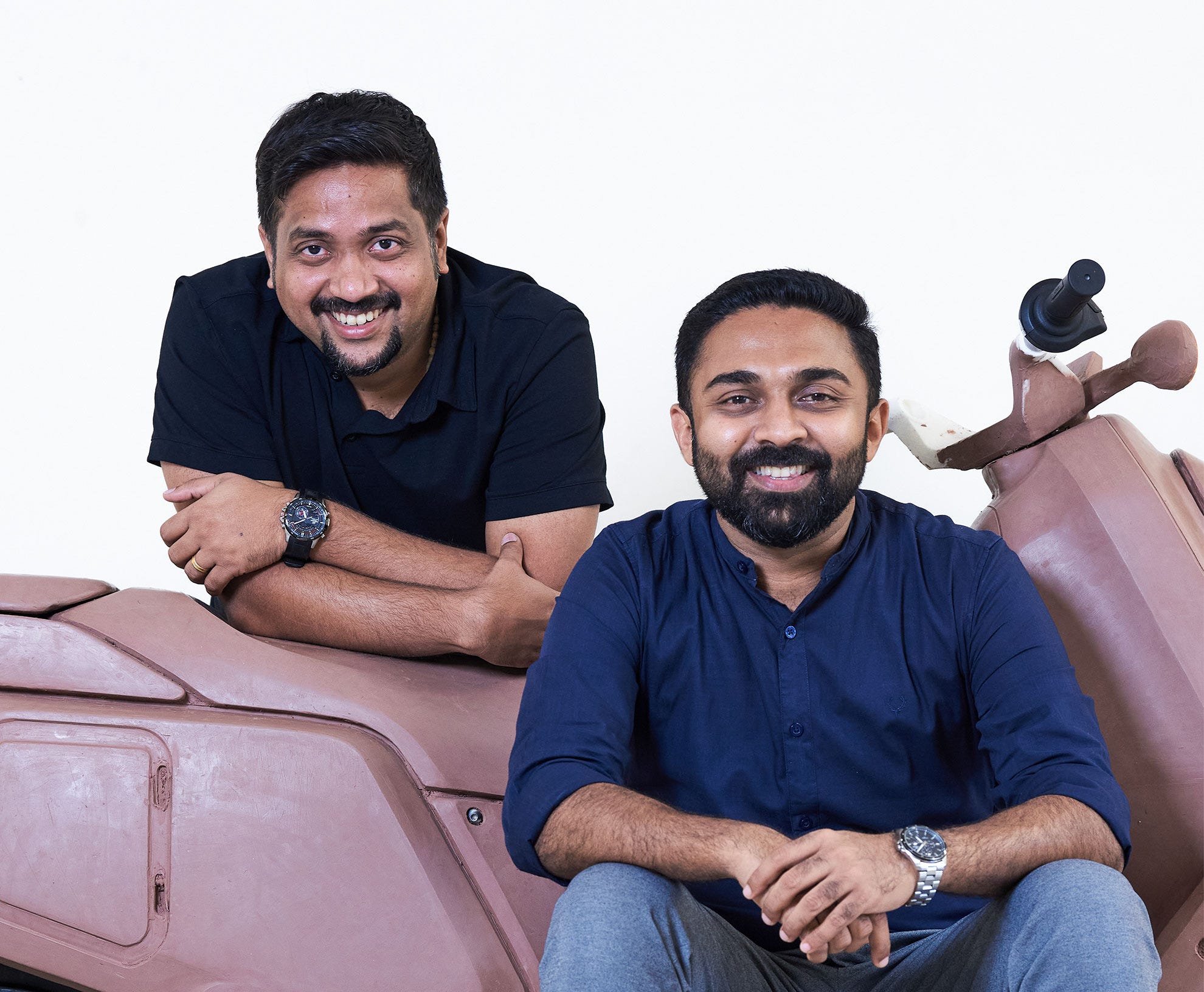
The photograph of them beside a clay model is an apt record of that partnership. Mani sits in front; George leans across the unfinished vehicle. The form already exists, but the finished machine still lies ahead. The photograph preserves an intermediate stage that the launch pictures usually hurry past.
They left their jobs and gave themselves nine to twelve months to raise money. River dates its start to March 2021, after an initial $2 million investment. George took the product side; Mani the commercial side. The early company spent its time on research, prototypes and a factory before there was a scooter to hand to a paying owner.
“We're in this for the next two decades.”
Aravind Mani, December 2023
The horizon in that remark is characteristic of his stated approach. Vehicle development needs time, and investors need to understand the wait. He described a sequence in which prototypes helped secure the next funding, which supported the manufacturing facility, which made the next stage possible. Money followed evidence, and each stage had to produce evidence for the next.
The first keys change hands
River unveiled Indie in February 2023. On 15 October, the first batch went to customers at its headquarters. That date belongs in Mani’s story because it changed the company’s relationship with its product. A vehicle in development can be discussed in the future tense. A vehicle belonging to a customer has to work on Monday.
Mani said River honoured the pre-order price despite reduced government subsidy support. That decision put a cost beside the company’s promise. His explanation was simple:
“We strongly believe a brand is built on trust.”
Aravind Mani, November 2023
The first River store opened in Bengaluru in January 2024. The following month, River announced a $40 million Series B led by Yamaha. Toyota Ventures, Lowercarbon Capital, Maniv Mobility and Al-Futtaim were already part of its funding story. Yamaha’s own announcement described an interest in business partnerships in India’s electric vehicle market.
For Mani, those relationships brought capital and automotive connections to a company that had only recently begun deliveries. Toyota Ventures had made River its first investment in India. Marubeni Ventures joined the investor base in June 2024. The company making a very locally useful vehicle was assembling an international circle of backers.
- 2021River begins
- Feb 2023Indie unveiled
- Oct 2023First handovers
- Jan 2024First River store
A showroom needs a workshop
The next challenge was getting the scooter beyond the founding city. Mani’s explanation of River’s early southern focus included geography as well as demand: keeping stores nearby made service easier to manage. By April 2026, he was describing a deliberate progression towards wider coverage, supported by a Delhi zonal office.
He had also set out a specific service policy: River would enter a city with service support, and stores would have a service centre within three kilometres. That is a promise customers can measure. Distance to help becomes rather less abstract when a vehicle is waiting for attention.
His expansion argument includes dealer economics. A store has to sell enough scooters to support the people running it. Adding another location changes that calculation. The public map of showrooms may look like a record of progress; inside the business, each point on it is a set of costs and customer obligations.
The financial record gives the ambition some resistance. River reported approximately ₹104 crore in revenue for fiscal 2025, while losses reached ₹176 crore. Growth had arrived alongside heavier losses. Those figures make profitability a consequential target rather than a decorative sentence in a plan. The company has to support its product, its dealers and the infrastructure being built around both.
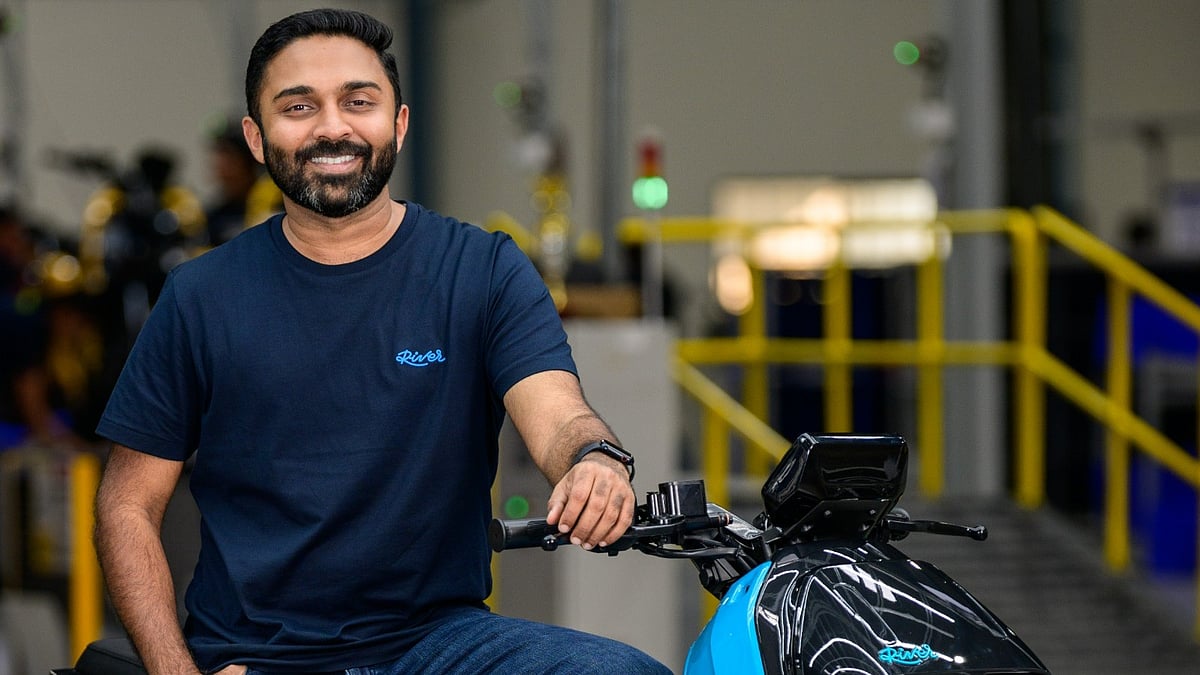
The next load is an entire company
In July 2026, River rolled its 50,000th Indie off the Hoskote assembly line. Mani credited the teams that had built that scale. The milestone brought engineering, manufacturing, quality and supply chains into the same number. A finished scooter is where those separate responsibilities meet.
Indies produced
A cumulative production milestone, not annual sales.In August, River announced a $120 million Series C comprising equity and venture debt, led by Elev8 Venture Partners and Claypond Capital. It introduced major Indian institutional backing alongside the international investors. The stated uses included more manufacturing capacity, a new factory and further products. Mani said about 40 per cent of the proceeds would go towards research and product engineering.
His next-stage plans included new products in 2027 and a wider retail network through 2028. Those plans extend the original proposition into a larger operating task. More scooters mean more parts, more handovers and more owners expecting help. A second product also brings another set of development decisions to a company built so far around Indie.
The useful thread through Mani’s career is his attention to that work. Software, petrochemicals and electric vehicles have given him different versions of the problem of organising a business. With George, he chose a product whose purpose is easy to recognise: give a rider room for the things the day requires.
Now the company has its own carrying problem. It must make space for new products, new markets and the obligations accumulated with every sale. Mani’s original question remains a fair test of all that expansion. When the customer sets off, does the scooter make the day easier?