The bed is the rare piece of technology that gets eight hours of attention by doing almost nothing visible. Sleep Number noticed the opportunity early. Beneath the quilted surface, its defining mechanism is disarmingly simple: an air chamber that grows firmer or softer at the press of a button. Put two chambers in a queen or king, and a couple can occupy the same mattress without agreeing on what comfortable means. That small peace treaty became a national retail brand.
Then the company kept going. Sensors arrived. The bed learned to register movement, heart rate and breathing patterns without asking anyone to wear a watch. Software produced a nightly SleepIQ score and personalized observations. Adjustable bases elevated a snoring partner. Premium models moved heat away or warmed feet. A mattress, ordinarily purchased and forgotten for years, became a connected object with an app, updates and a long after-sale relationship.
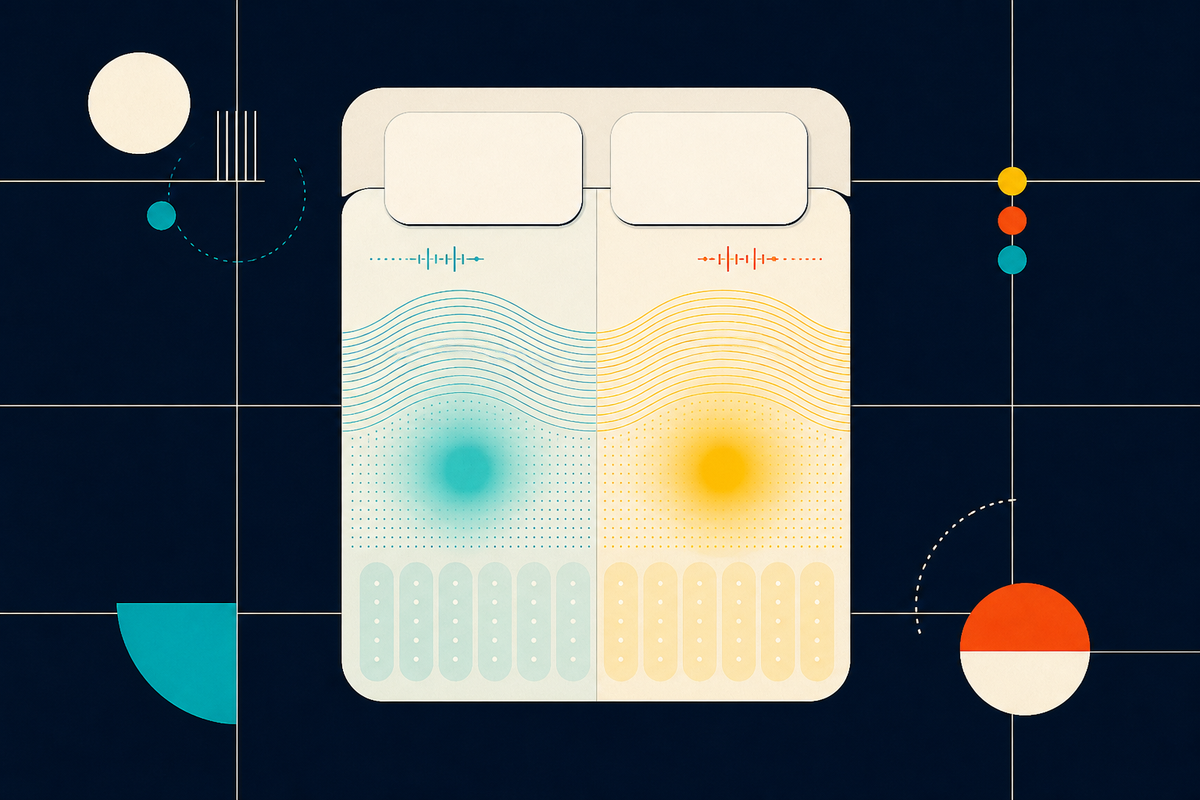
A control system disguised as furniture
Bob and JoAnn Walker founded Select Comfort in 1987, building a business around adjustable air support. The corporation took the name of its best-known product in 2017, the same year the Sleep Number 360 smart bed arrived. That change was more than cosmetic. The company no longer wanted to be understood as another mattress maker choosing among springs and foam. It wanted the bed to sense, respond and improve over time.
Softer left side, adjusted independently
Firmer right side, same shared mattress
This remains the clearest answer to what problem Sleep Number solves. Bodies disagree. They also change. Pregnancy, injury, aging, exercise and a restless week can alter what feels supportive. A conventional mattress freezes one compromise in foam. An air-supported bed lets the customer revise it tonight. For hot sleepers, the Climate range adds another variable: temperature on each side.
“Science tells us no two people are alike, and no two nights' sleep are the same.”Sleep Number, introducing its next generation of smart beds
The less obvious advantage sits in the data loop. People abandon wearables, forget to charge them or dislike sleeping with something on the wrist. A sensor inside a bed lives inside an existing habit. Sleep Number says its system has accumulated billions of hours of longitudinal sleep data. In research collaborations with Mayo Clinic and the American Cancer Society, opted-in data can help investigators study relationships between sleep, cardiovascular health and cancer journeys. The bed is sold as wellness technology, not a diagnostic machine, but its position under the sleeper creates an unusually persistent view.
The whole stack, including the truck
Sleep Number does not merely ship a compressed rectangle to a porch. Its vertically integrated model has historically controlled design, assembly, marketing, stores, consultation, delivery, installation, software and service. This makes sense for a product that customers may want to try, that may include pumps and moving bases, and that can cost several thousand dollars. It also turns a mattress sale into a chain of promises. The physical product must be comfortable. The app must connect. Replacement parts must exist. The delivery team must show up. The cloud must still answer years later.
That chain distinguishes Sleep Number from two sets of rivals. Traditional mattress companies such as Tempur-Pedic, Sealy and Saatva mainly compete through materials, comfort and brand. Connected-sleep companies such as Eight Sleep emphasize temperature and data, often through a system added to another mattress. Sleep Number combines the support surface, sensing, climate options, retail demonstration and service. Purple and Casper sit somewhere between, bringing direct-to-consumer language to a category still shaped by showroom visits.
The same integration that makes the proposition coherent also makes the economics less forgiving. In fiscal 2025, stores generated 88 percent of net sales; online, phone, chat and other channels generated 12 percent. Leases, sales staff, field service, assembly and technology do not shrink as quickly as demand. When the U.S. bedding market entered a long slump after pandemic-era buying, Sleep Number carried a retail network built for busier days.
Who buys a bed with a help desk?
The natural Sleep Number customer is not simply a gadget enthusiast. It is often a couple who has already discovered that “medium firm” is not a shared language. One partner sleeps hot; the other steals the blanket. One has a tender shoulder; the other wants a surface that barely yields. The showroom matters because the product asks for a more involved decision than choosing foam depth from a web page. A sales associate can move a customer through firmness settings, raise the base and demonstrate how each side behaves before a delivery team recreates the system at home.
There is also a practical reason to sell adaptability rather than one perfect feel. A mattress purchase has a long replacement cycle, while bodies have short ones. A runner's recovery night, a surgery, a new baby or an aging back can change the requirements long before the bed wears out. The pitch is that an adjustable chamber can follow those changes. Owners can soften the surface when pressure relief matters, firm it later and save distinct settings for two sleepers. Smart models add the quieter benefit of observation: the customer can look for patterns without remembering to start a tracker.
That convenience carries a different customer bargain. A traditional mattress can remain useful after its manufacturer disappears. A connected bed depends on software, account access and, for its smartest features, live infrastructure. The more the bed does, the more continuity matters. This is why the 2026 sale was not an abstract event for owners. Questions about warranties, replacement pumps and app availability go directly to the product's value. Sleep Number's decision to keep each of those services operating protected more than goodwill; it protected the usefulness of objects already sitting in millions of bedrooms.
Seven beds and a hard reset
Linda Findley became chief executive in April 2025 and inherited both a recognizable product and a stressed operation. The company cut costs, closed stores and simplified decisions. In March 2026 it completed its largest product reset in almost a decade, reducing 12 mattress models to seven across three collections. It was a merchandising decision and an admission: a customer looking for better sleep should not need a seminar in model names.
ComfortMode is the entry point, with adjustable firmness and temperature-balancing comfort but no required app connection. ComfortNext adds smart controls and, in two models, a “Tri-Brid” construction of micro coils, foam and air. Climate carries the premium technology. ClimateCool draws heat away through dynamic airflow; Climate360 adds active heating and cooling. Queen prices at launch stretched from $1,599 for ComfortMode to $9,999 for Climate360, before promotions and bases.
The products found external validation even as the business weakened. TIME included ClimateCool among its Best Inventions of 2025. J.D. Power ranked Sleep Number highest in both online and retail segments of its 2025 U.S. Mattress Satisfaction Study. Those facts sit awkwardly, and usefully, beside the financial results. Customer satisfaction and corporate solvency measure different things.
Fiscal 2025 net sales fell 16 percent to about $1.34 billion. The company reduced operating costs by $136 million compared with the prior year on its stated adjusted basis, but debt remained heavy. First-quarter 2026 net sales declined to $319 million. Findley said the capital structure was unsustainable. On June 12, Sleep Number entered Chapter 11 to run a court-supervised sale, while continuing orders, warranties, gift cards, deliveries, customer support and the infrastructure behind connected beds.
What Sleep Country actually bought
In July, a court approved Sleep Country Canada's acquisition of substantially all Sleep Number assets following a competitive process. The combination gave the Canadian retailer and its family of brands more than 800 locations across North America. More important than the count, it joined complementary capabilities: Sleep Country's multi-brand retail operation and Sleep Number's patented adjustable system, American store base, customer relationships and digital platform.
For customers, continuity is the immediate product. A connected bed is partly a promise about tomorrow. Buyers need the pump, parts, app and people who answer the phone to remain available. Sleep Number explicitly kept those services running through the sale. For its new owner, the opportunity is to keep the useful vertical pieces while removing the financial imbalance that overwhelmed the old corporate structure.
A loved product can live inside a stressed company. The bed and the balance sheet keep different scores.
Where does Sleep Number fit now? It occupies a narrow but meaningful space between premium furniture, consumer hardware and preventive wellness. It is not a hospital monitor, though researchers can learn from its opted-in data. It is not merely a mattress, because software and service affect the experience after delivery. It is not a typical gadget, because customers expect it to remain useful for a decade.
That awkwardness is the expertise. Sleep Number knows how to turn pressure, movement and temperature into a personalized nightly setting, then explain that system in a showroom. Its future depends on doing so with fewer layers and steadier economics. The central product insight remains intact: comfort is not a universal material. It is a setting, and tomorrow it may be a different one.