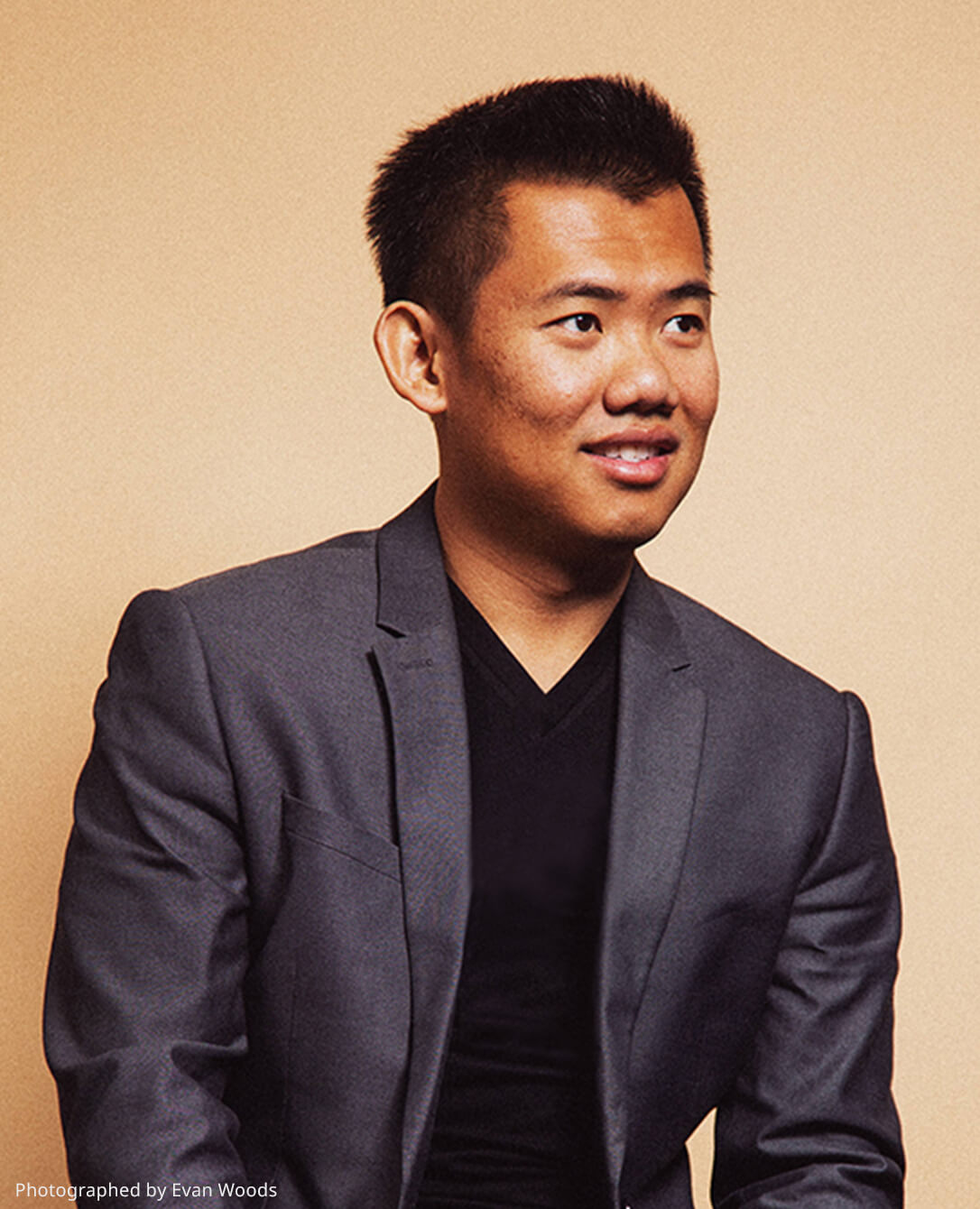
Every Friday in elementary school, Paul Tran placed a few nickels on a table and held a raffle. The stakes were modest enough to fit between the sofa cushions. The response was not. Classmates looked forward to the ritual, and a boy who had arrived in America from Vietnam without speaking English learned a durable piece of commerce: anticipation has value, and a small idea can become an event if people enjoy returning to it.
Tran was about five when his family immigrated. He remembers having little, but his account of childhood is not dour. Gratitude and ambition sit beside each other in the way he tells it. He would later put himself through the University of Southern California, moving between the Marshall School of Business and the Viterbi School of Engineering. The pairing suited him. One school asked whether an idea could sell. The other asked whether the object could work.
Several ventures followed, including the skincare business Dermaclara and WHIFF. He launched and sold companies, gathering the sort of education that does not issue a transcript. Then, in 2016, he found a problem so ordinary that its commercial neglect looked almost theatrical: men were grooming sensitive areas with tools designed for something else, while established brands behaved as though the entire subject had been removed from polite conversation.
Dermaclara had already shown him the peculiar etiquette of beauty. The company sold a science-led, non-surgical approach to wrinkles and stretch marks, placing Tran inside an industry full of private anxieties and public euphemisms. He came away convinced that taboos were often less a wall than a badly designed doorway. People would discuss an intimate problem if a company gave them useful language and an object that respected the problem. MANSCAPED would test that conviction in a category with even fewer volunteers for conversation.
“Dream big and be patient.”Paul Tran's personal maxim
The openingA very narrow door
The founding idea behind MANSCAPED was not “make everything for everyone.” It was nearly the opposite. Tran chose one awkward job and treated it seriously. The first run was 10,000 units. To test demand, he has said, the company used Facebook ads costing as little as $5 a day. This was not market research in a ballroom. It was a handful of signals arriving from strangers with credit cards.
Those signals mattered because MANSCAPED was not Tran's largest business at launch. It was simply the one showing the most interesting behavior. Buyers responded to the specificity. Two-thirds of first-time purchasers chose a starter kit, according to his later account, suggesting they wanted a routine rather than a lone gadget. The company could build around that: a trimmer, formulations, accessories, replenishment and, eventually, a membership relationship.
The humor arrived because it had a job. A euphemism could make somebody smile before embarrassment made him leave. But comedy created a second obligation: the physical product had to look considered. Otherwise MANSCAPED would be remembered as the company with cheeky copy and an object nobody bought twice. Tran's engineering instincts pulled against that risk. Packaging, blade design, ergonomics and the store experience all had to carry more seriousness than the advertisement.
Iteration became the unglamorous center of the operation. When the fourth generation of the Lawn Mower trimmer appeared in 2021, Tran said it had required more than 18 months of research, development and production. Each version had to answer the complaints and habits revealed by the one before it. The product team refined motors, blades, lighting and handling while the commercial team refined bundles and messages. In that sense, MANSCAPED behaved like two companies sharing one joke: a hardware maker measuring tolerances and a consumer brand measuring attention.
Learning in publicThe hour that cost $18,000
Early growth contained at least one reminder that digital advertising is capable of turning a typo into an invoice. Tran has recounted an errant campaign burning through roughly $18,000 in an hour, about a third of the company's starting budget. The lesson was partly mechanical: controls matter. It was also strategic. An advertisement built to harvest an existing intention is different from a brand idea built to lodge in memory.
MANSCAPED learned to do both. The company produced its creative work internally, bought podcast inventory and developed a voice recognizable before the logo appeared. Tran also says the team rejected provocative imagery that converted better in the short term because it would narrow the brand's future. Restraint is a curious word for a business famous for anatomical jokes, but the restraint was real. The company wanted permission to be funny without becoming crude wallpaper.
The numbers climbed with unusual speed. Public transaction materials reported that trailing twelve-month revenue grew from roughly $3 million in the first quarter of 2018 to $285 million in the third quarter of 2021. During that period, the company said it had used $23 million in raised equity, remained profitable and amassed more than one million active paying members. Tran described the acceleration as a blur, which is the sort of phrase one uses when the spreadsheet has begun moving faster than memory.
“While one person might start the idea, no one person can execute the entire vision.”Paul Tran, accepting his 2022 regional EY award
Earning the shelfFrom browser tabs to shopping carts
Tran did not treat retail as the automatic graduation ceremony for an internet brand. MANSCAPED waited until it had a large media engine, reportedly spending tens of millions annually, before asking stores to carry it. The calculation was plain: a shelf does not create awareness by itself. A customer should arrive already knowing why the black box with the puckish name exists.
Target came first in 2019. Best Buy, Macy's and others followed. Walmart arrived in 2024. Internationally, the company paired its own ecommerce operation with Amazon and local partners, from Tesco and Boots in Britain to retailers in Australia, Canada, Ireland and South Africa. By 2026, Shopify's profile of Tran credited the business with more than 15 million customers across 39 countries and $300 million in revenue.
A company born from a single grooming task was now making devices and formulations for beard, face, head and body. The expansion sounds obvious only in retrospect. A narrow brand risks becoming a punchline trapped in its first category. A broad brand risks becoming beige. MANSCAPED's task was to move outward while keeping the original audacity intact.
The deal and the day afterA billion-dollar door closes
In November 2021, MANSCAPED announced plans to merge with Bright Lights Acquisition Corp. The proposed transaction implied an enterprise value of about $1 billion and would have placed the company on Nasdaq under the symbol MANS. A tidy ticker, a large valuation and the machinery of public markets gathered around a business that had begun with 10,000 units.
The merger was terminated in 2022 amid unfavorable market conditions. In a later interview, Tran framed the decision to walk away as one he was glad to have made. The useful detail is less the verdict than what came next. MANSCAPED remained private and kept operating. It added retailers, countries and products. The grand transaction became a chapter instead of the ending.
That same year, Tran received the EY Entrepreneur Of The Year award for the Pacific Southwest region. His response redirected the honor toward the team. “Without you, I am nothing,” he wrote. It was consistent with the people-first language on his personal site, where he describes empathy as something learned through arriving with little and remembering who helped along the way.
The long viewHairballs at the Super Bowl
Ten years after the founding, MANSCAPED bought time just before kickoff at the 2026 Super Bowl. The commercial starred singing clumps of discarded body hair mourning their separation from former owners. No athlete explained the features. No actor borrowed prestige. The idea was peculiar, a little sweet and impossible to confuse with an insurance commercial.
It also marked a change in the assignment. The company wanted customers to understand that it no longer stopped at the category that made its name. Its new message was full-body care, compressed by the creative team into “From Ball to All.” The national spot was less a victory lap than a costly introduction to a second act.
Tran's own ambition extends further. He has spoken about making MANSCAPED a multigenerational company and about someday establishing a foundation for orphans and underprivileged children in Vietnam. At home, away from the product lab and the campaign review, he says time with his wife and two children is how he resets.
His public LinkedIn summary contains only three words: “Create. Innovate. Repeat.” The last word does the heaviest lifting. Repetition turned a nickel raffle into a Friday institution. It turned a small ad test into evidence, one trimmer into a shelf, and an awkward conversation into a company with customers across the world. The fortune was hiding in plain sight. The difficult part was being willing to point at it.