The phone call lasted long enough to ruin the pan. One evening in 2017, Jordan Nathan turned on a burner in his apartment, stepped away and returned roughly 45 minutes later to cookware that had blackened in a room full of fumes. The practical question was urgent and ordinary: what, exactly, had been sitting on his stove? The commercial question arrived soon after. Why did an object used every day feel so poorly explained, so visually resigned and so incomplete once dinner was over?
Nathan already knew the kitchen aisle from the inside. He had launched scores of products, watched sales data move in real time and learned how quickly an online marketplace could turn a colorful utensil into an inventory problem. The pan did not hand him a company. It handed him a category to reconsider.
Caraway, the business that emerged, would eventually be known for ceramic-coated cookware in muted colors, sold first on the internet and later on shelves across the country. Yet its more revealing invention was managerial: Nathan built his second serious attempt at entrepreneurship out of the mistakes, excesses and useful scraps of the first.
Before the pan, a student of wanting
At Colby College, Nathan did not find the course of study he wanted in the catalog, so he assembled one. His independent major combined psychology, economics and sociology into what he called behavioral business. “I was interested in why people bought things,” he later said. His capstone pulled customer definition, business planning and financial modeling into one project. This was consumer research with a cash register waiting at the end.
He tried the real thing while still a sophomore. Wanu was conceived as a marketplace for emerging brands, a broad shopping destination built before its founder had worked out the smaller proof that might validate it. The idea placed second in a campus entrepreneurship competition. After graduation, Nathan moved back in with his parents and kept working on it. Wanu did not last.
Failure supplied a useful edit: a founder can draw an enormous map and still neglect the first walkable block. Nathan would later describe the missing minimum viable product as a regret. He had gone wide before proving narrow.
Two hundred lessons in a hurry
His next education came at Mohawk Group, where he worked on the kitchen brand Vremi and eventually became its chief executive. Nathan was in his early twenties and, by his account, given broad control. It was a rare apprenticeship: product, brand, supply chain, sales and the wonderfully unforgiving arithmetic of Amazon all sat within reach.
Vremi brought more than 200 products to market in a compressed stretch of roughly 18 months to two and a half years, depending on how Nathan has described the period. It taught him to test, read demand and use digital feedback. It also taught him what happens when assortment grows faster than calm judgment. Forecasting becomes guesswork with a warehouse attached. Quality has more places to slip. Profitability, postponed as tomorrow's concern, returns with a clipboard.
From velocity to focus
The comparison is strategic, not chronological: rapid assortment at Vremi versus one core cookware set at Caraway's debut.
His pithy verdict was, “don't launch 200 products in 18 months.” Caraway began as the correction. Nathan left in 2018 and spent about 18 months developing a single cookware set. It came in five or six colors. The company had no initial intention of selling individual pans. Restraint was no longer an aesthetic preference. It was operating policy.
A launch with 150,000 witnesses
Patience did not mean quiet. Six months before the November 2019 debut, Caraway began assembling a waitlist. Prospective customers received development notes, glimpses of prototypes and surveys. By launch, the list reportedly exceeded 150,000 people.
The number made good publicity, but its more interesting role was disciplinary. A public date matters differently when a small city's worth of inboxes has been invited to watch. Nathan's team could test language and color while the future customers acquired a modest stake in seeing the project arrive.
Arrival was nearly indecorous. Three days before launch, close to 10,000 sets had reportedly reached the warehouse damaged and needed repacking. It is the sort of scene omitted from pastel advertising: cartons open, clock running, elegance waiting for someone to find more tape. The sets went out. The polished brand had acquired its first unpolished story.
The other 23 hours
Caraway's cookware used an existing ceramic non-stick category rather than a material Nathan had invented. His opening was interpretation. Traditional kitchen shelves offered plenty of black, steel and bright primary color. Caraway chose shades intended to sit more comfortably in a room, then photographed the pieces almost as sculpture. Early outreach favored lifestyle, design and wellness voices over the familiar procession of chefs and recipes.
The set also arrived with magnetic pan racks and a canvas lid holder. This was more than tidy packaging. A pan cooks for perhaps an hour and waits for the other 23. Nathan treated that waiting as part of the product. The company was selling the cabinet after the meal as surely as the sauté pan during it.
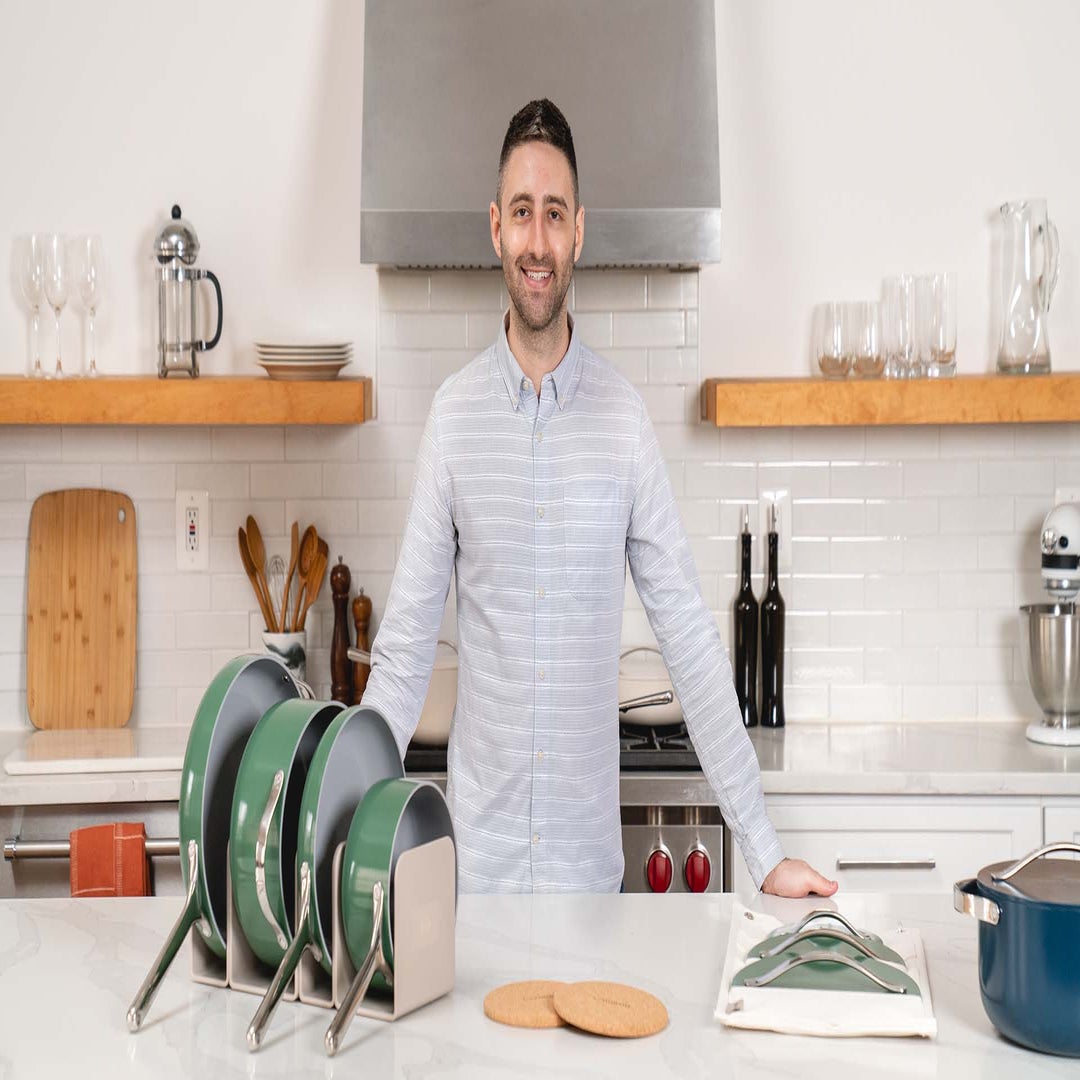
That attention suits Nathan's own account of the job. “I just love building stuff,” he has said. He describes his involvement as reaching down to small product decisions. The phrase sounds boyish; the practice is rather adult. Details are charming until there are thousands of them, each with a cost, a factory tolerance and a customer who will notice.
Late to the party, early to the shelf
Caraway entered an online cookware market already occupied by Our Place, Great Jones, Made In and other well-financed arrivals. Nathan came late enough to observe the gathering. Competitors clustered around food culture; Caraway could lean toward interiors. Others sold individual heroes; Caraway could make the complete set and its storage the argument. Being late is inconvenient only if one arrives without having watched the room.
The company was digital first but never planned to remain digital only. Nathan began conversations with retailers before launch, even when those retailers had little reason to trust an unknown label. The website provided the laboratory: price, message and demand could be tested directly. The store supplied touch, scale and a place to displace the old default on an actual shelf.
Caraway gradually moved into Crate & Barrel, Target and other national chains. Amazon followed in 2022, despite Nathan's early conviction that the company would never sell there. The reversal is revealing rather than embarrassing. The founder trained on Amazon wanted the romance of pure DTC. The operator eventually accepted that customers possess their own shopping habits.
Capital helped widen the route. A $5.3 million seed round in 2020 was followed by a $35 million investment led by McCarthy Capital in 2022. Nathan has said Caraway raised $40 million in equity overall. By 2025, he described a business approaching 100 employees and appearing in about 1,000 retail locations. The set had been joined, deliberately rather than all at once, by bakeware, food storage, prepware, kettles and utensils.
The long way around the kitchen
A five-year map and a century-sized test
Nathan says the product roadmap runs five years ahead. In 2025, that meant 25 to 30 items in development and a plan reaching 2030. Categories face a compact examination: Is the market large? Can the material approach improve? Does Caraway have something to say about design or organization? The questions are a brake as much as a filter, designed to keep the old appetite for 200 launches from returning in better typography.
His stated ambition is longer still. Nathan has spoken about building a company that could exist in 100 years and move beyond the kitchen. Fatherhood, he wrote in 2026, changed the motive. Caraway began partly as a bid for independence after a layoff and his own difficulty working for others. With two young children, he described the work in terms of what families bring into their homes and what his children might one day think of what he built.
The business continues to acquire the ordinary complications of scale. More channels mean more attribution puzzles. More products mean the inventory discipline Vremi taught him to respect. More visibility means every advertising phrase receives sharper scrutiny. In 2026, a Walmart launch added another large retailer and received a marketplace award within its first month. The late entrant keeps finding new shelves.
Nathan's story is tempting to compress into one ruined pan and one successful company. The better version includes the candy he sold at summer camp, the major he invented, the marketplace that failed, the hundreds of products that arrived too fast, and the thousands of sets that had to be repacked before opening day. Caraway did not spring from a flash of inspiration. It accumulated from revisions.
The nicest irony sits in the cabinet. Nathan built a brand in the noisy economy of online attention by thinking carefully about what happens when the product is out of sight. There, between meals, the racks keep the pans upright and the lids wait in order. A small domestic nuisance has been given the dignity of a business plan. One suspects the student of why people buy things would appreciate the answer: occasionally, they buy because someone noticed where the awkward part lived.