The first shelf never arrived. In 2015, Ben Lewis and Angela Vranich had fresh baby-food blends, ten planned products and an expected debut at Whole Foods. Then a last-minute roadblock delayed the launch. For a young food company, this is the kind of sentence that usually ends with a warehouse full of perishable optimism. Lewis and Vranich chose a more interesting verb: pivot. They would sell directly to parents instead.
It was not the plan, and that is precisely why it mattered. A grocery buyer had been replaced by thousands of households. Instead of fighting for two chilled slots beside yogurt or produce, Little Spoon could offer a rotating menu and explain why its food was different. More important, the company could hear what happened after the box reached the kitchen. The obstacle did not merely redirect distribution. It changed who got to speak first.
Eight years after its 2017 launch, Little Spoon entered more than 1,800 Target stores with 23 products spread across six aisles. By then, it said it had delivered more than 80 million meals, grown at a 79 percent compound annual rate over five years and become profitable in 2024. Lewis had finally reached the shelf, carrying years of customer knowledge with him.
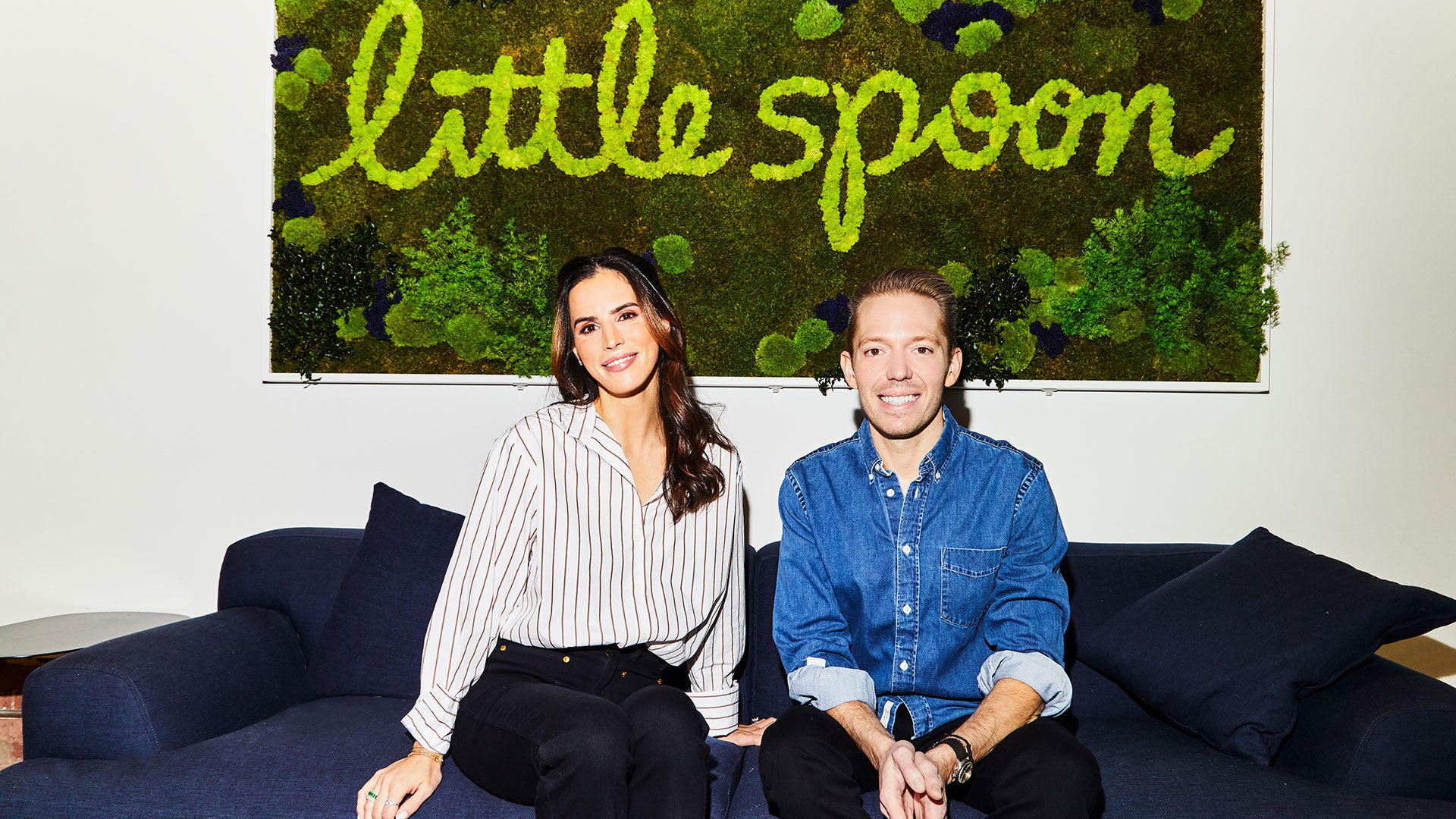
A founder before the title fit
Lewis grew up in Pittsburgh, where entrepreneurship found him early. In high school he started a bottled-water brand. Later came a Greek-yogurt company that he launched and sold, followed by Green Shoots, a food-distribution business. Those ventures sound like a tasting menu of startup life, but they share a useful discipline: food is physical. It must be made consistently, moved safely, priced sensibly and delivered before time changes it.
He also met Vranich while they attended neighboring Pittsburgh high schools. It was 2006; she was a sophomore, he a junior, and, according to her, Lewis threw the good parties. They went to college around Philadelphia, moved to San Francisco and kept circling the same industry from different angles. Vranich worked in natural-food marketing. Lewis learned distribution and food trends. Their eventual company would divide along those strengths: she led product, recipes, brand and packaging; he took operations, supply chain, fundraising and growth.
Vranich developed Little Spoon's earliest recipes in a Southern California tamale factory. The charming brand began, as food companies often do, somewhere more practical than picturesque.
The opportunity they saw was almost comic in its imbalance. Adults could buy fresh-pressed juice. Dogs could have fresh food delivered. Baby food was still largely organized around jars and long shelf lives. Lewis found it baffling that the category's central format had changed so little in roughly a century. Yet an idea is only charming until refrigeration enters the room. His experience told him that freshness would live or die by the supply chain.
“For us, it was always about the parent.”Ben Lewis on choosing the channel around the customer
The education of ten sales
Before Little Spoon committed to direct sales, an Erewhon sampling event offered a miniature lesson. Shoppers liked the product. Ten bought it over the course of the day. The problem was not necessarily food, price or packaging. It was probability. Only a narrow slice of passing shoppers had a child at the right age, and baby food is not an impulse purchase for many parents. It invites questions: ingredients, age, storage, testing, trust. The aisle offered seconds when the product needed a conversation.
Online, Little Spoon could answer those questions and provide variety without asking a grocer to surrender half a refrigerator. The company built subscriptions around a daily need and delivered fresh food every two weeks, a cadence that balanced convenience with costly chilled shipping. In 2019, Lewis described a rotating menu of 30 blends and 80 ingredients reaching every US ZIP code. This was not a website attached to a food company. The fulfillment logic was part of the product.
Direct contact also made the company curious in a useful way. Parents asked for help beyond purees. During the pandemic, messages described the strain of feeding children while home also became office, classroom and everything else. Little Spoon accelerated Plates, its ready-to-heat meals for toddlers and children, and sold more than 100,000 in the first week. Purees became meals, then finger foods, smoothies, snacks and lunch-box formats. The company was not stretching toward random grocery categories. It was following the same child forward.
The company that grew up with dinner
That progression reveals Lewis's larger ambition. He does not describe victory as owning baby food. In 2026, when Little Spoon entered infant formula, he put the aim differently: an “end-to-end feeding solution for parents.” By then the company said it had surpassed $150 million in direct-to-consumer revenue and offered 130 products across nine categories. Lewis later said it had delivered more than 100 million meals.
The direct relationship made that expansion more precise. Little Spoon could see not only what customers bought, but when a family might be approaching a new eating stage. Newsletters and account data became quiet signals. A parent buying purees could encounter the next relevant product without hunting through frozen foods, snacks and baby aisles. Lewis calls personalization exciting; beneath the enthusiasm is a practical retail critique. Physical shelves divide a brand by temperature and category. A digital account can keep the family whole.
Still, most grocery buying happens in stores. Eventually the absence from retail became its own limit. A Target buyer first showed interest in Little Spoon's frozen plates. Customers, meanwhile, had repeatedly asked to buy individual components such as turkey-kale meatballs in larger packs. Lewis and Vranich logged those requests even when the products made little sense for parcel delivery. The notebook of impractical ideas became a retail plan.
Target offered an opening in 2024. The founders declined, politely, because they wanted a larger arrival. Their own surveys had shown that 80 percent of Little Spoon customers shopped at Target. The eventual launch required new production, reworked packaging and an operation capable of serving produce, dairy, frozen, lunch-box, snack and baby aisles at once. The retailer called it its largest food-and-beverage launch. Little Spoon had returned to the place it once could not enter, this time with leverage.
The shelf was no longer the place to discover whether Little Spoon worked. It was the place to extend something already learned.
A stolen car and a delayed promise
Founders are often flattened into their preferred business vocabulary. Lewis has plenty: positive unit economics, capacity, personalization, customer feedback. His life with Vranich supplies livelier nouns. After spending the first months of pandemic lockdown stranded on the Caribbean island of Nevis, the couple bought a theft-recovery car at auction through a mechanic with the right license. They drove it from Los Angeles to New York. They later named their puppy after the mechanic, Gus. It is difficult to invent a better founder holiday: complicated acquisition, trusted intermediary, questionable asset, coast-to-coast logistics.
Then there is Mexico. When Little Spoon crossed $100,000 in weekly sales in 2019, someone joked that the team should celebrate there. The joke returned at larger milestones, including $100 million in annual sales, while the trip remained theoretical. As the company approached 100 full-time employees, Lewis decided the moment had come. Nearly 100 “Spooners” went. He later wrote that the return could not be measured in a spreadsheet. For an operator, that is close to poetry.
The anecdote matters because scaling a fresh-food company is mostly invisible labor. Refrigerators do not applaud. Forecasts are admired only when wrong. The box that arrives on time looks obvious. Lewis's work has been to make an improbable system feel ordinary to the family receiving it. Taking the team away for a week acknowledged the people inside that illusion of ease.
The advantage of arriving late
Little Spoon's story can be told as disruption, though that word has been pureed beyond recognition. A more accurate description is sequencing. Lewis and his co-founders built trust before reach, range before shelf space, and feedback before scale. When retail finally made sense, they did not tiptoe in with two products. They arrived across six aisles.
The next phase is broader again. Formula places the brand at the beginning of infancy; older-kid products extend the other end. Retail adds households that will never subscribe to a meal box. Digital keeps the detailed relationship that made the portfolio possible. The tension between those channels is now Lewis's operating problem, and likely his favorite kind: one with cold storage, imperfect data and a customer who needs lunch by noon.
The missing Whole Foods launch once looked like a closed door. In retrospect, it gave Little Spoon eight years to learn why anyone should open one. Failure is too dramatic a word for it. Detour is better. A detour, after all, still gets you there - with a much more interesting map.