The clue arrived as a nuisance. Customers of Hive Brands, the sustainable-grocery marketplace Katie Tyson had co-founded, kept asking the same question: Where had Love Grown gone? The cereal had slipped from store shelves. People wanted it back. Some messages carried the special panic reserved for a household staple that has vanished without warning. Tyson knew the product met Hive's standards. She had not known it commanded this sort of loyalty.
A conventional retailer might have offered an alternative and moved on. Tyson asked her team to find out what was happening. They could not reach the company at first. Eventually, they learned that Love Grown was in trouble and its original founders were leaving. Hive found the person who had assumed ownership and started a conversation. The pitch was simple: customers were already asking for this brand. There was demand hiding in plain sight.
The eventual deal was stranger than a neat acquisition announcement. Tyson has said the owner became an investor in Hive, and part of that investment funded the purchase of Love Grown. In October 2023, a marketplace designed to curate other people's products acquired a cereal company founded 15 years earlier by two University of Denver students. A rescue mission had become corporate strategy.
An apprenticeship in wanting
Tyson's route to the cereal aisle began at the University of Virginia, where she studied business with an emphasis on marketing and management. She graduated in 2008 and spent her first five working years in advertising. McCann Erickson and Saatchi & Saatchi taught her the large-agency version of persuasion. At VaynerMedia, she learned social and digital marketing while getting her first exposure to startup velocity.
Then came Freshpet, where Tyson built the company's digital marketing function from the ground up. She stayed for four and a half years, learned the grammar of consumer packaged goods and watched a mission-driven company make the transition to public markets. Freshpet offered something agency work could not: the consequences of a brand promise, all the way through the product and the business.
After Freshpet went public, she moved to Casper. The mattress company was in its early direct-to-consumer sprint, and Tyson spent two years building marketing and consumer-insights capabilities. Founders around her were close to her age. Their presence made an old ambition harder to ignore. She wanted to build something of her own.
2008 onward
CPG + IPO
DTC insight
Marketplace
Maker
Tyson had already been testing the edges of entrepreneurship. Alongside her operating jobs, she mentored early-stage companies, built an executive-coaching practice and consulted for startups. Her public biography still wears the variety proudly. She calls herself a multi-passionate entrepreneur, a useful phrase for someone whose career includes ad agencies, pet food, mattresses, coaching, sustainable retail, coffee and cereal. The list sounds scattered only if the connecting subject is missed. Tyson studies how people make choices, then builds systems around those choices.
The marketplace with a test
At the end of 2019, former Freshpet executive Scott Morris approached Tyson with the idea that became Hive Brands. Sustainable shopping had a research problem. A shopper might care about ingredients, packaging, a company's footprint and its treatment of producers, but verifying every claim across an ordinary grocery basket was absurdly time-consuming. Small companies with serious practices were hard to discover. Good intentions kept meeting bad user experience.
Hive launched in the second half of 2020 with an answer called the Hive Five. Products were examined across ingredients, recyclable packaging, carbon footprint, social impact and supply chain. The team tasted products together. In categories where curbside recycling was not practical, Hive offered a TerraCycle return program. Tyson argued that the target customer was better understood as a mindset than a demographic: someone who cared about what a purchase did beyond the pantry.
The framework did more than filter a catalog. It gave the young company a point of view. Yet the Love Grown messages exposed a different kind of information. Standards could determine whether a product deserved a place in the store. They could not predict which product customers would campaign to save. That required attention to emotion, not merely criteria.
The experiment becomes the plan
Owning Love Grown was the beginning of the difficult bit. In January 2025, Hive said goodbye to most of the outside brands on its marketplace. The team needed time and capital to test whether the rescued cereal could support the next version of the company. They ran coating trials, reduced sugar, removed seed oils and worked on cocoa, cinnamon and a new fruit flavor. A classroom helped taste the results, providing the sort of focus group whose members rarely soften a verdict for professional courtesy.
In February, Love Grown added coffee sourced from a family farm in Honduras. Original Power O's returned in March. The first full cereal production run followed in April, along with an immediate lesson in manufacturing constraints: there were not enough ingredients to make Cinnamon Power O's, so production paused. By May, the complete cereal line was back. In September, sales justified a second production run.
November supplied the cleanest signal yet. Love Grown reached a reported $1 million run rate. The team decided to go all in, built a new site, completed a restructuring and parted with the marketplace's remaining partner brands. Hive's original values survived, but the vehicle changed. The curator became the maker.
Tyson's phrase for this style of leadership is "strong ideals, loosely held." It is more demanding than it sounds. Weak ideals make every opportunity attractive; rigid plans make useful evidence inconvenient. Love Grown required a third position: keep the purpose, allow customers to redirect the machinery.
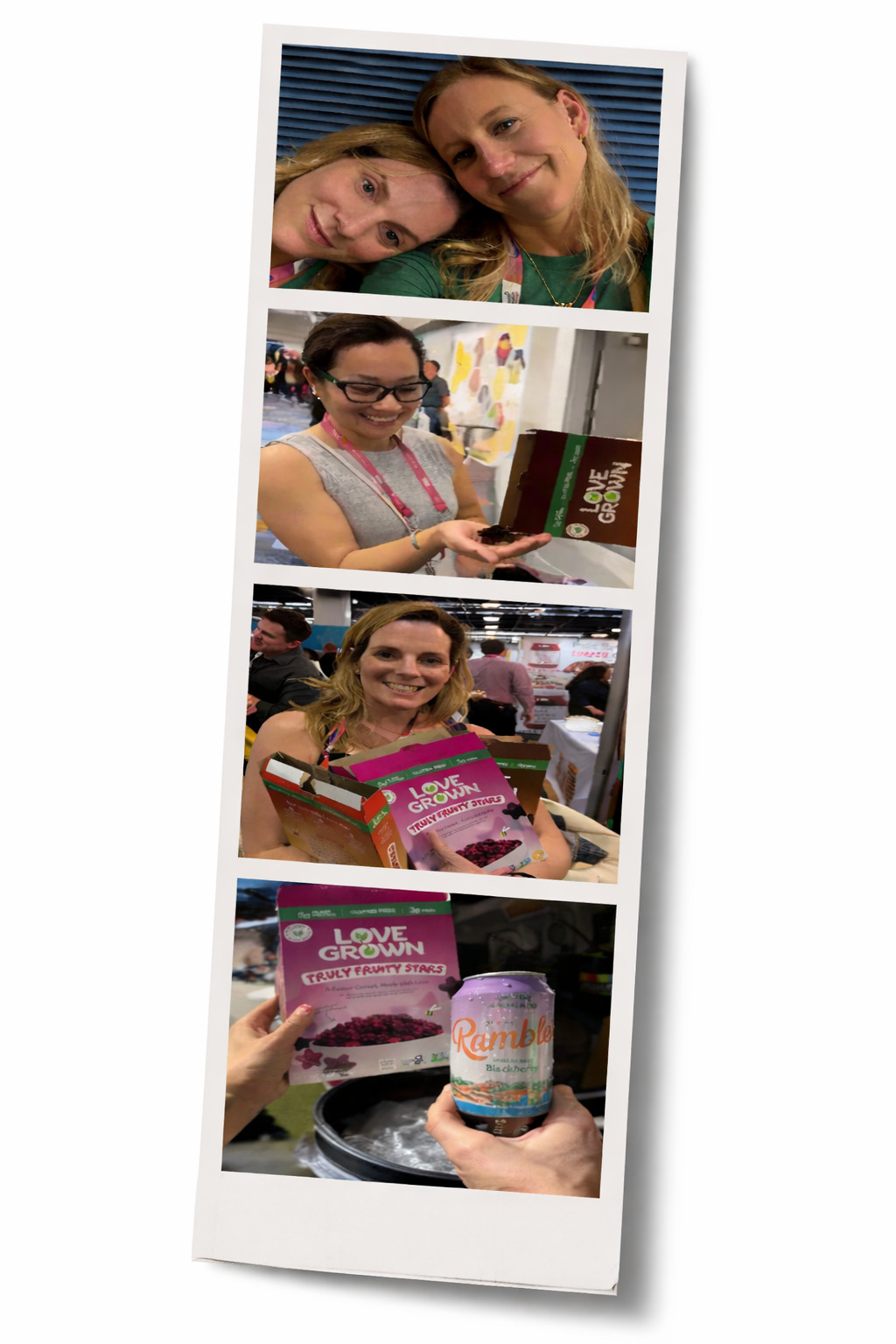
Box to hand, crumbs to floor
The small-company version of this philosophy appeared at Expo West in March 2026. Major food brands can spend hundreds of thousands of dollars on elaborate booths. Tyson and colleague Kate Harper nearly skipped the show because Love Grown could not compete on those terms. A week before it opened, they decided to attend without a booth.
Their alternative was "box-to-hand" sampling. They filled large tote bags with cereal boxes, walked up to showgoers and poured samples into open palms. The method was modeled linguistically on hand-to-hand combat, though Tyson noted that it was considerably less violent. Walking the floor made conversation easier and lowered the pressure. It also produced one slapstick casualty: Tyson forgot to close a box and flung Chocostars at the De Soi booth while accepting a sample. The staff helped sweep up. The cereal survived as anecdote.
The episode captures something glossy founder profiles often sand away. Resourcefulness is frequently a little undignified. It requires tote bags, cold introductions and the willingness to look briefly foolish in a convention hall. Tyson's recap ended with a lesson that sits comfortably beside all the strategy: perhaps having fun matters more than anything else. Her sign-off was even better: "With love and beans."
A company built at breakfast speed
By the summer of 2026, the Love Grown catalog had widened into cold brew and new coffee formats. Tyson's August company dispatch mixed product news with a personal milestone: she had married, and a Love Grown cold-brew martini appeared among the signature drinks. The detail is on brand without trying too hard. For a founder building around daily rituals, even the wedding toast arrived through product development.
Love Grown now describes Tyson as a Brooklyn-based dog mom to Lou, loyal to cereal and coffee, and responsible for putting the "grow" in the name. It is a compact portrait, warmer than a résumé and more revealing than a title. Her longer career offers the operational version. Advertising taught her to frame desire. Freshpet taught her to build a consumer function inside a product company. Casper taught her ecommerce. Coaching taught her to ask and listen. Hive supplied a mission and a marketplace. Love Grown converted the lot into boxes, bags, beans and repeat orders.
The stealable idea is not simply "listen to customers." Every company says that, usually while arranging the next survey. Tyson's version carries a cost. Listening changed what Hive sold, what it owned, how it spent and, eventually, what the company was. The signal was persuasive because the team permitted it to have consequences.
There is a modest grandeur in allowing breakfast to reorganize a business. Cereal is ordinary, which is precisely why its absence mattered. Customers had already built Love Grown into their routines. Tyson's team did not manufacture that attachment. They noticed it, respected it and made the increasingly unfashionable decision to follow through. The cereal aisle offered no trumpet fanfare. Just an empty space, an inbox and a question that would not go away.