The first clue that Love Grown mattered was not on a sales dashboard. It was in the inbox. Shoppers could no longer find their cereal, so they began contacting Hive Brands, the sustainable online grocer that had carried it. Love Grown, a Denver-born maker of crunchy O's built from navy beans, lentils and garbanzos, was sliding toward shutdown after pandemic-era cost pressure. The customers were not asking for a substitute. They were asking where their cereal had gone.
Hive called the owners. In October 2023 it acquired the brand for an undisclosed price and made the products exclusive to its marketplace. This was not a glossy roll-up. It was a rescue in which the first job was embarrassingly concrete: find a way to manufacture the cereal again, at the same standards, before loyalty curdled into nostalgia.
A cereal with a soup aisle ingredient list
The original Love Grown began with a family granola recipe. University of Denver students Maddy D'Amato and Alex Hasulak made it between classes, handed it to friends and, after graduating, worked from a borrowed commercial kitchen in Aspen. One City Market shelf became 80 King Soopers locations. By the end of 2010, a Kroger relationship had pushed the company to roughly 1,300 stores. In 2018, management said Love Grown products were sold in more than 12,000 U.S. and Canadian retailers.
But the defining invention arrived in 2014: Power O's. The ingredient logic was wonderfully strange. Take navy beans, green lentils and garbanzo beans, add brown rice, and turn the mix into a familiar cereal ring. It supplied plant protein and fiber without wheat or corn. By 2018, bean-based cereal generated about two-thirds of Love Grown's revenue. The weird product had become the serious business.
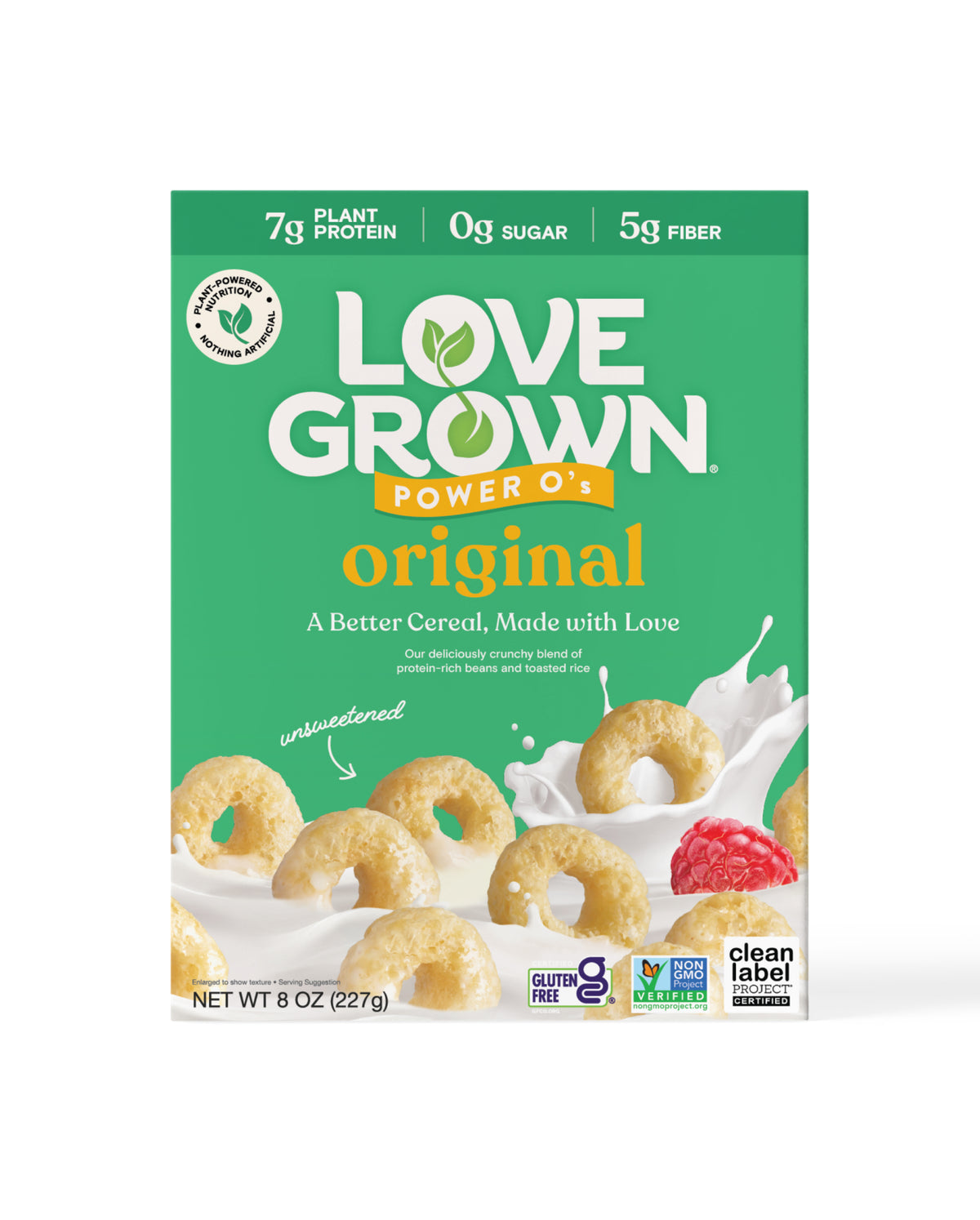
Love Grown sat in a useful gap. Traditional cereal offers low prices, broad distribution and childhood familiarity, but often leans on grains, sugar and artificial flavor systems. Newer protein cereals can be expensive and aggressively optimized for macros. Love Grown's pitch is quieter: recognizable cereal shapes, beans as the base, gluten-free and non-GMO positioning, plus no artificial colors or flavors. Current boxes begin at $6.79 online. This is premium breakfast, but it still looks like breakfast.
What failed first was the machine around the product
A beloved product can still live inside a fragile system. Love Grown had raised multiple rounds, including $4.73 million in 2015, $3 million in 2017, $600,000 in 2018 and a reported $4.6 million in 2019. Distribution was broad. Awards and founder profiles followed. None of that immunized a small food manufacturer against rising costs, production complexity and pandemic disruption.
When Hive stepped in, demand had survived but supply had not. The team needed a new manufacturing partner and had to reproduce the crunch and flavor people remembered. In early 2025, it ran repeated coating trials to reduce sugar, eliminate seed oils and improve cocoa and cinnamon. A classroom supplied unusually blunt taste testers. Then operations delivered the classic food-startup punch line: there were not enough ingredients for Cinnamon Power O's, so production paused.
unknown
Hive's 2023 acquisition cost was never disclosed. The costs that are visible are operational: a new manufacturer, reformulation trials, ingredients, inventory and the focus required to bring every cereal back by May 2025. Current entry prices run from $6.79 for cereal and $16.14 for coffee.
That answer matters because “What did it cost?” is often answered too neatly. The purchase price may be private; the strategic cost is plain. Hive eventually said goodbye to most third-party brands, then the rest, and reorganized around Love Grown and one other owned brand before focusing its public identity on Love Grown. A marketplace built to curate hundreds of products became a company making a handful of its own.
The number that changed their mind
The acquisition began as preservation. The full pivot required proof. Love Grown launched coffee in February 2025, returned Original Power O's in March, completed a full cereal production run in April and restored the assortment in May. In September it ordered a second cereal run because the first had sold sufficiently. Then, in November, management reported a $1 million annualized run rate.
That was the mind-changing number. The experiment could become the plan. By December, the team had completed a restructuring, ended the remaining marketplace relationships and opened a new warehouse. It had traded assortment breadth for ownership, operational control and a more coherent customer routine.
Starter pack
A discounted cereal or coffee bundle lowers the first-order risk.
→Subscription
Four-week refills receive a 15 percent discount and can be swapped or paused.
→Own the morning
Cereal, coffee, cold brew and WellDrops share one customer occasion.
The current model is direct-to-consumer ecommerce with one-time orders, bundles and subscriptions. A cereal-and-coffee starter pack begins at $20.77 and carries a 35 percent trial discount tied to recurring delivery. Whole-bean and ground coffee begin at $16.14; compostable pods at $18.70; cold-brew bags at $23.38. Hospitality, resale and Shopify Collective provide additional routes, but the website is the center.
From beans in the bowl to beans in the mug
Coffee could look like brand extension by pun. It is actually an occasion strategy. Love Grown already occupied breakfast; coffee sits beside the cereal. Both products can be explained through beans, agricultural sourcing and daily consumption. Both let the company sell trust: cereal with plant-powered ingredients and coffee independently tested for contaminants.
Love Grown says its Honduran Parainema coffee comes from family-owned farms and is grown without pesticides. Its decaf blends use Peruvian and Mexican beans processed with the Swiss Water method. The company sells whole bean, ground, cold brew and plastic-free compostable pods. Clean Label Project lists Love Grown as certified for cereal and coffee; B Lab lists the company as a certified B Corporation headquartered in New York.
In July 2026 the company added WellDrops, liquid functional-mushroom supplements intended to disappear into coffee without changing flavor or leaving powder at the bottom. It is a small product-design observation masquerading as category expansion: many wellness buyers already add powders to drinks and dislike the final chalky sip. Love Grown changed the format rather than asking customers to learn a new ritual.
That architecture also clarifies who the customer is. Love Grown is not selling primarily to the strictest biohacker or the bargain hunter studying unit prices. It is for households that want fewer artificial ingredients, shoppers managing gluten or allergen concerns, parents trying to improve the nutritional profile of a familiar bowl, and coffee drinkers uneasy about plastic pods or contaminants. The company says more than 1.1 million bowls and cups have been served, while its site displays roughly 28,900 verified ratings across products. Those figures describe reach, not market dominance. They do suggest the same buyer may plausibly move from cereal to coffee without needing a fresh lecture about what the brand stands for. In a crowded wellness market, that saved explanation is useful: the promise remains clean, tested and pleasant enough to use every morning.
The playbook worth copying
Founders should not copy the beans. They should copy the sequence. Love Grown's rescue worked because every stage generated a stronger form of evidence, from complaints to sales to repeat production. The company did not begin by announcing a platform. It earned the right to narrow.
When a product disappears, measure who notices, how quickly and whether they ask for that exact item.
Rebuild the loved SKU before adding adjacent products. Memory is an asset only if the replacement feels right.
One production batch proves curiosity. A reorder justified by sell-through starts to prove a business.
Add products used by the same person at the same time, with standards the brand can credibly carry over.
When this will not work
A rescue is a bad bet when nostalgia does not convert to paid repeat orders, when old customers depended on mass-retail pricing that DTC shipping destroys, when a formula cannot be reproduced, or when manufacturing minimums absorb the available cash. Loud inbox demand is useful evidence, not a purchase order.
Love Grown still faces the ordinary hazards of premium food: customers can compare a $6.79 box with cheaper cereal, health claims invite scrutiny, and coffee is brutally crowded. Competitors such as Magic Spoon, Catalina Crunch and Seven Sundays speak to similar better-for-you buyers. Purity Coffee and Lifeboost court the contaminant-conscious drinker. Certification helps, but it is not flavor. Subscription discounts help, but they are not retention.
The company has one advantage that cannot be formulated in a lab: people missed it. That bought Love Grown a second chance, not a permanent moat. Its next test is whether a rescued cereal can become a durable morning brand without losing the specific, crunchy thing customers called about in the first place.