There is a tiny heartbreak in being told to change your diet: the foods you miss are rarely the ones from a cookbook. They are the thoughtless pleasures. The curved crisp lifted from a cardboard tube. The orange cheese ball that leaves evidence on every fingertip. The loud bag opened during a quiet movie. When Matt Parry adopted a strict gluten-free diet in Australia, he did not dream of kale. He missed canister chips.
That craving became The Good Crisp Company, a Colorado-based snack business built around a precise proposition. Keep the form, flavor and lightheartedness of familiar salty snacks. Remove gluten, genetically modified ingredients, artificial colors, artificial flavors and preservatives. Make the result suitable for a wider table without making it feel like dietary homework.
The distinction matters. Plenty of food startups ask shoppers to acquire a taste for virtue. The Good Crisp Company decided the virtue should arrive disguised as something people already wanted. Its canister crisps stack. Its cheese balls are unapologetically spherical. Its crinkle cuts are built for dip. The package does not whisper from the supplement shelf; it shouts from the snack aisle in yellow, red, teal and orange.
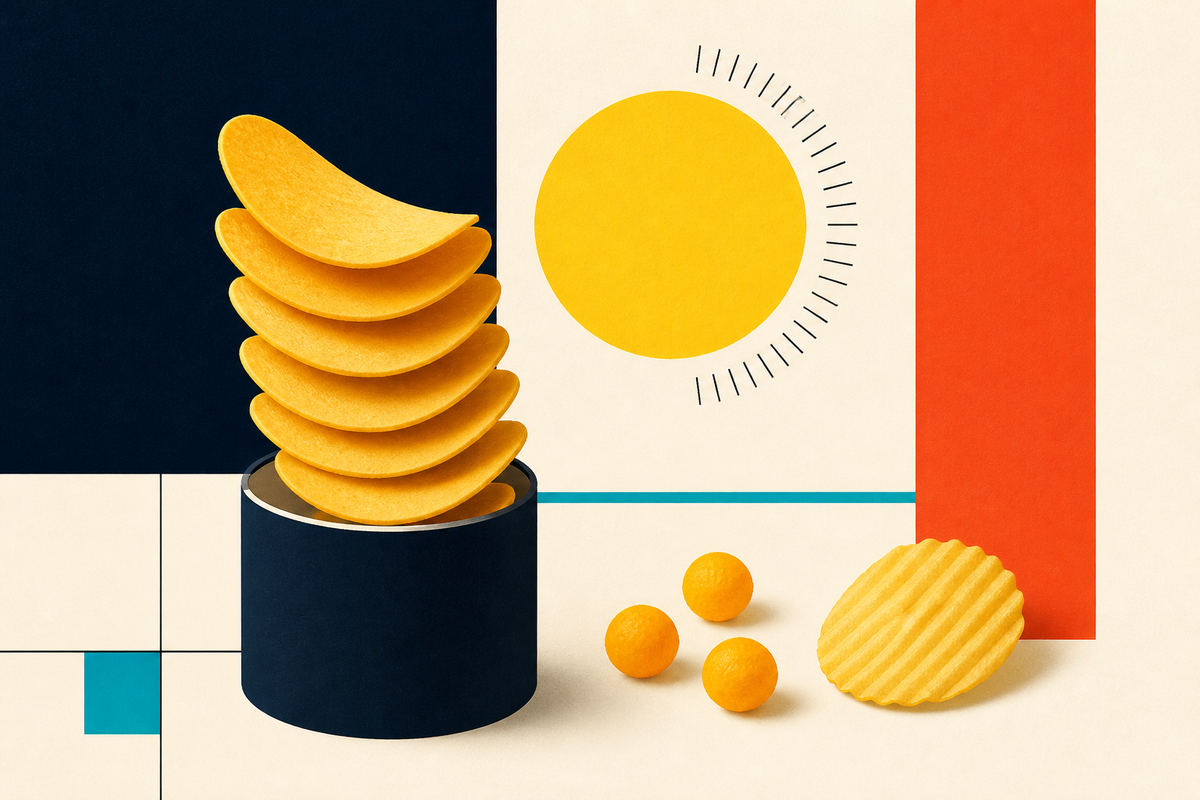
The shape was already famous
Parry began developing the idea in 2015. He was a father of three, and the test was not merely whether he could eat the product. His daughters had to want it too. That turned a personal restriction into a useful product brief: a child should recognize the treat; a parent should understand the ingredient list; a household with allergies should have more options; and nobody should feel they had accepted a consolation prize.
The first answer was the stacked potato crisp. The format gave the young company an advantage most new products lack - instant comprehension. A shopper could understand how and when to eat it before reading a single line of copy. The innovation lived less in behavior than in formulation: dried potato, a controlled crunch, recognizable flavors, gluten-free certification and Non-GMO Project verification.
“I wanted to recreate my favorite snacks without the top allergens and artificial ingredients so I could enjoy them with my three daughters.”Matt Parry, founder and CEO
As the brand gained traction in the United States, Parry moved his family from Australia to Colorado. The relocation was an unusually literal commitment to distribution. By December 2021, the company said it had passed 13,000 points of distribution, including Walmart, Whole Foods, Kroger and Wegmans. By the time MPearlRock announced its acquisition in January 2026, that footprint had grown beyond 20,000 retail doors across the United States, Canada, Australia and the United Kingdom.
A portfolio of recognizable mischief
The portfolio now works like a small museum of childhood snack forms. Six canister-crisp flavors cover the expected spectrum: Classic Original, Sour Cream & Onion, Outback BBQ, White Cheddar, Sea Salt & Vinegar and Spicy Jalapeño. Large tubes serve the pantry; mini canisters fit lunchboxes and portion-minded shoppers. Variety packs lower the risk of choosing incorrectly, an underrated piece of ecommerce design.
Canister crisps
Stacked, portionable and available in six familiar flavors plus mini formats.
Cheese balls
Real-cheese cornmeal snacks in Cheddar and Spicy varieties.
Crinkle cuts
Ridged potato chips positioned for dipping, crunch and broad family appeal.
Cheese Balls arrived in 2021 and moved the company beyond its founding canister. The original launch incorporated Kerry's Wellmune yeast beta-glucan, inspired in part by Parry's experience watching his youngest daughter undergo treatment for leukemia. The family's story also led Parry to start Trixie's Tribe, a nonprofit supporting children and families experiencing pediatric cancer. On the shelf, though, the cheese balls lead with pleasure: real cheese, a sharp crunch and the same absence of artificial color that defines the larger range.
Crinkle Cut chips completed a three-format platform. Their ridges are not a research paper. They are good at holding dip. That practicality captures the brand's broader instinct: improve the specification without draining the fun. A 2026 Crayola collaboration made the idea almost comically literal, bundling six cheese-ball bags with crayons and a custom activity page. Snack time became an activity kit.
What “allergen-friendly” actually means
Food labels reward precision, and The Good Crisp Company's positioning deserves the same. The company says its products are certified gluten-free and Non-GMO Project verified. It excludes artificial colors, artificial flavors and preservatives. Its canister crisps use palm oil from an RSPO-certified supplier, a sourcing decision tied to achieving the crisp's characteristic texture.
But “allergen-friendly” is not the same as universally allergen-free. Several flavors contain milk, including White Cheddar and Sour Cream & Onion canister crisps, Cheddar Sour Cream crinkle cuts and the cheese balls. The company also explains that some production facilities process soy even though its recipes are soy-free. The practical customer promise is therefore more thoughtful than a blanket claim: provide many options, publish product-level information and maintain strict controls, while asking people with serious allergies to read the relevant label.
This transparency solves two different problems. Gluten-free shoppers get access to formats they often cannot find in conventional brands. Parents and ingredient-conscious consumers get a shorter path through the package. The product still has fat, salt and calories; it is a snack, not a medical device. Its competitive claim is that the familiar experience need not carry every familiar additive.
Recognition
Classic shapes, bright colors, familiar flavors and the promise of crunch.
Reassurance
Certifications, ingredient exclusions and specific allergen guidance.
The shelf is the business model
The Good Crisp Company is a consumer-packaged-goods business, which means affection is necessary but distribution pays the bills. It sells wholesale through mass retail, conventional grocery, natural-food chains and specialty stores. Its own Shopify storefront sells multipacks and variety bundles directly. Marketplaces such as Thrive Market add another discovery channel.
Each channel does a different job. Online, the company has room to explain palm oil, certifications, facility controls and the founder's story. In a grocery aisle, it has seconds to communicate flavor and familiarity. Direct-to-consumer orders can raise basket size through eight- and twelve-packs. Retail puts the product into the weekly routine. The result is a two-part engine: explanation on the internet, repetition in the store.
Different company announcements used “points of distribution” in 2021 and “retail doors” in 2026. The bars show reported scale, not a like-for-like audited series.
Capital followed that expansion. CircleUp backed early rounds. In 2021, FF2032, the corporate venture fund of Lotus Bakeries, joined a Series A and brought generations of snack commercialization experience. SG Credit Partners supplied senior debt in 2023. Commercial databases report total funding of roughly $5.31 million, although the amounts of several individual rounds were not publicly disclosed.
The next chapter is operational
MPearlRock acquired The Good Crisp Company in January 2026 for undisclosed terms. The buyer is a partnership involving MidOcean Partners, Kroger and Kroger's data subsidiary 84.51°. Its pitch to emerging food brands combines merchandising, data science, sales, supply-chain and operating experience. For The Good Crisp Company, that shifts the central question from “does anyone want this?” to “how efficiently can it reach everyone who does?”
Parry said the new resources would help accelerate growth, expand reach and optimize the manufacturing footprint. Those are unglamorous verbs, which is exactly why they matter. In salty snacks, a charming origin story can win a first purchase. Replenishment, retailer performance, reliable production and good shelf placement build a company.
Australia. Parry starts rebuilding the canister crisp around his gluten-free diet and family.
Expansion. Cheese Balls launch, retail distribution passes 13,000 points and FF2032 invests.
Growth capital. SG Credit Partners provides a senior debt facility.
Acquisition. MPearlRock buys a platform present in more than 20,000 retail doors.
The competitive set is crowded. Pringles and Lay's Stax own enormous recognition. Cheetos and Planters compete for cheese-ball nostalgia. LesserEvil, Siete, Pipcorn and other modern brands speak fluently to ingredient-conscious consumers. The Good Crisp Company's place between those groups is its point: it borrows the emotional grammar of mainstream snacking and pairs it with the legibility of the natural-food aisle.
That position will not protect it by itself. Large incumbents can reformulate, retailers can launch private labels and cleaner-label rivals can undercut price or invent louder flavors. The durable expertise is more specific: translating dietary constraints into products that still look socially normal. Nobody at a birthday party needs instructions for a cheese ball.
The innovation is not a new way to snack. It is permission to rejoin an old one.
For consumers, the use case is refreshingly ordinary: pack a lunch, set out a bowl, bring a tube on a road trip, choose a flavor that works for more people. For the market, the company is a case study in subtraction as product development. Remove enough friction from a beloved format, explain the remaining tradeoffs and let recognition carry the rest.
The snack that started with a father reading labels now sits in tens of thousands of stores. Its most telling achievement may be how little ceremony the end product requires. Open. Crunch. Pass it over.